#Single-home Household
Related posts · 19 posts

Korea Comprehensive Real Estate Tax Joint Ownership Calculator — Spouses' KRW 900m Each vs One Spouse's KRW 1.2bn Plus Age and Holding Relief; at KRW 2bn Held 50:50 the Special Rule Wins Only at 80% (Art. 10-2)
A Korean couple who own one house half each are taxed separately for comprehensive real estate tax, each deducting KRW 900m. If they apply from 16 to 30 September, one spouse is treated as a single-house household with a KRW 1.2bn deduction and age and holding relief up to 80%. At KRW 2bn held 50:50, by share costs 655,200 won; the special rule at age 70 with 20 years costs 576,000 won (our arithmetic).
Korea Multi-Unit House (Dagagu) Capital Gains One-Home Checker — 3 Floors, 660 m², 19 Households: Sold Whole It Is One Home
Korea's Income Tax Act Enforcement Decree Art. 155(15) treats each divided part of a dagagu house as one home, but the whole as one home if sold as one unit. A 3-floor, 600 m², 9-household building sold whole for 1.1 billion won is one home, within 1.2 billion won (our example).
Korea Redevelopment Right Two-Home Capital Gains Exemption Calculator — Right Bought After 1 Year, Old Home Sold Within 3 Years
Korea's Income Tax Act Art. 89(2) removes the one-home exemption when you sell a home while holding a redevelopment right, but Decree Art. 156-2(3) treats the sale as one household, one home if the right is bought at least 1 year after the old home and the old home is sold within 3 years. A right bought on 20 November 2026 gives 20 November 2029.

Korea Presale Right Two-Home Capital Gains Exemption Calculator — Rights From 1 January 2021, Old Home Sold Within 3 Years
Korea's Income Tax Act Art. 89(2), which removes the one-home exemption when you sell a home while holding a presale right, applies to rights acquired from 1 January 2021. Decree Art. 156-3(2) treats the sale as one household, one home if the right is acquired at least 1 year after the old home and the old home is sold within 3 years. A right acquired on 1 July 2025 gives 1 July 2028.

Marriage or Parent-Care Merger Two-Home Exemption in Korea — Sell the First Home Within 10 Years of Marrying or Moving In (Calculator)
Income Tax Decree Art. 155 treats the first home sold within 10 years as one household, one home when two one-home owners marry, or a one-home owner merges with a parent aged 60 or over who owns one home. Art. 154(1), such as holding 2 years, still applies.

One Household (1-Sedae) Rule for Korean Capital Gains Tax — Single at 30 or Over, Widowed or Divorced, or 40% of Median Income (Checker)
Income Tax Act Art. 88 item 6 and Decree Art. 152-3 count a person as one household without a spouse if aged 30 or over, widowed or divorced, or earning at least 40% of the standard median income annualised over 12 months while living independently. Minors are excluded as a rule.

One-Home Capital Gains Tax Exemption in Korea — 2 Years' Holding, 2 Years' Residence If Bought in an Adjusted Area, 5 Exceptions (Checker)
Korea's one-home exemption needs the home held 2 years or more on the sale date, plus 2 years' residence if it was in an adjusted area when bought. Five exceptions such as expropriation and emigration drop both tests. Bought on 29 October 2024, holding reaches 2 years on 29 October 2026.
Sangsaeng Rental Home Exemption in Korea — 5% Rent Cap, 18 and 24 Months, Sell by End-2029 (Calculator)
In Korea, a landlord who signs a lease raising deposit or rent by no more than 5% over the previous lease, by 31 December 2026, after letting for 18 months and then 2 years, is free of the residence rule on sale. From 1 October 2026 the sale must come by the earlier of 1 year after the lease ends and 31 December 2029.

Rural Home Capital Gains Tax Exemption in Korea — Inherited, Ex-Farmer and Return-to-Farm Homes (Checker)
In Korea, a household with one rural home in an eup or myeon outside the capital region and one ordinary home is treated as owning one home when it sells the ordinary home. Inherited and ex-farmer homes need 5 years' residence; return-to-farm homes need a site of up to 660 square metres and a sale within 5 years.
Temporary Two-Home Capital Gains Tax Exemption in Korea — Sell Within 3 Years, or 2 in Adjusted Areas (Calculator)
In Korea, if you buy a new home before selling the old one, the old home keeps the one-home exemption when the new home is bought at least 1 year after the old one and the old one is sold within 3 years. From 1 October 2026 it is 2 years if both are in adjusted areas. A new home bought on 28 October 2026 gives 28 October 2029.
Property Tax Calculator Korea (Housing) — 5% Tax-Base Cap, 43–45% Ratio for One-Home Owners, Half in July and September
Korean housing property tax multiplies the standard value by the 2026 fair market value ratio (60%, or 43–45% for one-home households), caps the base at last year's level plus 5%, then applies the rates. The housing tax-burden cap was deleted. A 500 million won one-home pays 246,800 won.
Property Tax Deferral in Korea — One-Home Owners Aged 60 or Holding 5 Years, Tax Over 1 Million Won
Under Local Tax Act Art. 118-2, a one-home owner aged 60 or over or holding the home 5 years, meeting the income test (wages of 70 million won or less, etc.), with tax over 1 million won and no arrears, may defer by applying 3 days before the due date. Homes over 900 million won are included.

Comprehensive Real Estate Tax Deferral Checker (Korea) — Age 60 or 5 Years Owned, Salary ₩70 Million or Less, Tax Over ₩1 Million, 3.1% Interest
A one-home household aged 60 or over, or owning the home 5 years, with last year's salary ₩70 million or less and housing tax over ₩1 million can apply, with security, 3 days before the deadline to defer the tax. On sale it is paid with interest at 3.1% a year.

Inherited House Capital Gains Exemption Checker (Korea) — Only a Home You Already Owned, Not One Gifted Within 2 Years (Decree Art. 155(2))
A household with one inherited home and one ordinary home is treated as owning one home when it sells the ordinary one. The ordinary home must already be held when the inheritance began; a home gifted by the deceased within 2 years before is excluded.

Age and Holding Relief — the Tables Add to 90%, the Law Cuts at 80%
Age 65 with 15 years and age 70 with 10 land on exactly the same figure — and nothing beyond it.

Long-Term Holding Deduction in Korea — Residence Alone Is Worth KRW 11.6m
Two people sell the same home after the same ten years. One pays 2.62m, the other 14.23m. Holding is not what separates them.
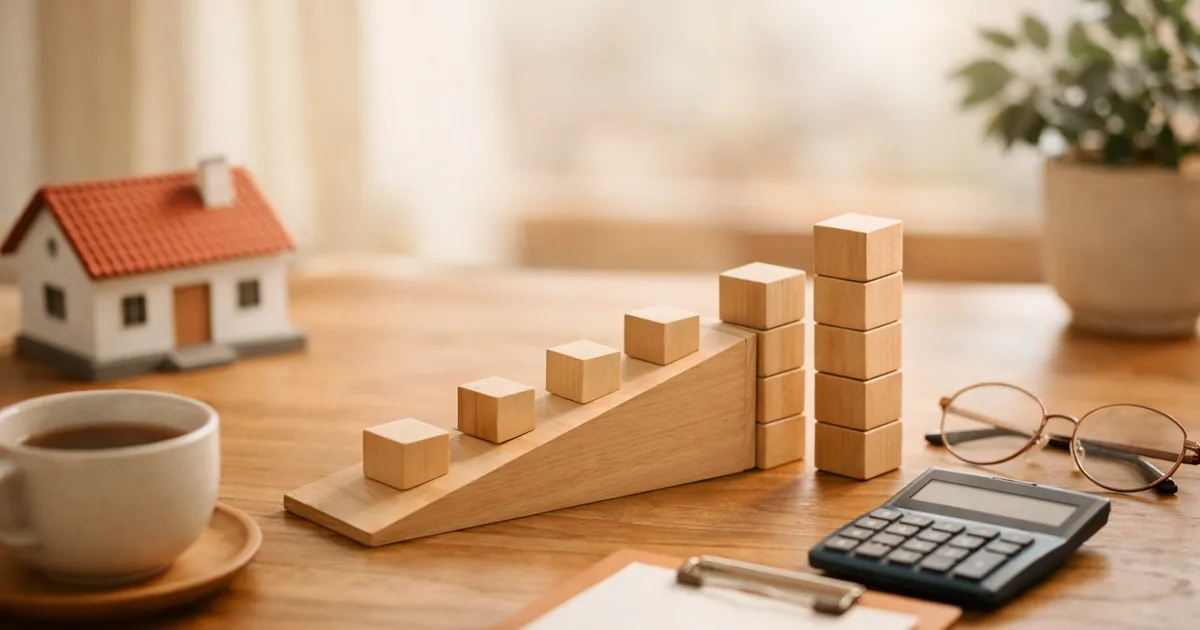
KRW 1.2bn Apportionment in Korea — A Slope, Not a Cliff
“Exempt up to 1.2bn” is right. The sentence that usually follows is not — crossing it does not put the whole gain into tax.
Your July Property Tax Bill in Korea — the Numbers Are in the Decree, Not the Act
All the Act contains is a 40-80% band. And the tax burden cap for housing was deleted outright in 2023.

Korea's One-Home Capital Gains Exemption — “How Many Years” Has No Single Answer
Trading up gives you three years; caring for a parent and marriage give ten. And trading up carries a second requirement almost nobody mentions.