Retirement
Pensions and planning for later life
Topic guides
Scattered guides, put in the order you meet themRetirement
62 posts
Pensions and Retirement in Korea — From Building Up National Pension Years to Drawing It: 119 Months of Back Payment, 70% Early, 136% Deferred, the 15 Million Won Line
Years make the pension, and back payment fills missing ones up to 119 months. Workplace and private pensions open at 55, the National Pension at 65, and the same record pays 70% five years early or 136% five years deferred. 45 guides in the order you meet them.

SME Retirement Pension Fund Subsidy Calculator (Korea) — 30 or Fewer Workers, Pay Under 2.81 Million Won, 10% up to 281,000 Won a Year, 3 Years
Korea’s SME Retirement Pension Fund is open to firms under 100 workers. The state subsidy goes to firms of 30 or fewer, for members paid under 2.81 million won a month: 10% of on-time regular contributions, up to 281,000 won each a year, for 3 years. A 2.5 million won contribution earns 250,000 won.

Average Wage Calculator (Korea) — 3 Months’ Pay Divided by Total Days, 8 Excluded Periods Such as Probation and Parental Leave
Under the Labor Standards Act, average wage is the pay in the 3 months before the reason arises divided by the total days, with 8 kinds of period such as probation and parental leave taken out of both. Below the ordinary wage, the ordinary wage applies. With 31 of 92 days on parental leave, 6 million won ÷ 61 days = 98,360 won.

DC Pension Employer Contribution Calculator (Korea) — 1/12 of Annual Pay, 10% Late Interest, 20% After 14 Days From Leaving
In a Korean DC pension the employer must pay at least 1/12 of the member’s annual pay at least once a year. Late payment carries interest from the next day: 10% a year until 14 days after leaving, 20% after that. Annual pay of 36 million won means at least 3,000,000 won.

Korean National Pension Unemployment Credit Calculator — 1 Month per 30 Benefit Days, Up to 1 Year, Up to Three-Quarters Supported, Apply by the 15th (Art. 19-2)
If you apply to the National Pension Service while receiving jobseeker's benefit, that period is added to your membership: one month per 30 cumulative days, up to 1 year, with contributions supported within three-quarters. Apply by the 15th of the month after the benefit ends.

Korean National Pension Military Service Credit Checker — 6 to 12 Months Now, the Whole Service Period for Discharges From 1 January 2027 (Art. 18)
Service as an active-duty soldier, alternative service member, regular reservist or social service agent is added to National Pension membership. For 2026 discharges it must be at least 6 months and at most 12 are added; an amendment of 20 October 2026 adds the whole period for discharges from 1 January 2027.

Korean National Pension Childbirth Credit Calculator — 12 Months for One Child, 27 for Two From 2027, 18 Each After (Art. 19)
Korea's National Pension childbirth credit adds 12 months for one child. Under an amendment of 20 October 2026, a second child from 1 January 2027 makes 27 months for two, plus 18 for each child after. With a first child by 2025 and a second from 2027 it is 15 months.

Forfeiture of Inheritance Checker (Korea) — Heirs Who Seriously Breached the Duty of Support, Six Months to Apply
Civil Act Art. 1004-2 lets the family court strip inheritance from an heir who seriously breached the duty to support, or committed a serious crime or gross mistreatment. With a notarial will the executor applies; otherwise co-heirs apply within six months of learning.

Reserved Share (Yuryubun) Calculator (Korea) — Half the Statutory Share for Children and Spouse, a Third for Parents, None for Siblings
Korea's Civil Act Art. 1112 reserves half the statutory share for descendants and the spouse and a third for ascendants; siblings' reserved share was deleted on 20 September 2024. With a spouse and two children and a 700 million won basis, each child's reserved share is 100 million.

Inheritance Renunciation & Qualified Acceptance Deadline Calculator (Korea) — Three Months from Learning, Otherwise Outright Acceptance
In Korea, renunciation or qualified acceptance must be filed with the family court within three months of learning the inheritance opened, or you're deemed to accept outright. Learn of excess debt later, without gross negligence, and you get three months from then for qualified acceptance. Learned on 21 October 2026: by 21 January 2027.

Unemployment Benefit After 65 — Not for Jobs Started After 65, Yes If Insured Before 65 and Kept On
Korea's Employment Insurance Act Art. 10(2) disapplies unemployment and parental-leave benefit chapters to people hired or starting self-employment after 65, except those insured before 65 and kept on. The rule moves to para. 3 from 2027.

Re-employment Support Service Checker — 1,000+ Employers, Age 50+, 1 Year Insured: Mandatory from 3 Years Before Leaving
Korean employers with 1,000+ workers must give re-employment support to leavers aged 50+ with 1 year's insured service (3 for fixed-term) leaving involuntarily, starting 3 years before leaving (1 year for redundancy).

Retirement Age 60 — Anything Lower Counts as 60, Rehiring Is a Duty to Try, Aged Means 55+ (Korea)
Korea's aged employment act requires a retirement age of 60 or above and deems a lower one to be 60. Rehiring retirees is a duty to try, and on rehiring, service and pay can be reset by agreement. 'Aged' means 55 and over.

Continuing National Pension Contributions After 60 in Korea — Until 65, Three Exclusions, and Leaving
Article 13 of Korea's National Pension Act lets members who turn 60 apply to keep contributing until 65. People who never paid, are drawing an old-age pension or took a lump-sum refund are excluded; you can leave any time by applying.

Severance Pay Must Go to an IRP in Korea — Within 14 Days, with Five Exceptions Including Leaving After 55
Article 9 of Korea's Employee Retirement Benefit Security Act requires severance to be paid within 14 days by transfer to the IRP account the worker names, or to an IRP in their name. Leaving after 55, small amounts, death, foreign workers departing and deductions under other laws are exceptions.

Working While on the National Pension — No Reduction Below 2 Million Won of Excess Income From 17 June 2026, With a Calculator
Article 63-2 of the National Pension Act reduces the old-age pension of pensioners in income-earning work according to excess income (monthly income minus the A value). A December 2025 amendment deleted the bands below 2 million won, so from 17 June 2026 there is no reduction there, applying to income from 1 January 2025.

National Pension Subsequent Payment (Chunap) — Under 10 Years, Application-Month Contribution × Months
Article 92 of the National Pension Act lets members pay later, for less than 10 years, for gaps after first paying, exemption periods, and military service where they joined afterwards. The amount is the application-month contribution times the months, with interest if paid in instalments.

Youth First National Pension Contribution Support — From 2027, Ages 18 to Under 27, Once
Article 100-5 of the National Pension Act, added in May 2026, says the state pays one month’s contribution, once, for anyone aged 18 to under 27 who applies. Those who have already paid get one month added instead. It applies to people who turn 18 on or after 1 January 2027.

Korea's National Pension Livelihood Test — Registered Household for the Dependants' Addition, Home and Transfers for the Survivor's Pension
The dependants' addition, survivor's pension, death lump sum and unpaid benefits all ask whether family members' livelihood was maintained, but Table 1 of the Decree sets a different test for each. For the dependants' addition a parent must share the registered household; for the survivor's pension a parent living apart counts with a reason or regular living costs.

Objecting to a Korean Health Insurance Decision — 90 Days From Learning of It, 180 From the Disposition, Decided in 60 Days
If you object to an NHIS disposition on eligibility, contributions or benefits, you may file an objection within 90 days of learning of it and 180 days of its date. The Service decides within 60 days, extendable by 30, and a further appeal lies to the Health Insurance Dispute Mediation Committee.

Medicare Late Enrollment Penalties — 10% a Year for Part B, 1% a Month for Part D, and a 7-Month First Window
Medicare's first sign-up window runs 7 months around the month you turn 65. Miss it and Part B costs 10% more for each year late and Part D 1% for each month, usually for life. On the 2026 standard premium of $202.90, 2 years late makes $243.50.

US Required Minimum Distributions — From Age 73, First Due by 1 April of the Next Year, 25% if Missed or 10% Once Corrected
A traditional IRA or 401(k) requires a minimum withdrawal each year from age 73. The first is due by 1 April of the following year and later ones by 31 December; a shortfall draws a 25% excise tax, 10% if corrected within 2 years. Roth IRAs have no lifetime requirement.

Duties While Receiving Korea's Basic Pension — Report Within 30 Days, Overpayments Recovered, Object Within 90 Days, 5-Year Prescription
Basic Pension recipients must report within 30 days when a suspension ground ends, income or assets change, or they marry, divorce or lose a spouse; failure carries a fine of up to 100,000 won. Overpayments are recovered, objections run 90 days from learning of a disposition, and prescription is 5 years.

Challenging a Korean National Pension Decision — Review Within 90 Days of Learning of It and 180 Days of the Disposition, Decided in 60 Days
If you object to a disposition of Korea's National Pension Service, you may request a review within 90 days of learning of it and within 180 days of its date. The Service decides within 60 days, extendable by 30, and a re-review may be sought within 90 days of receiving the decision.

Foreigners and Korea's National Pension — Automatic Coverage, a Lump-Sum Refund in Only 3 Cases, and Social Security Agreements First
Article 126 of Korea's National Pension Act automatically covers foreigners employed at a covered workplace or residing in Korea, unless their home country's law does not apply its pension to Koreans. The lump-sum refund is not available in principle, with 3 exceptions: reciprocity countries, workers under the foreign-worker employment Act, and industrial trainees.

Time Limits on Korea's National Pension — 5 Years to Claim Benefits, 10 Years for a Lump-Sum Refund, 3 Years to Collect Contributions, No Running While Fully Suspended
Article 115 of Korea's National Pension Act sets prescription at 3 years for the right to collect contributions, 5 years for the right to receive benefits, to recover overpaid amounts and to recover wrongly paid benefit, and 10 years for the lump-sum refund under Article 77(1)1. Time does not run while the whole benefit is suspended, and a claim interrupts it.

Reporting Duties and Suspension While Drawing Korea's National Pension — A Death Within 1 Month of Learning of It, Late-Reported Payments Recovered With Interest
Article 121 of Korea's National Pension Act requires changes in or the end of a benefit right to be reported to the Service, and a pensioner's death to be reported within 1 month of learning of it. Failing to report without just cause can suspend payment under Article 86, and wrongly paid benefit is recovered under Article 57.

When a Korean Employer Deducts the National Pension Contribution but Does Not Pay — 1/2 Counted, 0 From the Month After the Arrears Notice, All if You Pay Directly
Article 17 of Korea's National Pension Act counts 1/2 of a period in which the employer deducted the contribution from wages and did not pay. From the month after an arrears notice nothing is counted; paying the employee's share gives 1/2 and paying both shares gives the whole period. On 6 months of arrears that is 3 or 6 months.

National Pension Contribution Deadline and Late Charge in Korea — The 10th of Next Month, 1/1,500 a Day to 2%, Then 1/6,000 a Day to 5%
Article 89 of Korea's National Pension Act sets the deadline at the 10th of the following month. Under Article 97 a late charge of 1/1,500 of the overdue amount accrues daily up to 2%, and after 30 days a further 1/6,000 a day up to 5%. By our arithmetic that is 2% at 30 days and 5% at 210 days.

National Pension Contribution Exemption in Korea — 7 Grounds Such as Unemployment, Leave, Military Service and School, Not Counted, Back Payment Within Less Than 10 Years
Article 91 of Korea's National Pension Act lets contributions go unpaid while one of 7 grounds continues, including business suspension, unemployment, leave, military service and school enrolment, but the period is not included in the insured period. Under Article 92 it can be paid back within a range of less than 10 years and then counts.

National Pension Payment Day and Unpaid Benefits in Korea — The 25th, From the Next Month to the Month the Right Ends, Claim Within 5 Years of a Death
Article 54 of Korea's National Pension Act pays each month's pension on the 25th (the day before on Saturdays and holidays), from the month after the ground arose to the month the right ends. Benefits left unpaid at a pensioner's death are claimed by the spouse, children, parents, grandchildren, grandparents or siblings, in that order, within 5 years.

National Pension Dependants' Addition in Korea — 150,000 Won a Year for a Spouse, 100,000 per Child or Parent as the Base, Lost at 19 or With Their Own Pension
Article 52 of Korea's National Pension Act adds a price-adjusted amount based on 150,000 won a year for a dependent spouse and 100,000 won per child under 19 or parent 60 or over. In 2026 that is 306,630 and 204,360 won; it stops when the family member draws a pension or a child turns 19.

Voluntary National Pension Membership in Korea — Ages 18-60 Not Compulsorily Covered, Homemakers and Students Under 27, Lost After 6 Months of Arrears
Article 10 of Korea's National Pension Act lets anyone aged 18 to under 60 who is not a workplace or regional member join voluntarily. Spouses without income and students or service members under 27 are the typical cases; membership starts when the application is accepted and ends after 6 months of continuous arrears or at 60.

National Pension Disability Pension in Korea — 100%, 80% and 60% for Grades 1-3, a 225% Lump Sum for Grade 4, and the Contribution Tests
Articles 67 and 68 of Korea's National Pension Act pay members disabled by illness or injury 100%, 80% or 60% of the basic pension (grades 1-3) plus dependants' additions, and 225% as a lump sum for grade 4. At first treatment you must be 18 or older and have paid for a third of the liable period, 3 of the last 5 years, or 10 years.

National Pension Lump-Sum Refund in Korea — Under 10 Years at 60 Means Contributions Plus Interest, but No Voluntary Extension
Article 77 of Korea's National Pension Act refunds contributions with interest when someone with under 10 years reaches 60, dies without a survivor's pension being paid, or emigrates. Taking it at 60 rules out voluntary membership to 65, and rejoining lets you repay in up to 3, 12 or 24 instalments to restore the years.

National Pension Death Lump Sum in Korea — Siblings and Cousins When No Survivor Qualifies, Capped at 4 Times Monthly Income
When a National Pension contributor dies, article 73 survivors such as a spouse, children under 25 and parents 60 or older receive a survivor's pension. Without them, article 80 widens the circle to siblings and relatives within the fourth degree for a death lump sum equal to the refund but capped at 4 times standard monthly income, with a 5-year limitation.

Protecting Your Pension From Seizure in Korea — Entitlement Protected, 2.5 Million Won of Paid Pension Protected, and New Living-Expense Accounts
Article 58 of Korea's National Pension Act bans transferring, seizing or pledging the pension entitlement, and protects paid benefits up to the Civil Execution Act Decree amount. That amount became 2.5 million won from 1 February 2026, the same day one-per-person living-expense accounts of 2.5 million won a month took effect.

Long-Term Care Grades in Korea — Grade 1 From 95 Points, Cognitive Support Under 45, 15% at Home and 20% in Facilities
Article 7 of Korea's long-term care insurance decree grades applicants by a recognition score: 95 or more grade 1, 75-95 grade 2, 60-75 grade 3, 51-60 grade 4, and for dementia patients 45-51 grade 5 and under 45 the cognitive support grade. Co-payments are 15% for home-based care and 20% in facilities.

Senior Discounts in Korea at 65 — Subways, Palaces and Museums Free, Saemaeul and Mugunghwa 30%, the KTX Not in the Law
Annex 1 of Korea's senior welfare decree sets 100% off Seoul-area commuter rail, urban subways, palaces and public museums, 30% off Saemaeul and Mugunghwa trains (Saemaeul excluded on Saturdays and public holidays) and 50% off commuter trains. The KTX is not listed, and the law says only 'may'.

The Last $400 of the Roth IRA Band — the Cliff the $200 Floor Creates
One dollar of income costs $200 — and two IRS pages give different answers.

The Traditional IRA Deduction Bands — Same Rule, Widths Reversed
A single filer loses the deduction first and fast; a joint filer loses the contribution first.

The 78-83 Social Security Break-Even — Re-Run, It Is Three Numbers
“Around 78 to 83” was never a range. Name the comparison and it lands on 78y8m, 80y4m or 82y6m.

Social Security Withheld for Working — It Comes Back at Full Retirement Age
Withheld months are erased from the reduction count. Claim at 62 with an FRA of 67 and the benefit climbs from 70% to 75% to 80%.

Korean Retirement Pension Early Withdrawal — Enough to Pledge, Not Enough to Withdraw
Art. 14 never lists the grounds itself — it calls art. 2, then defers to a ministry notice. Opening that notice narrows loan repayment to a shutdown-or-disaster loan three months in arrears.

What Health Insurance Costs After You Retire — and Three Deadlines You Can't Undo
Voluntary continuation is exactly double what you paid while employed (325,392 won a month on a 4m salary). The comparison that counts is against regional enrolment.

Divided and Survivor Pensions — What Happens After Divorce or Loss
The divided pension's five years do not start at divorce — the provision says “from the time all the requirements are satisfied.”
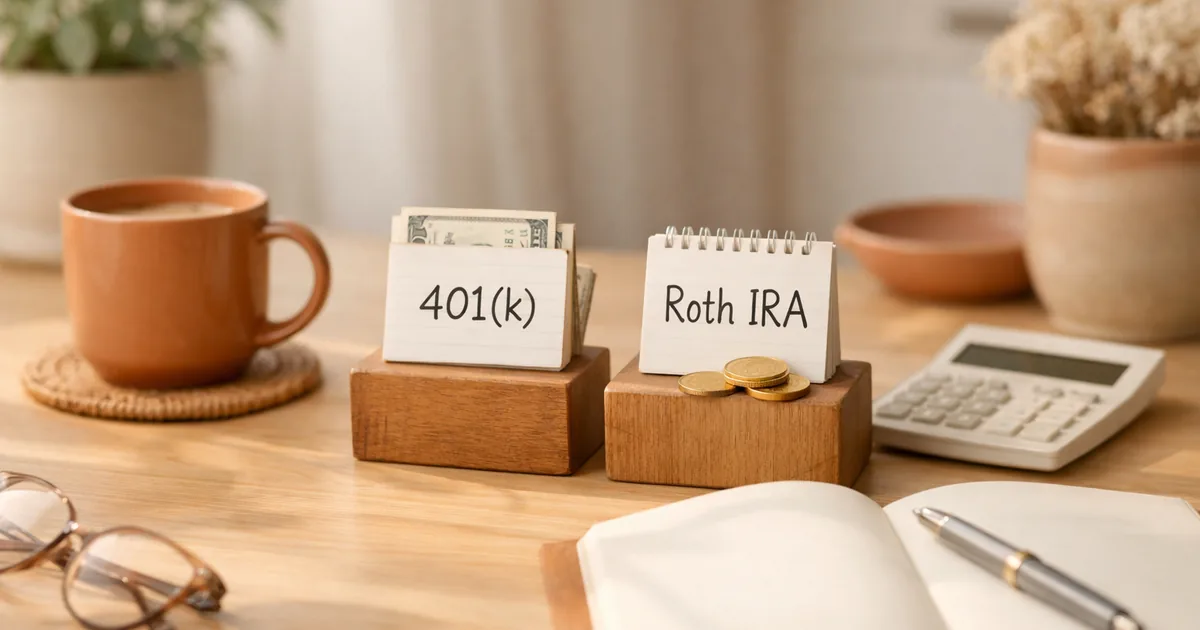
401(k) vs Roth IRA — 2026 Limits and Income Bands, Read Off the IRS Pages
We opened five IRS pages to pin down the 2026 numbers — and found two of them contradicting each other.

Get up to ₩1.48M Back Just for Saving: Pension Savings & IRP (2026)
The common line that an IRP needs “six months of treatment plus 12.5% of wages” does not match the text. The 12.5% test belongs to DC plans; the general IRP article carries no such threshold. Articles 2, 14 and 18 of the Decree, side by side.

Bridging the Pension Gap — Income & Health Insurance Before It Starts
Retire at 60, pension at 63–65. How to bridge the gap without an early-pension cut.

Retirement Prep by Age — Your 30s, 40s, 50s, 60s
Habit in your 30s, accelerate in your 40s, review in your 50s, design withdrawals in your 60s.

How Much for Retirement — Adequate Living Cost & the Shortfall
Adequate: ~1.976M won single, ~2.981M couple. Compute the gap vs your pension to see the plan.

The US 401(k) Explained: Limits, Match, Roth vs Traditional (2026)
The employer match is an instant 100% return. 2026 limit $24,500, Traditional vs Roth, rollovers.

US IRA: Roth vs Traditional Explained (2026 Limits & Income Rules)
Pay tax now or later. 2026 limit $7,500, Roth income limits, and the order to save.

US Social Security Explained: 62 vs 67 vs 70, and the Korea Agreement
~30% less at 62, ~24% more at 70. The 40-credit rule and the US-Korea totalization agreement.

The Art of Drawing Down — Korea's 15M Won Rule and Withdrawal Strategy
Everyone explains how to save into a pension. Almost nobody explains how to take it out — where tax varies threefold.

Claiming a Korean pension early or late — 70% against 136% (2026)
The source describes a scheme for undoing an early claim. And even an on-time pension is cut for five years if your income is high.

Six ways to raise a Korean pension — back-payment stops at 119 months (2026)
The source revealed an ‘under ten years’ ceiling on back-payment, and a childbirth credit that from 2026 counts the first child with no cap.

Korea's three pension tiers — two open at 55, one at 65, leaving a ten-year gap
Opening the Easy Law text tier by tier and overlaying the start ages: workplace and private pensions open first, the state pension a decade later.

Korea's Housing Pension — Mortgage Method or Trust Method (2026)
The method comes before the amount. “Automatic spousal succession” is not true of the mortgage method.

Korea's 43% pension replacement rate is a reversal, not a rise (2026)
Opening the NPS formula showed that the constant equals the replacement rate times 0.03, exactly. And the start age is set by birth year, not calendar year.

DB vs. DC Retirement Pensions in Korea — Which Should You Pick?
Does the company invest it, or do you? Plus how IRP fits in.

Korea's Basic Pension 2026 — halve the couple threshold and it is exactly 80%
The Easy Law text prints the formula with its statutory citations. Working it shows the Basic Pension is untouched until the National Pension passes a line.