Falling ill or having an accident abroad tends to empty your head. You don't know the local emergency number, you can't explain the problem, and you have no idea what the bill will look like.
1. Who to call. Two numbers to save — the consular call centre and 119. 119 is not only an ambulance line: it gives medical advice from abroad too, and pressing 2 brings an interpreter on.
2. Where the risk is. Your medication may be prohibited in the country you are going to, and your insurance may simply not apply there — both are problems that can only be solved before you leave.
3. What to do. Calling free comes with conditions — work them out now, or you cannot use them when it matters. Saving those two numbers to your phone is the single most useful thing on this page.
The numbers and their scope come from Korea's Ministry of Foreign Affairs and National Fire Agency; the medicine and insurance material from the US Centers for Disease Control and Prevention.
Two numbers to save
Memorising emergency numbers country by country is not realistic. What is realistic is two numbers that reach Korean-language help around the clock. Put them in your contacts before you leave.
| Number | Who | For what |
|---|---|---|
| +82-2-3210-0404 | Ministry of Foreign Affairs consular call centre | Incidents and accidents, interpreting, passports, visas |
| +82-44-320-0119 | National Fire Agency, 119 emergency medical advice for citizens abroad | Illness or injury — advice from an emergency physician |
The judgment call at home — emergency room or clinic — is covered in this article. Both lines run 24 hours, every day of the year, and either one can hand you to the other: the official diagram shows an arrow between the two agencies marked three-way calling and two-way call transfer. What triggers a transfer is not stated.
The consular line answers with an automated menu. Worth reading now rather than under pressure — 1 incidents and accidents / 2 foreign language interpreting / 3 passport guidance / 4 entry requirements, visas and other queries.
What the 119 line will and will not do
Barely known, and genuinely useful: advice from a Korean emergency physician, in Korean.
“A 119 service through which advice and guidance from emergency medicine specialists can be obtained in emergencies abroad such as unexpected illness or injury.”
“Medical advice is available by phone, email, web and KakaoTalk. (Emergency physicians on duty 24 hours)”
— National Fire Agency, 119 emergency medical advice service for citizens abroad
Four ways in, so a bad line need not stop you.
| Channel | Contact |
|---|---|
| Phone | +82-44-320-0119 |
| Web | www.119.go.kr |
| [email protected] | |
| KakaoTalk | Search the channel for the Fire Agency's overseas 119 medical advice service, add it, then message 1:1 |
What matters as much is that the limits are published too. Expecting the wrong thing wastes time you may not have.
| Available | Not available |
|---|---|
| First-aid guidance before reaching a hospital — what to do right now | Interpreting test or imaging results |
| Medication guidance (advice on foreign-market drugs is limited) | Second opinions on whether a diagnosis or treatment plan is appropriate |
| — | Ophthalmology, dentistry, obstetrics and gynaecology, psychiatry and similar specialties |
In short, “what should I do right now” is in scope; “is this diagnosis right” is not. Think of it as the line you use before reaching a local hospital. Eligibility is broad — travellers, expatriate staff, students, seafarers and aircrew and their passengers, and overseas Koreans, or as the material puts it, any Korean national abroad.
When you cannot make yourself understood — press 2
The least known feature of the consular line, built for exactly the moment a hospital or police station stops making sense.
| Channel | Detail |
|---|---|
| Menu option 2, interpreting | Seven languages — English, Chinese, Japanese, Vietnamese, French, Russian, Spanish |
| Free calling app | Running since November 2020. No voice charges over Wi-Fi or other internet |
| Messaging | KakaoTalk, WeChat and LINE — “without installing a separate application” |
| Roaming text | The welcome text on arrival has a call button that connects directly (charged) |
Describing symptoms at a hospital is where this earns its place. Combined with the prescription copies and generic names below, you can show the paper and speak through the interpreter. Note that interpreting covers those seven languages and no others.
Calling free — with conditions
Besides the charged main number there are three free routes. Which ones work depends on the country.
| Route | How | Countries |
|---|---|---|
| Free route ① | local international dialling code + 800-2100-0404 or 800-2100-1304 | 17 |
| Free route ② | Auto Collect Call | 19 |
| Free route ③ | country access number + 5 | 41 |
Three warnings are attached. “Use a local landline or payphone for the free connection numbers.” / “Connection may not be reliable depending on KT and local carrier conditions.” / “Attempts from a mobile phone may fail or incur access charges.”
So the free routes are a bonus; the number to save is the charged main line. Route ① is only one number to remember — it is not different per country but 800-2100-0404 with that country's international dialling code in front (011 for the US and Canada, 00 across Europe and Taiwan, 001 for Thailand, Singapore and Hong Kong, 0011 for Australia, 010 for Japan).
🔴 Re-checked on 28 September 2026, the ministry’s table had changed. The table copied in July listed 42 countries (routes ① 18, ② 20, ③ 42). The call-centre page now heads its columns route ① 17, route ② 19, route ③ 41, and the Netherlands row is gone (it had all three routes). The numbers for the remaining 41 countries were compared line by line and are unchanged. The page gives no reason for the removal — in the Netherlands, use the paid main number +82-2-3210-0404. The page address has also moved and the links below point to the new one.
Below is all 41 countries. Counting the table, route ① is filled in for 17 countries, ② for 19 and ③ for 41 — matching the counts in the heading exactly. So ③ is the full list and ①/② are subsets of it. More than half of them, 21 countries, have only route ③ — Vietnam, Guam, Saipan, India, Egypt, the Czech Republic and Poland among them.
| Country | ① local intl. code + 800-2100-0404 / -1304 | ② auto collect call | ③ access number + 5 |
|---|---|---|---|
| Guam | — | — | 1-888-865-8581 |
| Greece | — | — | 00-800-82-2111 |
| South Africa | — | — | 080-099-0082 |
| Norway | — | — | 800-199-82 |
| New Zealand | 00-800-2100-0404 00-800-2100-1304 | 0800-449522 | 080-099-0200 000-982 |
| Germany | 00-800-2100-0404 00-800-2100-1304 | 0800-181-6982 | 0800-0800-082 |
| Russia | — | 810800-2022-2082 | 8-10-800-110-2082 |
| Macau | — | — | 080-0820 |
| Malaysia | 00-800-2100-0404 00-800-2100-1304 | — | 1-800-80-0082 |
| Mexico | — | — | 800-123-0292 |
| Mongolia | — | — | 00199-14-959-0976 |
| United States | 011-800-2100-0404 011-800-2100-1304 | 1-866-236-5670 | 1-800-288-7358 1-800-822-8256 |
| Vietnam | — | — | 120-82-3355 |
| Belgium | 00-800-2100-0404 00-800-2100-1304 | 0800-7-1233 | 080-010-082 |
| Saipan | — | — | 233-2582 |
| Sri Lanka | — | — | 011-2473-000 |
| Sweden | — | — | 020-799-355 |
| Singapore | 001-800-2100-0404 001-800-2100-1304 | 800-8211-338 | 8000-820-820 8000-820-000 |
| UAE | — | — | 8000-0282 |
| United Kingdom | 00-800-2100-0404 00-800-2100-1304 | 0800-028-8307 | 080-089-0082 0808-589-0082 |
| Austria | — | — | 0800-200-219 |
| Israel | 00-800-2100-0404 00-800-2100-1304 | 180-947-6887 | 180-949-4820 |
| Egypt | — | — | 2-3655-08 |
| Italy | — | 8007-82603 | 800-172-222 |
| India | — | — | 000-8227 |
| Indonesia | — | 001-803-821-16863 | 0018-0182 007-801-82-70 |
| Japan | (001) 010-800-2100-0404 (001) 010-800-2100-1304 (0061) 010-800-2100-0404 (0061) 010-800-2100-1304 carrier code (001/0061) may be omitted | 00531-82-0440 | 00-6635-821 00539-821 |
| China | 00-800-2100-0404 00-800-2100-1304 | 10800-282-0001 (north of Shanghai) 10800-820-0001 (south of Shanghai) | 108-2-821 (south of Shanghai) |
| Czechia | — | — | 800-001-138 |
| Kazakhstan | — | — | 8800-821-4321 |
| Canada | 011-800-2100-0404 011-800-2100-1304 | 1-866-708-2838 | 1-800-660-0682 |
| Thailand | 001-800-2100-0404 001-800-2100-1304 | 001-800-821-16892 | 1800-0082-10 001-999-82-1000 (from a payphone) |
| Taiwan | 00-800-2100-0404 00-800-2100-1304 | 00801-82-7353 | 008-0182-0082 |
| Türkiye | — | — | 0-811-2880082 |
| Pakistan | — | — | 00800-11082 |
| Poland | — | — | 0080-0821-1122 |
| France | 00-800-2100-0404 00-800-2100-1304 | 0800-90-2590 | 080-099-0082 |
| Finland | — | — | 080-011-0820 |
| Philippines | 00-800-2100-0404 00-800-2100-1304 | 1-800-1-821-0248 | 10-10-55-8220 10-10-55-8221 10-10-55-8222 10-10-55-8223 10-10-55-8224 |
| Australia | 0011-800-2100-0404 0011-800-2100-1304 | 1-800-249-224 | 1-800-88-1820 1-800-55-1182 |
| Hong Kong | 001-800-2100-0404 001-800-2100-1304 | 800-90-0524 | 800-96-0082 |
A few things stand out. Japan allows the carrier code (001/0061) to be omitted; Thailand has a separate number for payphones (001-999-82-1000); China splits routes ② and ③ north and south of Shanghai; and the Philippines lists five numbers under ③. France and South Africa share the same ③ number (080-099-0082), which the source does not explain, so neither do we.
The three routes are not nested either. Malaysia has ① but not ②, while Russia, Italy and Indonesia have ② but not ①. Numbers change, so check them again just before you travel.

Can you take your medicines?
This one can only be solved before departure. A medicine you take daily may be prohibited where you are going.
“Check with the embassy of your destination, and of any country you have a layover in, to make sure your medicine is permitted.”
— US Centers for Disease Control and Prevention, travelling abroad with medicine
The phrase “any country you have a layover in” is the part people miss. A medicine cleared at the destination can still cause trouble at the airport where you change planes. Sleep aids, painkillers and some cold remedies are ordinary in one country and controlled in another.
| Step | CDC wording |
|---|---|
| ① Check it is permitted | “with the embassy of your destination, and of any country you have a layover in” |
| ② Carry-on baggage | “pack medicine in your carry-on in case your luggage is lost or delayed” |
| ③ Original container | “keep medicine in its original, labelled container. Make sure the label clearly shows your name, your clinician's name, the generic and brand name, and the exact dosage” |
| ④ Prescription copies | “bring copies of all prescriptions, including the generic names” |
| ⑤ A letter from your doctor | “if you take controlled substances or injectable medicines such as an EpiPen or insulin, ask your prescribing clinician for a note” |
| ⑥ Bring extra | “enough for the whole trip, plus extra in case of delays” |
The third is where practice most often diverges. Emptying bottles into a small pill case is standard packing advice, and the CDC guidance says the opposite — the labelled original container is the only thing that proves what the medicine is.
Note too that “generic name” appears twice: on the container label and in the prescription copies. Brand names differ by country while generic names travel, which is decisive when a local pharmacy has to find the equivalent. The 2024 CDC Yellow Book went further and suggested carrying prescription copies “translated, if possible.” The 2026 edition, published in April 2025, drops that phrase and instead asks for a medical summary listing regular medications “generic, not trade names” (checked 29 September 2026).
Does your insurance work there?
“Not all health insurance covers travel abroad. Consider whether you need travel health insurance or evacuation insurance.”
“Know which embassy to contact if you have a problem.”
— US Centers for Disease Control and Prevention, getting health care abroad
Evacuation insurance being named separately is easy to skim past. Covering treatment where you are and covering the cost of moving you home or to a larger hospital are different items, and the second runs far larger. Check how your policy handles each.
What to sort out before you go
| When | What |
|---|---|
| Weeks ahead | Check with embassies that your medicines are permitted at the destination and any layover |
| Weeks ahead | Request a doctor's letter for controlled substances or injectables — issuing takes time |
| Before leaving | Prepare prescription copies — generic names included, translated if possible |
| Before leaving | Check your policy for overseas cover and evacuation cover separately |
| Before leaving | Save +82-2-3210-0404 and +82-44-320-0119 in your contacts |
| Packing | Medicines in their original containers, in carry-on, with extra |
| Packing | The kit and documents below |
The first two rows cannot be done at the last minute. Embassy checks and doctor's letters take time, so handle them while planning the trip.
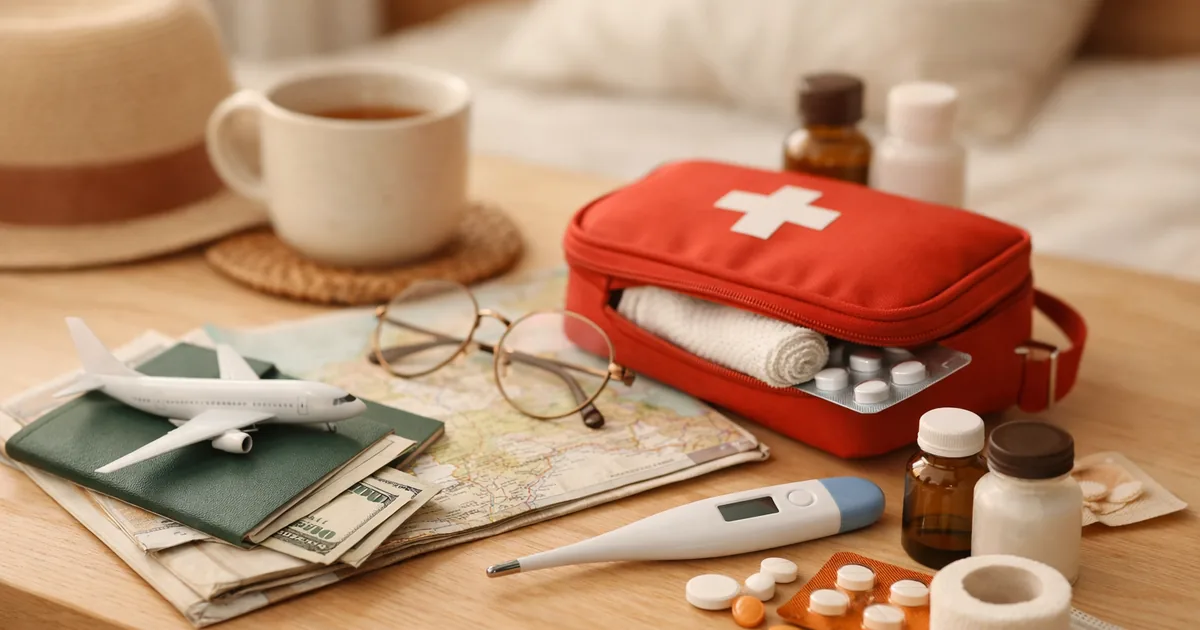
The CDC sets out the kit itself by category.
| Category | What the CDC lists |
|---|---|
| Prescription | Your own medicines, antibiotics for travellers' diarrhoea if prescribed, malaria prophylaxis if prescribed |
| Allergy | Antihistamines, epinephrine auto-injector, oral steroids (for severe allergy and anaphylaxis) |
| Over the counter | Antidiarrhoeal, antacid, antihistamine, motion sickness medicine, cough and decongestant medicine, pain and fever relief, laxative, sleep aid |
| Prevention | Hand sanitiser with at least 60% alcohol, water purification tablets, insect repellent with DEET or picaridin, sunscreen SPF 15 or higher |
| First aid | Hydrocortisone cream, antibacterial ointment, thermometer, oral rehydration salts, wound cleanser, aloe gel, plasters, gloves, cotton swabs, tweezers, eye drops |
| Documents | Copies of passport and travel documents, prescription copies, insurance card and papers, and contacts for family, clinicians, accommodation, hospitals and the embassy |
| Also (Yellow Book) | Spare glasses and contact lenses, insulin and glucose testing supplies, spare needles, documentation of underlying conditions, an ECG record if relevant, vaccination certificates |

If you take several medicines together, interactions are covered in managing medication; for stomach trouble on the road see gastroenteritis, and for staying active while away, maintaining muscle. Card costs abroad are in overseas payment fees and cash exchange in exchange fees.

Questions people ask
Who do I call if I fall ill abroad?
+82-44-320-0119, the National Fire Agency line, for advice from a Korean emergency physician in Korean, around the clock. For incidents, accidents or interpreting, +82-2-3210-0404. The two connect to each other.
Can the 119 line diagnose me?
No. It covers first-aid guidance before reaching a hospital and medication advice; interpreting test results or second-guessing a treatment plan is out of scope, as are ophthalmology, dentistry, obstetrics and gynaecology and psychiatry.
What is the local emergency number?
It varies and changes, so this article does not list them. Every number in the ministry's country table connects to the consular call centre, not to local emergency services. Check for your destination before you travel.
Can I decant medicines into a pill case?
CDC guidance says the original labelled container, with your name, your clinician's name, generic and brand names and the exact dosage on the label. Saving space costs you the only proof of what the medicine is.
How much should I bring?
The CDC says “enough for the whole trip, plus extra in case of delays.” No number of days is given.
Is travel insurance enough on its own?
Check the policy for overseas treatment cover and evacuation cover separately. Moving a patient home or to a larger hospital is a distinct item and a much larger sum.
Heading to Southeast Asia or China for a long stay? Check your Japanese encephalitis vaccination too — the KDCA lists 25 risk countries and recommends paid vaccination for unvaccinated adult travellers (Japanese encephalitis).
Sources
- Ministry of Foreign Affairs of Korea — Overseas Safe Travel, consular call centre guidance (checked July 2026, re-checked 28 September 2026). Source for the 24-hour year-round service, the domestic 02-3210-0404 and overseas +82-2-3210-0404 numbers, the four-option menu, the seven interpreting languages, the free calling app (from November 2020) and KakaoTalk/WeChat/LINE messaging, the three free routes (17, 19 and 41 countries — 18, 20 and 42 in July, before the Netherlands was dropped) with the country access numbers, and the warnings that connection may be unreliable and that mobile attempts may fail or incur charges.
- National Fire Agency of Korea — 119 emergency medical advice for citizens abroad (checked July 2026). Source for the description of the service, “emergency physicians on duty 24 hours,” the phone, web, email and KakaoTalk channels, the eligible groups, what is provided (pre-hospital first-aid guidance and medication advice, with foreign-market drug advice limited), the three stated limits on consultations, the escalation procedure, and the three-way calling and two-way transfer with the consular call centre.
- US Centers for Disease Control and Prevention — travelling abroad with medicine. Source for checking with destination and layover embassies, carry-on packing, the “original, labelled container” requirement and what the label must show, prescription copies including generic names, the doctor's letter for controlled substances and injectables, and bringing enough for the trip plus extra.
- US Centers for Disease Control and Prevention — pack smart and travel health kits (Yellow Book 2024) · the same chapter, 2026 edition (2026 edition, published 23 April 2025, updated 20 July 2026 — it gives sunscreen as SPF 30 or greater, unlike the SPF 15 on the packing page; the table here carries the packing-page figure). Source for the kit by category, hand sanitiser at 60% alcohol or above, DEET or picaridin repellent, SPF 15 or higher sunscreen, the documents list including insurance and embassy contacts, and the spare glasses, condition documentation, ECG record and “translated, if possible” prescription copies.
- US Centers for Disease Control and Prevention — getting health care abroad. Source for “not all health insurance covers travel abroad — consider whether you need travel health insurance or evacuation insurance” and for knowing which embassy to contact.
- What we counted. That route ① is filled in for 17 countries, ② for 19 and ③ for 41 is our own count of the table, matching the figures in the heading. “More than half of them, 21 countries, have only route ③” comes from the same count and is not how the ministry presents it, and the observation that the three routes are not nested (Malaysia has only ①; Russia, Italy and Indonesia only ②) comes from comparing the columns.
Where to check further
This article goes as far as the agency material allows. The rest is best looked at here.
- Local emergency numbers and whether your medicines are permitted — checked here, with the destination's embassy. Both vary by country and the CDC publishes no country list. These are the two items to handle while planning rather than while packing.
- Overseas and evacuation cover — read your policy. The CDC material is written for a US market, so Korean products have to be checked in their own terms.
- The free connection numbers — re-check at Overseas Safe Travel before departure. Numbers change, and the table above was re-checked on 28 September 2026.
As of July 2026. The consular numbers and their use come from the Ministry of Foreign Affairs, the 119 medical advice service from the National Fire Agency, and the medicine and insurance material from the CDC; the counts in the country table are ours. This is general health information and does not substitute for medical diagnosis or treatment. If you have a chronic condition, discuss the trip with your doctor before leaving.