Getting ready for a cold snap or heavy snow after the forecast arrives is too late. On its “Preparing for a Winter Storm” page, the US Centers for Disease Control and Prevention (CDC) says to plan ahead, get supplies, and get your home and car ready. At home that starts with insulating water lines on outside walls and sealing doors and windows; if you’ll use a fireplace, wood stove or kerosene heater, put a smoke detector and a battery-operated carbon monoxide detector near the area being heated, test them monthly and replace batteries twice a year. For the car: antifreeze, washer fluid, tires and fuel, plus a 17-item emergency kit. Here is the page’s home, car and pre-storm advice in its own order.
1. Weatherproof the home — insulate outside-wall water lines, caulk and weather-strip, insulate walls and attic, fix roof leaks, cut back branches.
2. Detectors before heaters — a smoke detector and a battery-operated CO detector, tested monthly, batteries replaced twice a year.
3. The car — tire pressure typically 30–35 psi, tank near full, a 17-item kit.
Weatherproofing the home — CDC
| Type | What the source says | Worth noting (ours) |
|---|---|---|
| Water lines | Insulate water lines along exterior walls so they are less likely to freeze | Thawing frozen pipes: link below |
| Doors, windows | Caulk and weather-strip doors and windows | — |
| Walls, attic | Insulate walls and attic | — |
| Windows | Storm or thermal-pane windows, or plastic from the inside | Same idea as Korean bubble-wrap film (ours) |
| Roof, trees | Repair roof leaks; cut away branches that could fall on the house in a storm | — |
Keeping pipes from freezing and thawing them is in preventing frozen pipes.
Heaters and detectors — CDC
| Type | What the source says | Worth noting (ours) |
|---|---|---|
| Detectors | Using a fireplace, wood stove or kerosene heater? A smoke detector and a battery-operated CO detector near the area to be heated | Battery so it works in a power cut (our reading) |
| Testing | Test monthly; replace batteries twice a year | Twice a year = every 6 months (our sum) |
| Extinguisher | A multipurpose dry-chemical extinguisher nearby | — |
| Venting | All fuel-burning equipment vented to the outside | — |
| Furnace check | Each winter, a qualified technician checks the furnace system and vent | — |
| Over 65 | If you or a loved one is over 65, an easy-to-read thermometer indoors | Somewhere you see often |
This page says only “near the area to be heated”; it doesn’t give levels or bedroom positions. The every-level, outside-sleeping-areas rule is from the US Consumer Product Safety Commission (CPSC), in generator safety in a power cut. Korean height and distance rules are in the Korean CO alarm notice.
Getting the car ready — CDC
| Type | What the source says | Worth noting (ours) |
|---|---|---|
| Cooling | Have the radiator serviced or check antifreeze yourself with a tester; top up as needed | — |
| Washer fluid | Switch to a wintertime mixture | — |
| Tires | Check tread and pressure, replace worn tires, inflate to your car’s recommended pressure — typically 30–35 psi | 30–35 psi ≈ 207–241 kPa (our conversion) |
| Fuel | Keep the tank near full to avoid ice in the tank and fuel lines | — |
| Nine checks | Heater, defroster, brakes, brake fluid, ignition, emergency flashers, exhaust, oil, battery | — |
The CDC calls 30–35 psi “typical”; the real figure is your car’s recommended pressure, which in Korea is usually on the driver’s door label in kPa or psi (our note). Pre-winter servicing overlaps the NHTSA advice in winter car preparation.
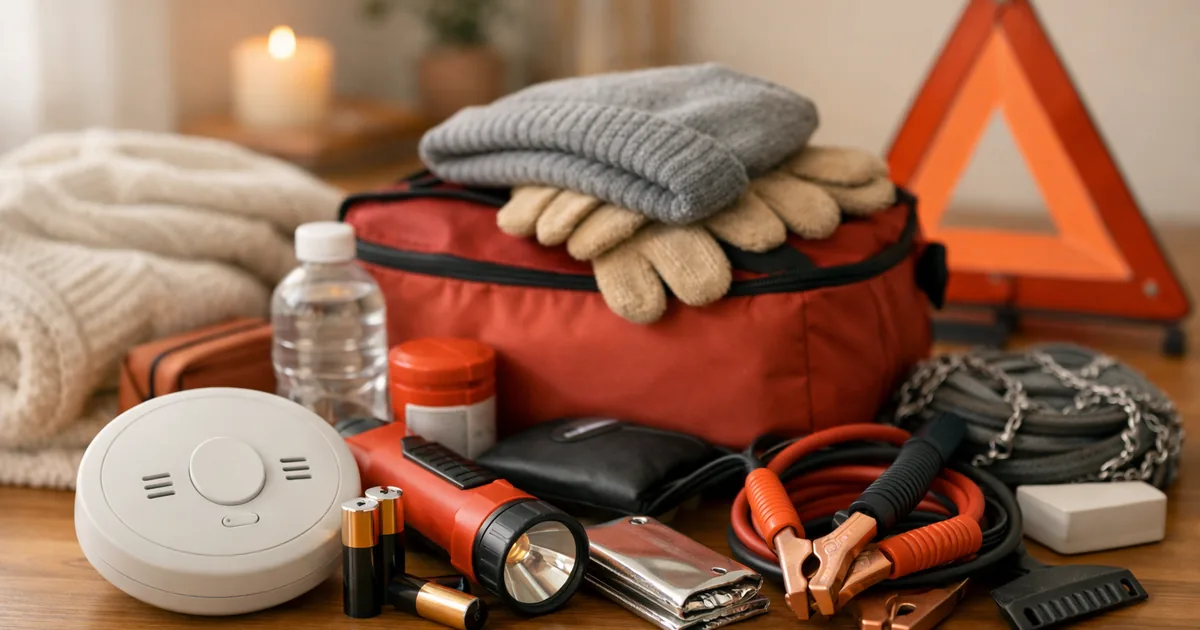
The 17-item car kit — CDC
- Cell phone, portable charger and extra batteries
- Items to stay warm — extra hats, coats, mittens and blankets
- Windshield scraper
- Shovel
- Battery-powered radio with extra batteries
- Flashlight with extra batteries
- Water and snack food
- First aid kit with any necessary medicines, and a pocket knife
- Tow chains or rope
- Tire chains
- Canned compressed air with sealant for emergency tire repair
- Cat litter or sand for traction, or road salt to melt ice
- Booster cables with a fully charged battery, or jumper cables
- Hazard or other reflectors
- Bright flag or help signs, emergency distress flag and/or flares
- Road maps
- Waterproof matches and a can to melt snow for water
The list has rural US strandings in mind and may look long for city driving in Korea. Still, a phone charger, blanket and gloves, a scraper, water and snacks, and a flashlight fit easily in a corner of the boot (our note). What to do if you’re stranded is in snow shoveling and ice safety.
Before the storm — CDC
| Type | What the source says | Worth noting (ours) |
|---|---|---|
| Forecasts | Listen to forecasts and check emergency food and water | — |
| Pets | Bring pets indoors; otherwise shelter from wind and unfrozen water | — |
| Plan | Make a family communication and disaster plan in advance | — |
Checklist
- ☐ Outside-wall water lines insulated, gaps sealed
- ☐ Smoke and battery CO detectors near heaters — tested monthly, batteries twice a year
- ☐ Furnace and vent checked every winter
- ☐ An easy-to-read thermometer for anyone over 65
- ☐ Tire pressure (typically 30–35 psi), tank near full
- ☐ As much of the 17-item kit as you can carry
Questions that remain
Does a flat with a gas boiler need a detector?
The CDC sentence is about using a fireplace, wood stove or kerosene heater. It also says all fuel-burning equipment must vent outside and be checked every winter. For Korean boiler rules, see the notice article.
When should I change the batteries?
The CDC gives the frequency, not dates. Picking two easy-to-remember days six months apart is our suggestion.
Sources
- CDC — Preparing for a Winter Storm — source (page last reviewed 2 December 2025; checked 26 October 2026). Five weatherproofing steps; smoke and CO detectors near heaters (monthly test, batteries twice a year); extinguisher, venting and furnace checks; thermometer for over-65s; car preparation (typically 30–35 psi, fuel); the 17-item car kit; before the storm.
- Not read. The rest of the over-65 thermometer paragraph, family plan details, Korean gas boiler rules.
- What we added. The “worth noting” column and the Korean everyday gloss.
Where to check further
- Your car manual or door label — recommended tire pressure.
- Building management or gas supplier — boiler vent checks.
Written on 26 October 2026. The content is from the source; the glosses are ours.