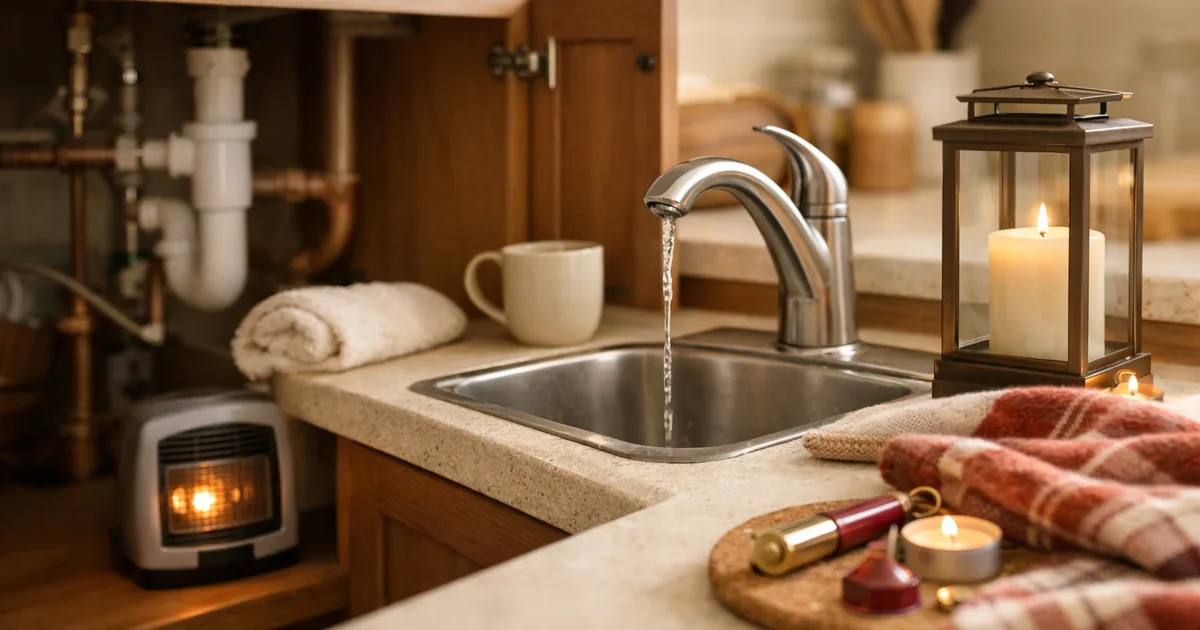
A cold snap can freeze water pipes so nothing comes out, or burst them. The American Red Cross says water expands as it freezes, and no matter how strong a pipe is, that can break it. When it’s very cold, it says let cold water drip from faucets served by exposed pipes, open cabinet doors under sinks so warm air reaches the plumbing, and keep the thermostat the same day and night. If a pipe freezes, thaw it with a hair dryer, an electric heating pad or towels soaked in hot water, and never use a blowtorch or any open flame. This sets out the Red Cross page “Frozen Pipes”.
1. In very cold weather: let cold water drip, open cabinets under sinks, keep the same heat day and night.
2. When away, leave the heat on, no lower than 55°F (about 13°C).
3. To thaw: hair dryer, heating pad or hot wet towels — no blowtorch or open flame. Can’t find it or thaw it: call a plumber.
Why pipes freeze, and which are at risk — American Red Cross
The Red Cross says water expands as it freezes, and that pressure can break even strong pipes.
| Pipes at risk | What the Red Cross says | Worth noting (ours) |
|---|---|---|
| Exposed outdoors | Outdoor hose bibs, pool and sprinkler supply lines | In Korea, balcony or yard taps (our gloss) |
| Unheated indoor areas | Basements, crawl spaces, attics, garages, kitchen cabinets | — |
| Exterior walls | Pipes running along exterior walls with little or no insulation | Also named as a likely place for freezing |
Before cold weather — American Red Cross
| Type | What the source says | Worth noting (ours) |
|---|---|---|
| Do | Drain pool and sprinkler supply lines as the maker directs | Don’t add antifreeze unless directed |
| Do | Close inside valves to outdoor hose bibs and keep the outside valve open so remaining water can expand | — |
| Do | Add insulation to attics, basements and crawl spaces | — |
| Do | Insulate both hot and cold pipes in unheated areas — pipe sleeves, UL-listed heat tape or cable, or newspaper | — |
When it’s very cold — American Red Cross
| Type | What the source says | Worth noting (ours) |
|---|---|---|
| Do | Keep garage doors closed if there are water lines inside | — |
| Do | Open kitchen and bathroom cabinet doors so warm air reaches the plumbing | — |
| Do | Let cold water drip from faucets served by exposed pipes | — |
| Do | Keep the thermostat the same day and night | A burst pipe costs far more, it says |
| When away | Leave the heat on, no lower than 55°F | About 13°C (our conversion) |
If a pipe freezes — American Red Cross
| If | What to do | Worth noting (ours) |
|---|---|---|
| Only a trickle comes out of a faucet | Suspect a frozen pipe | Exterior walls are a likely spot |
| While thawing | Keep the faucet open so water can flow as ice melts | — |
| Safe heat | An electric heating pad wrapped round the pipe, a hair dryer, a space heater kept away from flammables, towels soaked in hot water | — |
| Never use | A blowtorch, kerosene or propane heater, charcoal stove or any open flame | — |
| How long | Until full water pressure is restored | — |
| One pipe froze | Check other faucets too | Others may freeze as well |
| Can’t find, reach or thaw it | Call a licensed plumber | — |
This page is written for US homes. In Korea, apartment water meter freezing guidance and reporting come from local water authorities, and we didn’t read current material this time (our note). The carbon monoxide risk behind the open-flame warning is in carbon monoxide poisoning.
Checklist
- ☐ Before the cold: drain outdoor lines; insulate pipes in unheated areas
- ☐ Very cold: drip cold water, open sink cabinets, same heat day and night
- ☐ Away: no lower than 55°F (about 13°C)
- ☐ Frozen: tap open; hair dryer, heating pad or hot wet towels
- ☐ No open flames; call a plumber if you can’t thaw it
Questions that remain
Isn’t letting water drip wasteful?
The Red Cross says, about keeping the heat steady, that you prevent a much more costly repair if pipes freeze and burst. This page gives no drip rate.
Can I pour hot water straight on?
This page says to wrap towels soaked in hot water round the pipe; it doesn’t cover pouring boiling water directly.
Sources
- American Red Cross — Frozen Pipes — source (no published or updated date shown; checked 19 October 2026). Why pipes freeze, 3 at-risk pipe types, 4 steps before the cold, 5 during, thawing and forbidden heat sources, when to call a plumber.
- Not read. Current Korean water authority guidance on water meter freezing.
- What we added. The “worth noting” column, the Celsius conversion and the Korean housing gloss.
Where else to check
- Your local water authority — meter freezing prevention and reporting.
Written on 19 October 2026. The content is from the source; the glosses are ours.