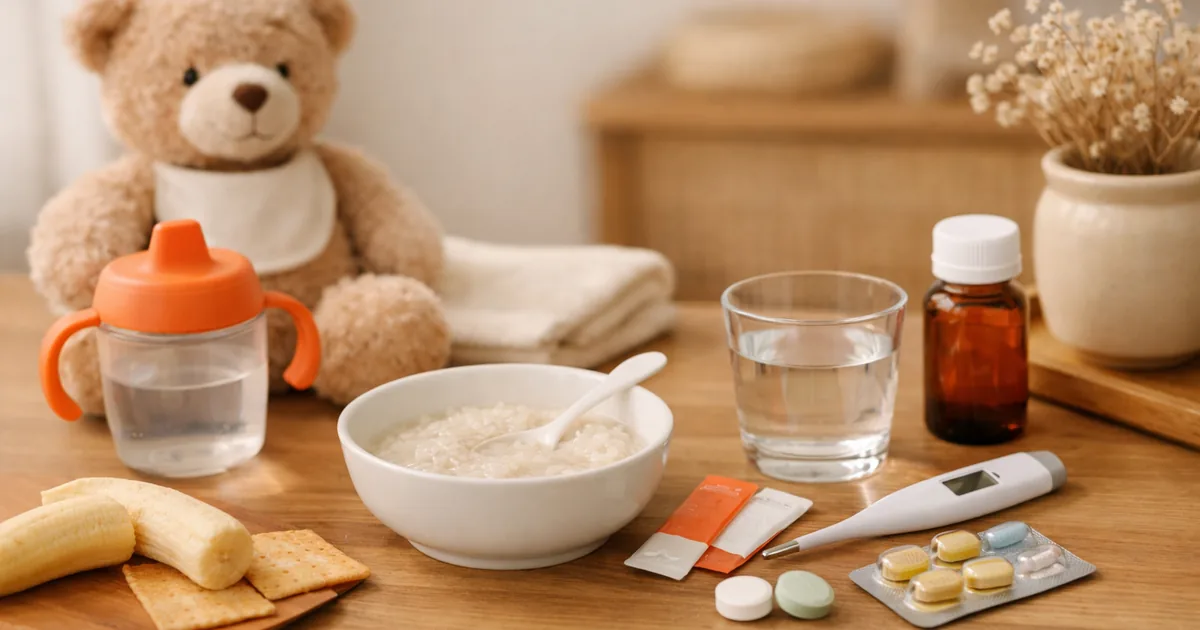
1. What the real danger is. Not the vomiting or the diarrhoea but dehydration. The question is not “what do I stop” but “how do I protect fluids” — don't withhold food; small amounts, often.
2. When to go in. The CDC states dehydration in countable terms — no urine for 8 hours, a dry mouth, and crying without tears. Far easier to judge at 3 a.m. than “seems listless.”
3. How long it lasts. Symptoms begin 12–48 hours after exposure and most improve within 1–3 days. The less-known part: a child keeps shedding the virus for more than two weeks after recovering — which is what handwashing and nursery return should be planned around.
Your child throws up everything they ate, and the diaper is soaked with watery diarrhea. After a few changes through the night, the fear creeps in. Vomiting and diarrhea in babies is usually viral gastroenteritis that passes in a few days — but the real danger isn't the vomiting or diarrhea itself. It's dehydration. The key isn't “what to stop” but “how to protect fluids.”
The one rule: don't starve them, give little and often
- Fluids come first. Replacing the water and electrolytes lost is the core of treatment.
- “Small and frequent” wins. A big amount at once irritates the stomach and comes right back up. A spoonful every 5–10 minutes.
- Don't starve them. The old “fasting” advice is outdated. Once fluids stay down, continue their usual food (breastmilk, formula, meals).
What to give vs. avoid
| Category | Give | Avoid |
|---|---|---|
| Fluids | Oral rehydration solution (ORS), little and often. Keep breastmilk/formula going | Plain water only (lacks electrolytes); undiluted sports drinks/juice (too much sugar worsens diarrhea) |
| Food | If they want it: rice, porridge, banana, potato — normal food | Greasy foods, very sugary snacks, caffeine |
| Nursing infants | Breastmilk/formula as usual, small and frequent | Watering down formula on your own (distorts nutrition/electrolytes) |
ORS (sold at pharmacies and convenience stores) has an optimized water-salt-sugar ratio for absorption. Using the product beats mixing your own. Our home first-aid kit guide covers what to keep on hand.
How much to give: a quick guide
The rule is “small enough not to trigger vomiting.” These are general starting points — increase slowly as they tolerate it.
| Child | Per serving | Interval |
|---|---|---|
| Breastfed infant | Nurse briefly and often | Rest 30 min after a vomit, then resume |
| Formula/weaning age | Start with ORS ~1 tsp (5 mL) | Every 5 min, increase if tolerated |
| Toddler (over 1) | ORS 5–10 mL | Every 5–10 min |
A whole cup at once irritates the stomach and comes back up. The “spoon method” looks tedious but it's the surest way to prevent dehydration. No need to wake a sleeping child, but keep it up diligently while they're awake.
Dehydration signs — save this table
Babies dehydrate much faster than adults. If these appear, head to a doctor.
| Level | Signs | Action |
|---|---|---|
| Mild | Slightly less urine, mouth a bit dry. Still playful, drinking well | ORS little and often, observe at home |
| Moderate | Clearly less urine, few tears when crying, dry mouth/lips, sluggish | Push ORS + see a pediatrician |
| Severe (emergency) | No urine for 6–8 hrs, sunken eyes/soft spot, limp, cold hands and feet | ER immediately |
The CDC's dehydration thresholds are countable
“Passing less urine” and “seems tired” are hard to judge at 3 a.m. The CDC states its thresholds as numbers and observable facts.
Emergency warning signs in children — “Dehydration (no urine for 8 hours, dry mouth, no tears when crying)”
— US Centers for Disease Control and Prevention, flu signs and symptoms page (last reviewed 1 August 2024)
The norovirus page adds one more for children — “crying with few or no tears and be unusually sleepy or fussy”. Note that “unusually fussy” is listed as a dehydration sign. It is not only the limp, quiet child who is in trouble; a child who is unusually irritable is signalling too.
The timeline — and what outlasts it
| Point | What happens |
|---|---|
| 12 to 48 hours after exposure | Symptoms begin — diarrhea, vomiting, nausea, stomach pain (sometimes fever, headache, body aches) |
| 1 to 3 days | “Most people with norovirus illness get better within 1 to 3 days” |
| 2+ weeks after recovery | “You can still spread norovirus for 2 weeks or more after you feel better” |

That last line is the least known of the three. A child back at nursery after recovering can still spread the virus for two weeks or more. Hence the CDC's two prevention lines: “wash your hands well and often” and “clean and disinfect contaminated surfaces”.
On treatment the CDC is equally clear — “There is no specific medicine to treat people with norovirus illness. Antibiotic drugs will not help treat norovirus infections because they fight bacteria, not viruses.” Oral rehydration solution is recommended for mild dehydration; severe dehydration needs intravenous fluids.
Signs to go to the ER now
- ☐ “Severe” dehydration above (no urine for half a day, sunken soft spot/eyes, limp)
- ☐ Under 3 months with vomiting/diarrhea
- ☐ Green (bile) vomit, or blood in vomit or stool
- ☐ Can't keep down even a sip, vomiting everything for 8+ hours
- ☐ Severe pain — screaming inconsolably in waves (possible intussusception)
- ☐ High fever with lethargy or seizure (see baby fever guide)
Caution. Don't casually give anti-diarrheal medicine to babies — it can block the gut from clearing the virus/toxins and is not recommended in young children. Likewise, don't give anti-nausea medicine or antibiotics without a doctor's order. The center of treatment is fluids, not drugs.
A real example: a 10-month-old vomiting and having diarrhea all night
It starts in the evening and watery diarrhea continues through the night. ① After a vomit, rest the stomach for about 30 minutes, then give ORS a teaspoon (5 mL) every 5 minutes. ② If nothing comes up for 15–20 minutes, increase the amount slowly. If breastfeeding, nurse briefly and often. ③ If they vomit again, rest 10 minutes and restart with a smaller amount. ④ If the diaper is dry for over 6 hours, they cry without tears, or they go limp, that's dehydration — go to a doctor. ⑤ If fever is also present, give weight-appropriate medicine. Most gastroenteritis resolves in 3–5 days when fluids are protected. Unsure? See our ER vs. clinic guide.


Prevention & recovery checklist
- ☐ Thorough handwashing — gastroenteritis mostly spreads hand-to-mouth (rota/norovirus)
- ☐ Wash hands after diaper changes and before meals; sanitize toys and dishes
- ☐ Check the rotavirus vaccination schedule (for infants)
- ☐ Keep ORS at home for the nights you can't reach a pharmacy
- ☐ In recovery, briefly avoid greasy foods and very sugary snacks
- ☐ If diarrhea lasts over 2 weeks or weight drops, revisit the pediatrician
Questions this raises
Q. Can I give sports drinks or juice?
Not recommended. Store sports drinks and juice are high in sugar, which can pull water into the gut and worsen diarrhea. The right choice is a properly balanced oral rehydration solution (ORS).
Q. Isn't it better to fast them so they don't vomit?
No. Prolonged fasting slows recovery and raises dehydration risk. Rest the stomach briefly (about 30 minutes), start fluids little and often, and resume normal food once tolerated — that's the current guidance.
Q. How many days of diarrhea is normal?
Viral gastroenteritis diarrhea usually lasts 5–7 days, sometimes up to ten. As long as fluids hold and the child is active, it's usually fine. See a doctor for diarrhea over 2 weeks, blood in stool, weight loss, or dehydration signs.
Q. I heard not to give honey water before age one?
Correct. Never give honey under 12 months — risk of infant botulism. Rehydrate with ORS, breastmilk, or formula, not honey water.
The whole game with baby gastroenteritis is preventing dehydration: little and often, don't starve, don't casually use anti-diarrheals. No urine for half a day → go to a doctor.
Before and after caring for someone with vomiting or diarrhea is one of the CDC’s key times to wash hands — soap for at least 20 seconds (handwashing for 20 seconds).
For adults, the NHS has separate diarrhoea and vomiting advice — diarrhoea 5 to 7 days, vomiting 1 to 2, and 2 days off after the last bout (diarrhoea and vomiting).
Sources
- US Centers for Disease Control and Prevention — About Norovirus (last reviewed 24 April 2024). Source of symptoms beginning 12 to 48 hours after exposure, “most people get better within 1 to 3 days”, the child dehydration sign (“crying with few or no tears and be unusually sleepy or fussy”), “there is no specific medicine… antibiotics will not help”, oral rehydration for mild and IV fluids for severe dehydration, and “you can still spread norovirus for 2 weeks or more after you feel better”.
- US Centers for Disease Control and Prevention — Signs and Symptoms of Flu (last reviewed 1 August 2024). Source of “dehydration (no urine for 8 hours, dry mouth, no tears when crying)” and “not alert or interacting when awake” among emergency warning signs in children.
- Seoul Metropolitan Government — night and holiday paediatric care notice (5 February 2024). Source of the Moonlight Children's Hospital hours and the 33 public night pharmacies open 22:00–01:00 — useful when oral rehydration solution is needed after hours. 🔴 The 33 is a February 2024 figure. Re-checked on 28 September 2026, Seoul’s public late-night pharmacy notice (revised 23 September 2026) lists 40 pharmacies across 25 districts, open 22:00–01:00, with opening days varying by pharmacy, so call before you go.
Where to check further
- How much fluid, for your child's age. Specifics like “a teaspoon every five minutes” are widely taught, but the CDC pages we opened give no volumes or intervals (what was verified word for word is the dehydration criteria, timeline and treatment principles). The leaflet on an oral rehydration solution from a pharmacy carries age-based amounts.
- Sources disagree on how long diarrhoea lasts. The CDC norovirus page says 1–3 days while the common figure is 5–7; both are kept, since it varies by virus (rota, noro and others). If it runs long, judge on dehydration signs rather than the calendar.
- Distinguishing surgical emergencies such as intussusception or bile-stained vomiting. These were not on the CDC pages we opened. Green (bile) vomit, blood in the stool, or episodic screaming with the legs drawn up is a different problem — go to a paediatrician or emergency department straight away.
Written as of July 2026. The dehydration thresholds, the timeline and the treatment principles come from the CDC pages above. This is general information, not a diagnosis. Babies dehydrate quickly — if danger signs appear, contact a pediatrician or emergency line without delay. If cough or a cold is also present, see baby cough and cold care, and our home emergency guide covers the broader basics.