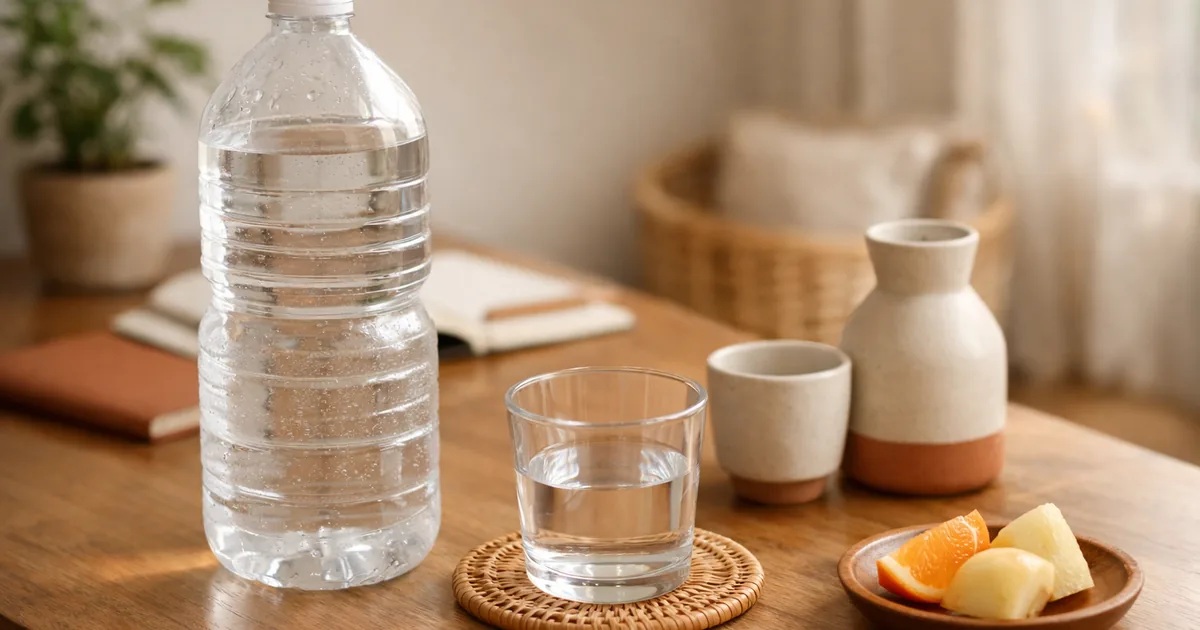
“Two litres a day.” Eight glasses. An app that buzzes at you. Few health numbers are repeated as confidently as this one. This article does not stop at checking it — it answers three questions: how much you actually need to drink, whether too much is dangerous, and when and how to drink it.
1. What you actually drink is about one litre. Korea's official reference sets liquid intake at 1,000–1,200 mL for adult men and 900–1,000 mL for women. The two-litre figure is the total-water column — food included.
2. There is an upper limit. The US National Institute for Occupational Safety and Health writes: “Do not drink more than 48 oz (1½ quarts) per hour!” — because blood salt can fall dangerously low.
3. Drink before you're thirsty, in small amounts. “By the time you feel thirsty, you are already behind in fluid replacement,” the same source says.
Each of the three, worked through below.
How much you actually need — and which column the two litres is in
Start with Korea's own reference. The Dietary Reference Intakes for Koreans, published by the Ministry of Health and Welfare, splits water into two columns: liquid (water, beverages, milk) and total water (liquid plus the water in food).

| Age | Sex | Liquid (water, drinks, milk) | Total water (food included) |
|---|---|---|---|
| 19–29 | Men | 1,200 mL | 2,600 mL |
| Women | 1,000 mL | 2,100 mL | |
| 30–49 | Men | 1,200 mL | 2,500 mL |
| Women | 1,000 mL | 2,000 mL | |
| 50–64 | Men | 1,000 mL | 2,200 mL |
| Women | 1,000 mL | 1,900 mL | |
| 65–74 | Men | 1,000 mL | 2,100 mL |
| Women | 900 mL | 1,800 mL | |
| 75+ | Men | 1,100 mL | 2,100 mL |
| Women | 1,000 mL | 1,800 mL | |
| Dietary Reference Intakes for Koreans, 2025. An “adequate intake” is used where the evidence is too thin to set a recommended intake, so it is a rough anchor rather than a bar to clear. | |||
This is where the two-litre figure comes from. A number in the two-litre range does exist — in the total-water column. It includes the water in soup, fruit and vegetables, and the liquid you have to drink separately is less than half of it. “Drink two litres of water” most likely comes from reading the total-water figure as if it were the liquid figure.
The US Centers for Disease Control and Prevention declines to give a number at all: “Daily water intake recommendations vary by age, sex, pregnancy, activity level and breastfeeding status.” What it does describe is where the water comes from, and it matches the two-column structure: “Most of your daily fluid intake comes from water and other beverages. Food, especially food with high water content such as fruits and vegetables, can also contribute to your fluid intake.”
Is too much dangerous — the limit is written down
This box sat empty for a long time. But NIOSH's heat-stress hydration material carries a numerical ceiling.
“Do not drink more than 48 oz (1½ quarts) per hour!”
Drinking excessive amounts of water or other fluids (sports drinks, energy drinks and so on) can lower blood salt concentration to a dangerous level and become a medical emergency.
— US National Institute for Occupational Safety and Health, “Heat Stress: Hydration”
| Item | What NIOSH writes | Converted |
|---|---|---|
| Recommended rate | 1 cup (8 oz) every 15–20 minutes | 24–32 oz an hour — about 0.7–0.9 L |
| Ceiling | No more than 48 oz per hour | About 1.4 L |
| How to drink it | “Drinking at shorter intervals is more effective than drinking large amounts infrequently” | Do not down it all at once |
| The litre conversions are ours (1 oz ≈ 29.6 mL). This guidance is for working in heat and should not be carried across to a daily target. | ||
Note that the ceiling is per hour, not per day. It exists to stop people downing large volumes at once when thirst finally arrives, not to cap a daily total. And sports drinks and energy drinks sit inside the same sentence as water.
When and how to drink it
Timing matters more than volume, and NIOSH says so plainly: “Drink before feeling thirsty. By the time you feel thirsty, you are already behind in fluid replacement.”
The CDC, instead of a daily number, lists the situations in which the body needs more.
| Step | What to do | The basis |
|---|---|---|
| 1 | Take about one litre of liquid as the everyday anchor. The rest arrives with meals | The liquid column of Korea's reference intakes |
| 2 | Raise it in four situations — hot weather, high physical activity, fever, diarrhoea or vomiting | The four situations the CDC lists |
| 3 | Working or exercising in heat, drink a cup every 15–20 minutes, before thirst | NIOSH's interval |
| 4 | Do not exceed about 1.4 litres in an hour | NIOSH's ceiling |
| 5 | You do not have to fill it with water alone. Other beverages and water-rich food count in the same column | The CDC and the total-water concept |
| Arranging the sequence is ours; the basis in each row is carried as written. Anyone on a fluid restriction for kidney or heart disease sits outside this table. | ||

Sports drinks are not the default. NIOSH writes this about people working in heat: “Some workers may prefer the taste of sports drinks, but these types of drinks are often not necessary for electrolyte replacement. Workers who eat regular meals and salty snacks can usually replace the electrolytes lost through sweat.” That is about electrolyte replacement, though — dehydration from diarrhoea or vomiting needs a different response, covered in emergencies at home.
For calories and weight, see the BMI and calorie calculator; for reading checkup figures, liver and kidney numbers. For summer outdoor preparation, see the home first aid kit. Another belief checked the same way is in should you eat breakfast.

Questions that come up
So is “two litres a day” wrong?
Closer to reading the wrong column than to being wrong. In Korea's reference the two-litre range is total water, food included, and the liquid to drink separately is about one litre. Drinking two litres of water is not harmful, but there is no basis for treating it as the standard.
Do coffee and tea count?
Korea's “liquid” column is defined to include water, beverages and milk, and the CDC says “water and other beverages.” But nothing in the sources opened here singles out coffee or tea, or addresses caffeine.
How much should I drink while exercising?
NIOSH's cup every 15–20 minutes is guidance for “work in heat, moderate activity, moderate conditions.” Whether it transfers directly to exercise is not something the source says. But “before thirst” and the 48-oz hourly ceiling point the way.
Do older people need more water?
The reference table runs the other way. Total water falls from 2,600 mL for men aged 19–29 to 2,100 mL for those 65 and over. That is a figure for need rather than intake, and the table does not address reduced thirst sensation in later life.
Can you drink too much?
NIOSH sets a ceiling — no more than 48 oz (about 1.4 L) per hour — and gives the reason: excessive amounts can lower blood salt to a dangerous level and become a medical emergency. Note that the figure is hourly, not daily.
What we read into it
There is a pattern in how these agencies handle numbers: no number when the conditions are open, a number when they are pinned down.
| Aspect | Everyday life (CDC) | Working in heat (NIOSH) |
|---|---|---|
| Daily amount | No number given | Set per hour |
| Interval | Not specified | A cup every 15–20 minutes |
| Thirst | Not mentioned | “Before feeling thirsty” |
| Ceiling | Not mentioned | 48 oz per hour |
| Sports drinks | Not mentioned | Often unnecessary |
| The same agency family, with numbers on one side only — the side where “heat, moderate activity, moderate conditions” are stated. | ||
Korea's reference does the same thing by pinning the conditions to age and sex. Which is exactly why one number cannot fit everyone. This comparison is ours from placing the three sources together; none of them presents it this way.
Sources
- Ministry of Health and Welfare, Korea — Dietary Reference Intakes for Koreans 2025 (tier 1, government publication) — summary PDF (checked August 2026). Source for the full adequate-intake table by age and sex, including the split between liquid and total water. The publisher is the Ministry of Health and Welfare; the PDF was accessed through the Seoul Medical Association's health portal.
- US Centers for Disease Control and Prevention (tier 1, government agency) — Water and healthier drinks (checked August 2026). Source for “daily water intake recommendations vary by age, sex, pregnancy, activity level and breastfeeding status,” “most of your daily fluid intake comes from water and other beverages… food with high water content such as fruits and vegetables can also contribute,” and the four situations calling for more water. Neither “two litres” nor “eight glasses” appears on that page.
- US National Institute for Occupational Safety and Health (tier 1, government agency) — Heat Stress: Hydration (2017) (checked August 2026). Source for “drink 1 cup (8 ounces) of water every 15–20 minutes” and its hourly equivalent of 24–32 ounces, “do not drink more than 48 oz (1½ quarts) per hour!” with the warning about dangerously low blood salt, “drink before feeling thirsty. By the time you feel thirsty, you are already behind in fluid replacement,” and “drinking at shorter intervals is more effective than drinking large amounts infrequently.”
- US National Institute for Occupational Safety and Health (tier 1, government agency) — Keeping workers hydrated and cool in the heat (checked August 2026). Source for sports drinks being “often not necessary for electrolyte replacement” and for workers eating regular meals and salty snacks usually replacing what sweat takes.
- Our own conversion. Turning 48 oz into about 1.4 L and 24–32 oz into about 0.7–0.9 L is our arithmetic (1 oz ≈ 29.6 mL). So is the observation that the two-litre figure belongs to the total-water column.
Where to check further
- The full reference intakes — what this article carries is the water table from the summary edition. The rationale and the values for pregnancy and lactation sit in the Ministry of Health and Welfare’s 2025 Dietary Reference Intakes publication and the Korean Nutrition Society’s KDRIs library.
- How caffeinated drinks are treated — not established in the sources opened here. The full reference may cover it in its commentary on water — the summary edition does not.
- When fluid is restricted — if you have been placed on a restriction for kidney or heart disease, the figures here do not apply. Follow your clinician's instructions.
Written as of August 2026. The adequate intakes by age and sex come from the Dietary Reference Intakes for Koreans 2025; the absence of a daily number and the four situations from the CDC; the interval, the ceiling and the sports drink material from NIOSH. The ounce conversions and the point that the two-litre figure is the total-water column are marked as ours. This article is general health information and does not substitute for medical diagnosis or treatment. If you have kidney or heart disease or have been told to limit fluids, follow your clinician's instructions.