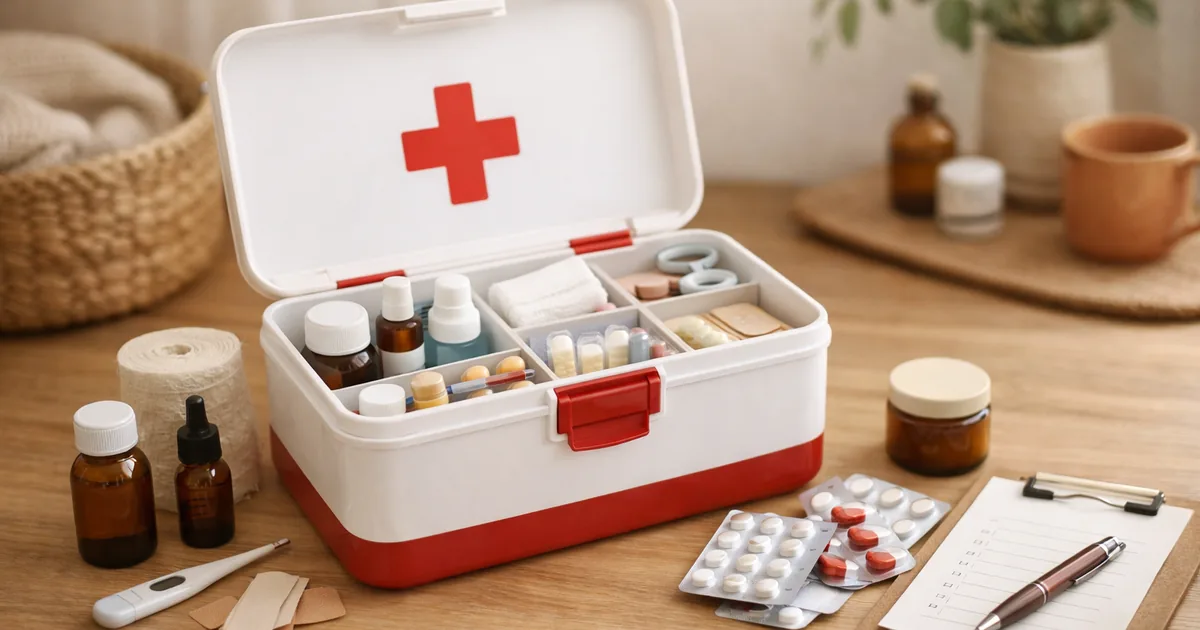
You discover there's no fever medicine in the house at 2 a.m., after the fever starts. A first-aid kit can only be built before the accident.
1. What to buy. Search and you get dozens of competing lists. The agency's own list runs to 26 items — nine of them medicines — and it is reproduced here as written.
2. Why so little is available at night. Korea's Pharmaceutical Affairs Act sets only a ceiling of “up to 20 items” and leaves the actual list to a ministerial notice — which changes without amending the law.
3. What to do. Keep the kit at home, not only in the suitcase — injuries mostly happen at home. And without expiry management a kit quietly becomes a medicine graveyard.
17 September 2026 — we opened the notice, and one line in this article was wrong. The earlier version said below that “the notice changes independently, so check the current one”. The Designation of Safe Household Medicines notice is still at MOHW notice 2016-156, in force 24 August 2016 — unchanged since 2016.
Its article 3 requires the Minister to review the notice every three years from 1 January 2016. Those review points have passed without an amendment. Under the “up to 20” ceiling, the actual list has stood for a decade — which is the other half of the answer to “why is this all a convenience store carries?”
Below: what to buy, how to manage expiry dates, and how to dispose of old medicine.
The essential kit: take this list to a pharmacy
Nothing fancy is required. This entire table costs roughly the price of a takeout dinner for two.
| Category | Items | Purpose & buying tips |
|---|---|---|
| Wound care | Sterile gauze pads, paper tape, adhesive bandages (assorted sizes), elastic bandage | Buy individually wrapped gauze. The elastic bandage doubles as sprain compression |
| Povidone-iodine, small bottles of sterile saline | Saline works for wound and eye rinsing. Hydrogen peroxide is no longer recommended | |
| Oral medicine | Two classes of pain/fever relievers: acetaminophen + ibuprofen | Different classes allow alternating (ask a pharmacist). With kids, weight-dosed syrup is a must |
| Antacid, anti-diarrheal, laxative | For acute diarrhea, hydration comes first; medication is backup | |
| Antihistamine (allergies, hives, insect bites) | Second-generation ones cause less drowsiness for daytime use | |
| Topicals | Antibiotic ointment, burn ointment, mild steroid cream (bites, eczema) | Burns get cool water first; ointment only for redness-level burns |
| Pain-relief patches (cold & warm), blister bandages | Cold patches for fresh injuries (first 48h), warm for chronic aches | |
| Tools | Thermometer, scissors, tweezers, disposable gloves, cotton swabs, ice pack (keep in freezer) | A non-contact thermometer is easiest for families |
What an agency actually lists — 26 items when you count them
Search “what goes in a first-aid kit” and you get fifty lists. So we took one list an agency actually publishes, copied it as written, and counted the items by group ourselves.
| Group | Count (ours) | As listed in the source |
|---|---|---|
| Medicines | 9 | diarrhea medicine · antacid · antihistamine · motion sickness medicine · cough drops/suppressant/expectorant · decongestant · pain and fever medicine · mild laxative · mild sedative or sleep aid |
| First-aid supplies | 12 | 1% hydrocortisone cream · antibacterial/antifungal ointments · digital thermometer · oral rehydration salts · antiseptic wound cleaner · aloe gel · insect-bite gel · bandages · disposable gloves · cotton swabs · tweezers · eye drops |
| Documents | 5 | ID copies · prescription copies · insurance documents · vaccination proof · emergency contacts |

Three things stood out while copying the list.
① Disposable gloves are on it. Korean kit lists rarely include them — the item assumes you may be handling someone else's blood.
② Oral rehydration salts are there too, which assumes a situation where water alone will not do.
③ Documents and contacts form a whole group. The kit is treated as “everything the situation needs,” not a medicine box.
We still could not obtain a Korean agency's home-kit list. What we did obtain this time is what Korean law itself sets out — and the first thing the statute explains is why no such list appears in the law at all.
Buying medicine at a convenience store is the exception, not the rule
When the pharmacy is shut at 2am you go to a convenience store. It feels so ordinary that nobody asks how it works. Open the Pharmaceutical Affairs Act and it turns out to be a narrow exception carved out of a flat prohibition.
“A person who is not the establisher of a pharmacy (including a pharmacist or herbal pharmacist working at that pharmacy) may not sell medicines or acquire them for the purpose of selling.”
— Pharmaceutical Affairs Act, art. 44(1) (translated)
That is the rule. Paragraph 2 then lists the exceptions, and item 1-2 is the convenience store.
“A seller of safety OTC medicines registered under art. 44-2 (only where selling the safety OTC medicines under art. 44-2(1))”
— Pharmaceutical Affairs Act, art. 44(2) item 1-2, inserted 14 May 2012 (translated)
The parenthesis carries the weight — only where selling those items. Convenience stores were not permitted to sell medicine; an exception was opened for a designated list and nothing else.
So how many items? The Act only sets a ceiling of 20
“Why is the convenience-store selection so small?” is a standing complaint. Half the answer sits in the definition clause.
Safety OTC medicines are “medicines among over-the-counter drugs, used mainly for mild symptoms requiring prompt treatment and capable of being used at the patient's own judgement, which the Minister of Health and Welfare designates and publishes by notice, within a limit of 20 items, taking into account each product's ingredients, side effects, dosage, formulation, public familiarity and ease of purchase.”
— Pharmaceutical Affairs Act, art. 44-2(1), inserted 14 May 2012 (translated)
The only number in the Act is the ceiling: 20. Which drugs actually make the list is fixed not by statute but by ministerial notice. That is why searching the statutes for a Korean list turns up nothing — and why this article spent so long unable to find one.
Look again at the six factors the Act says to weigh. Ingredients, side effects, dosage, formulation are what you would expect of a drug rule. “Public familiarity” and “ease of purchase” are a different kind of criterion altogether — how well known a product is, and how easy it is to buy, sit inside the designation test.
| What | Set where | What it says |
|---|---|---|
| Who may sell | Act art. 44(1) | As a rule, pharmacies only |
| The store exception | Act art. 44(2) item 1-2 | A registered seller, only for those items |
| Number of items | Act art. 44-2(1) | 20 at most (a ceiling only) |
| The actual list | Ministerial notice | Not in the statute |
| Eligible premises | Act art. 44-2(2) | Open 24 hours, year-round |
| Registration | Act art. 44-2(1), (5) | With the local authority; details by ministerial decree |
| Seller training | Act art. 44-3(1) | Must be taken before registering |

The appendix, opened — thirteen items
It opened at the third attempt. The first two failed because we were assembling the address; this notice's appendix opens only by clicking the entry in the list. Obtained 18 September 2026.
| Kind | No. | Item, as the notice names it |
|---|---|---|
| Painkiller | 1 | Children's Tylenol tablets 80mg (10 tabs) |
| Painkiller | 2 | Tylenol tablets 160mg (8 tabs) |
| Painkiller | 3 | Tylenol tablets 500mg (8 tabs) |
| Painkiller | 4 | Children's Tylenol suspension (100ml) |
| Painkiller | 5 | Children's Brufen syrup (80ml) |
| Cold remedy | 6 | Pancol-A oral liquid (30ml × 3) |
| Cold remedy | 7 | Panpyrin-T tablets (3 tabs) |
| Digestive | 8 | Bearse tablets (3 tabs) |
| Digestive | 9 | Dr. Bearse tablets (3 tabs) |
| Digestive | 10 | Festal Gold tablets (6 tabs) |
| Digestive | 11 | Festal Plus tablets (6 tabs) |
| Patch | 12 | Shinshin Pas Arex (4 patches) |
| Patch | 13 | Jeil Cool Pap (4 patches) |
Thirteen — seven places below the ceiling of twenty. And only four kinds: five painkillers, two cold remedies, four digestives, two patches. No anti-diarrhoeal, no antihistamine, no antiseptic, no ointment — which is where “the convenience store will have something” breaks down.
The notice names products, not substances. Brand names, verbatim — so another product with the same active ingredient is outside the list, and the fact that the list has been unchanged since 2016 reads heavier for it. The thirteen lines above are the appendix's own wording; the four groupings are ours.
What overlaps with a home kit, and what does not. Painkillers and patches overlap with the essentials above. But antiseptic, plasters, burn ointment and antihistamines cannot be bought at a convenience store — which makes them exactly the things worth buying in advance.
Why convenience stores specifically? The clause says so
Everyone calls them “convenience-store medicines,” yet the phrase “convenience store” never appears in the statute. What appears is this:
“…shall be a person with premises open 24 hours a day, year-round, and shall meet the registration criteria prescribed by ministerial decree in consideration of convenience of use for local residents and the ease of recovering hazardous medicines.”
— Pharmaceutical Affairs Act, art. 44-2(2) (translated)
The condition was “open 24 hours, year-round.” Convenience stores are what meet that condition in practice, so convenience stores are what it became — the law did not pick them.
The phrase sitting next to it is worth noticing too: “the ease of recovering hazardous medicines.” Whether a bad batch can be pulled back is written into the registration criteria. The clause thinks about retrieval before it thinks about sales.
None of which makes a convenience store a substitute for a kit at home. The exception covers fewer than twenty items, and the clause itself narrows them to “mild symptoms requiring prompt treatment.” Stocking ahead and buying in a hurry do not replace each other.
Why it belongs at home, not in a suitcase
Plenty of people keep the kit packed for trips. The statistics suggest the opposite order.
The US Centers for Disease Control and Prevention reports that among adults 65 and older, “over 14 million, or 1 in 4… report falling every year,” and that “about 37% of those who fall reported an injury that required medical treatment or restricted their activity for at least one day.”
These are US figures, and the source does not say how many of those falls happen indoors. What is clear is that this is ordinary life, not an exotic accident. So keep the kit where people actually spend time, not by the front door.
Expiration management: don't let your kit become a medicine graveyard
The biggest enemy of a first-aid kit is time — everything's expired exactly when you finally need it. The rule is simple: check twice a year, when the seasons change.
| Type | Use within (after opening) | Note |
|---|---|---|
| Tablets/capsules (sealed) | Printed expiration date | Never store in a humid bathroom |
| Syrups (children's fever medicine) | About 1 month | Write the opening date on the bottle |
| Ointments & creams | About 6 months | Discard if the nozzle discolors |
| Eye drops (multi-use) | 1 month | Single-use vials: same day only |
| Sterile saline | Immediately to a few days | Small bottles are the answer |
| Antiseptics (povidone) | 6–12 months | Discard if discolored or separated |
Key point. Don't throw expired medicine in the trash or flush it — it contaminates water. In Korea, take it to the collection box at any pharmacy or public health center; many countries have similar take-back programs at pharmacies.

Out of medicine at midnight? (Korea edition)
When every pharmacy is closed, Korean 24-hour convenience stores legally sell a set of designated OTC medicines — acetaminophen (Tylenol), cold medicine, digestive aids, and pain-relief patches. The government is currently working to expand the list (up to 20 items). Treat it as a bridge to get through one night; if symptoms continue, see a doctor the next day. For finding late-night hospitals and pharmacies, see our guide to ER vs. clinic in Korea.
Custom additions for your household
| Household | Add these |
|---|---|
| Infants and toddlers | Two classes of weight-dosed fever syrup, digital thermometer, oral rehydration solution (ORS), nasal aspirator |
| Elderly family members | Blood pressure monitor, medication list posted on the fridge, juice or candy for dizzy spells |
| Allergy sufferers | Prescribed antihistamines, an emergency action plan agreed with your doctor, epinephrine auto-injector if prescribed |
| Hikers and campers | A portable mini kit, fine-tipped tweezers for ticks; skip “venom extractors” — soap and water work better |
| Frequent travelers | A travel pouch with anti-diarrheal and motion-sickness medicine (see our travel emergency guide) |
A real-world example: Sunday-night hives
Thirty minutes after dinner, hives bloom on a family member's arms and legs. ① Give an antihistamine from the kit and watch. ② Hives alone usually fade within hours. ③ But swelling lips or eyes, a changing voice, or any trouble breathing suggests anaphylaxis — call an ambulance immediately. ④ Even if it settles, note what they ate and get an allergy test on a weekday. Knowing these decision points in advance matters more than the kit itself — see when symptoms need an ER.
Today's checklist
- ☐ Screenshot the essentials table and go to a pharmacy
- ☐ Use a lidded box or pouch, clearly labeled (an airtight container is plenty)
- ☐ Location: not the humid bathroom or under the sink — cool, dry, out of children's reach
- ☐ Tell the whole family where it is (a kit only you know about doesn't exist)
- ☐ Write opening dates on syrups and ointments
- ☐ Put two check-up dates on the calendar (e.g., first weekends of April and October)
- ☐ Bag up expired medicine for the pharmacy take-back box
Swallowed button batteries (two hours, 10 mL honey) are covered in button batteries.
Questions that remain
Is a store-bought pre-made first-aid kit good enough?
It's a fine start, but pre-made kits are mostly bandages and gauze — they usually contain no oral medicine at all. Add the two fever-reducer classes, an antihistamine, and a thermometer yourself.
Why do I need both acetaminophen and ibuprofen?
They're different drug classes, so when one isn't enough you can alternate them (confirm dosing with a pharmacist), and each suits different situations — acetaminophen is gentler on an empty or sensitive stomach. For children, always dose by weight.
Can I keep leftover prescription antibiotics in the kit?
No. Prescriptions are matched to a specific illness and duration; reusing them is risky, and antibiotics should be finished as prescribed, not saved. Leftovers go to the take-back box.
Is a stocked kit enough to handle emergencies?
The kit is a tool — skills make it work. Pair it with our guides to home emergencies and CPR and choking response, and keep the everyday basics strong too, like reading your check-up numbers.
A first-aid kit proves its worth in the ten seconds after an accident. Findable, usable, and known to the whole family — build it today, not the night you need it.
When choosing what goes in the kit, see choosing OTC medicine by symptom — acetaminophen is in over 600 products.
One bit of first aid needs no kit — a nosebleed is stopped by pinching above the nostrils for 10 to 15 minutes (how to stop a nosebleed).
Sources
- US CDC Travelers' Health — “Pack Smart” (checked July 2026). Source for the 9 medicines, 12 first-aid supplies and 5 documents. It is a travel list and does not map one-to-one onto a home kit.
- US Centers for Disease Control and Prevention — falls data (checked July 2026). Source for “over 14 million, or 1 in 4” and “about 37% of those who fall reported an injury…” US figures.
- Pharmaceutical Affairs Act (Korea) — art. 44 (sale of medicines) · art. 44-2 (registration of safety OTC sellers) · art. 44-3 (seller training) (Korean statute portal, checked August 2026). Source for the pharmacy-only rule in art. 44(1), the “only where selling the safety OTC medicines” carve-out in art. 44(2) item 1-2 (inserted 14 May 2012), the definition and the “within a limit of 20 items… designates and publishes by notice” in art. 44-2(1), the six designation factors (ingredients, side effects, dosage, formulation, public familiarity, ease of purchase), the “open 24 hours, year-round” and “ease of recovering hazardous medicines” in art. 44-2(2), and the pre-registration training duty in art. 44-3(1). Quotations are our translation of the Korean text.
- Our own calculation. The group counts (9, 12, 5) and the total of 26 are our tally of that list, not numbers printed in it.
Where to check further
- Which items convenience stores may currently sell. We opened the notice this time — the Designation of Safe Household Medicines notice, whose article 2 hands the list to an appendix. That appendix opened on 18 September 2026, at the third attempt — the thirteen items are transcribed above. What is left is what the shop actually stocks: being in the notice does not put it on the shelf, so read it alongside the sign at the counter.
- A domestic agency's recommended home kit list. For homes the only agency list here is still a US one. But Korean law does carry a list in one place — the workplace. Occupational Safety and Health Standards Rule art. 82 requires employers to keep “bandages, cotton wool, tweezers and plasters; antiseptic for wounds; tourniquets, splints and stretchers; burn ointment (only where burns are a risk),” tell workers where they are and name someone to keep them (checked 23 September 2026). The core is tools to cover, stop bleeding and move, not medicine — which overlaps with the CDC list above (our comparison). For a local equivalent, Red Cross first-aid course materials cover home kit composition.
- Where to dispose of old medicine. Take it to a pharmacy or public health centre take-back bin; many local authorities also place bins at community centres. It should not go in household waste or down the drain.
As of August 2026. The agency list comes from CDC source text, the legal structure of convenience-store sales from arts. 44, 44-2 and 44-3 of the Pharmaceutical Affairs Act, and the counts are ours. This is general information — follow package directions and the advice of pharmacists and doctors, especially for infants, pregnancy and chronic conditions.