Most emergencies don't happen in hospitals — they happen at home. What you do in the first few minutes shapes how fast it heals, and sometimes whether someone survives.
1. What people get wrong. For burns, the answer is one thing: cool running water for 20 minutes (NHS). The NHS says not to put creams, oils or butter on it. For a nosebleed, lean forward, not back, and pinch just above the nostrils for 10 to 15 minutes (NHS).
2. The danger you cannot see. Carbon monoxide. No colour, no smell — and the symptoms look like flu (headache, dizziness, weakness). The CDC counts more than 400 deaths a year in the US outside of fires.
3. What to do. Check consciousness and breathing first; if either is wrong, drop everything and call emergency services. And note that the emergency line also gives first-aid advice — “should I be calling an ambulance for this?” is a legitimate call.
Below, each situation with what to do and what not to do side by side.
Rules that apply to every emergency
- Take one deep breath first — panicked decisions make things worse. Three seconds is enough.
- Check consciousness and breathing first — if someone is unresponsive or breathing abnormally, drop everything and call emergency services. If cardiac arrest is suspected, start CPR.
- When in doubt, call and ask — emergency dispatchers in most countries can advise you over the phone and tell you whether an ambulance is needed.
Burns: the most common — and most mishandled — injury
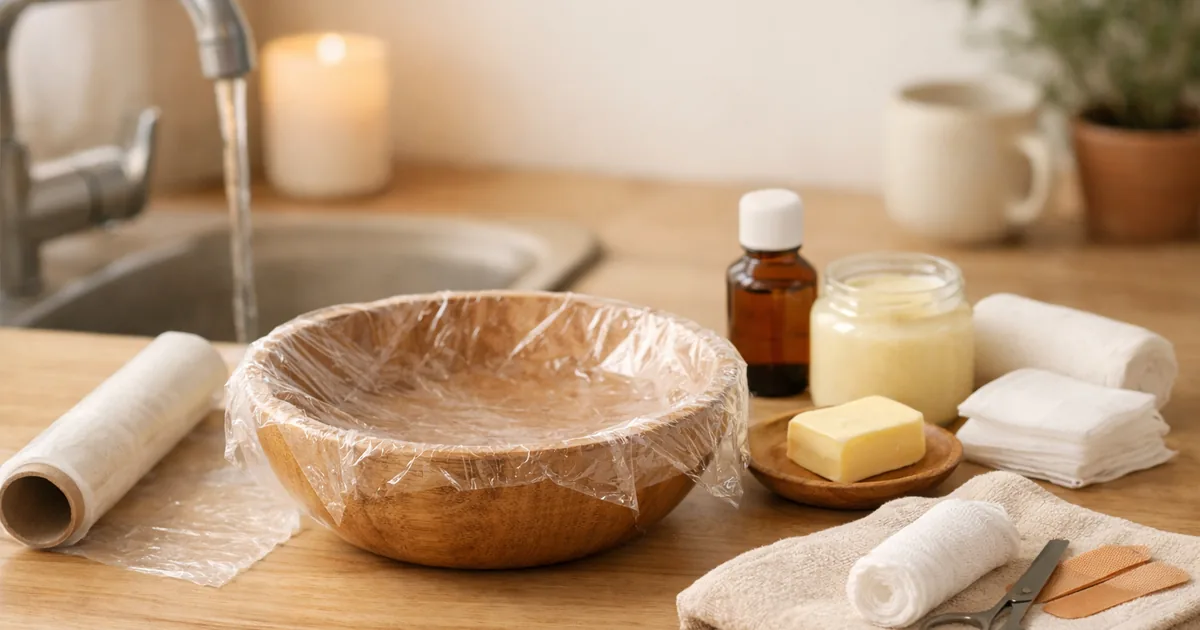
Instant noodle soup, water dispensers, curling irons. The correct response is simple: cool running water for 20 minutes — the NHS says to cool it even if you’re late, as long as it’s within 3 hours.
| Situation | Do | Don't |
|---|---|---|
| Any burn | Cool under cool running water for 20 minutes (within 3 hours); remove nearby clothing and jewellery but nothing stuck to the skin; once cooled, lay cling film over it without wrapping | Creams, oils or butter; plasters or sticky dressings; bursting blisters (NHS) |
| If blisters form | Leave them intact | Bursting blisters (NHS) |
| Go to a hospital when | Very large or deep burns; on the face, genitals or bottom; caused by acid, chemicals or electricity — the NHS criteria for 999 or A&E | Assume ointment alone will fix it |
Cuts and bleeding: pressure first
For a kitchen cut, press on the wound with a clean, folded cloth or bandage; if blood soaks through, add another layer on top rather than lifting it (NHS). The NHS page gives no number of minutes.
- You cannot stop the bleeding → emergency services or A&E
- Blood spurts out, bright red and hard to control → emergency services or A&E
- A very large or deep wound, a bad cut on the face or palm, or something stuck in it such as glass (do not take it out yourself) → emergency services or A&E — all NHS criteria
- The NHS notes you may need a tetanus injection or antibiotics if the cut could be infected
Sprains: PRICE for the first 2 to 3 days (NHS)
For a rolled ankle or twisted wrist, the NHS describes five PRICE steps for the first 2 to 3 days. The table carries four of them in its words.
| Step | How | Caution |
|---|---|---|
| Rest | Stop exercise or activities; try not to put weight on it | — |
| Ice | An ice pack or frozen vegetables wrapped in a tea towel, up to 20 minutes every 2 to 3 hours | Avoid heat (hot baths, heat packs), alcohol and massage for the first couple of days |
| Compression | Wrap a bandage round it for support during the day | — |
| Elevation | Keep it raised on a pillow as much as possible | Avoid strenuous exercise such as running for up to 8 weeks |
Cannot put any weight on it or walk more than a few steps: urgent care (NHS 111 in the UK). Heard a crack, or the part has changed shape or points at an odd angle: emergency services or A&E (NHS). Do not drive yourself.
Nosebleeds: lean forward, not back
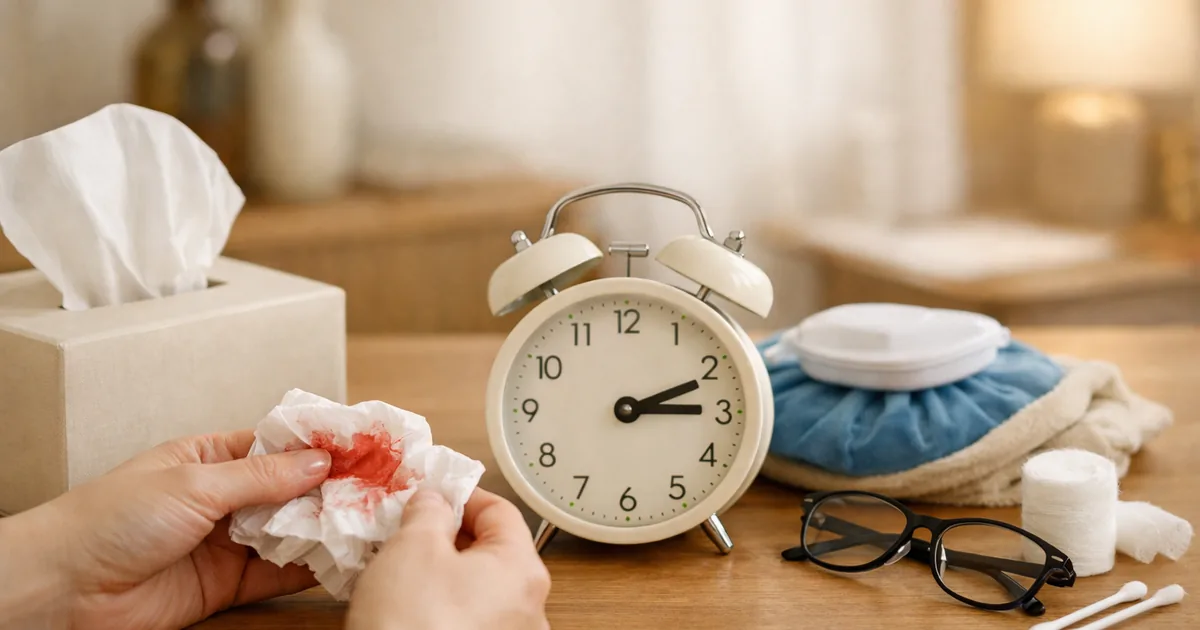
This is the one everyone gets backwards. The NHS says to lean forward, not back: sit, lean forward and pinch just above the nostrils for 10 to 15 minutes. If it lasts longer than 10 to 15 minutes, go to A&E (NHS; see how to stop a nosebleed).
The quietest danger in a home — carbon monoxide
Burns and cuts announce themselves. One thing does not: you cannot see or smell it.
The US Centers for Disease Control and Prevention writes that “each year, more than 400 Americans die from unintentional CO poisoning not linked to fires, more than 100,000 visit an emergency department, and more than 14,000 are hospitalized.”
The symptoms happen to look like a bad cold. The CDC lists headache, dizziness, weakness, upset stomach, vomiting, chest pain and confusion — and describes them as “flu-like.”
That is exactly what makes it dangerous: you lie down to rest and keep breathing it.
One test that separates them: if other people in the same room feel ill at the same time, suspect the air, not a virus. Open windows, get outside, then call.
| Item | What the CDC states |
|---|---|
| Sources inside a home | gas- and oil-burning furnaces · portable generators · charcoal grills · gas ranges · lanterns · fireplaces |
| Detector placement | “near every sleeping area in your home” (battery-operated or battery back-up) |
| Replacement | “following the manufacturer's instructions or every 5 years” |
“Near every sleeping area” is the operative phrase — while you sleep there is nobody to notice the symptoms. This is US guidance. Korea’s rules are set out in our CO alarm article from the fire agency’s standard (NFPC 206): a CO alarm is a “may”, not a “must”, and ordinary homes are not a listed category. Not mandatory is not the same as not needed.
Falls — the numbers are getting worse, not better
The most common household emergency is not dramatic. It is a fall. And this number is not improving.

The CDC reports that among adults 65 and older “over 14 million, or 1 in 4… report falling every year,” and adds that “about 37% of those who fall reported an injury that required medical treatment or restricted their activity for at least one day, resulting in an estimated nine million fall injuries.”
Multiply those two figures and they do not meet.
37% of 14 million is about 5.2 million, not nine million (our calculation).
Counting people who fall more than once in a year would explain it — but the page does not say that.
→ So this article uses “1 in 4” and “37%” only, and leaves the nine-million total out.
These are US statistics. Korean fall data is covered separately in preventing falls in older adults.
Quick-reference table for common situations
| Situation | First action | Never do | Call an ambulance if |
|---|---|---|---|
| Fall (elderly or child) | Keep them comfortable and warm; help them up carefully only if they can get up | Lifting them yourself | May have hurt the head, back, neck or hip, or cannot get up: emergency services (all NHS) |
| Seizure | Move them only if in danger; note when it starts and stops; turn them on their side once the convulsions stop | Putting anything in the mouth, including fingers | A first seizure, over 5 minutes (if their usual length is unknown), not regaining consciousness, seriously injured, or trouble breathing (all NHS) |
| Child choking on an object | If they cough loudly, encourage them to keep coughing and stay with them | Poking blindly with fingers (it can push the object further in) | Silent or weak cough: back blows and thrusts (choking response); still blocked, call emergency services (all NHS) |
| Swallowed medicine or detergent | Take the substance or its packaging to show doctors | Making them sick | You think they swallowed, touched or breathed in something harmful: emergency services or A&E (all NHS) |
| Head injury | An adult stays with them for at least the first 24 hours (sleeping is fine if tired) | Driving yourself to A&E after hitting your head | Knocked out and not woken, cannot stay awake, a seizure, new numbness or weakness: emergency services (all NHS) |
| Suspected stroke | FAST — face, arms, speech, and Time to call 999 | Waiting because the signs have stopped (the NHS says call even if they stopped within 24 hours) | Any one sign: call immediately |


A real-world example: a child spills hot soup
Your 4-year-old pulls a bowl of hot soup onto their arm. ① Carry them straight to the bathroom and hold the arm under cool running water. Remove nearby clothing, but leave anything stuck to the skin. ② Keep cooling for 20 minutes while another adult gets ready to leave for the hospital. ③ Once cooled, lay cling film over it without wrapping, and don't burst blisters. ④ A large or deep burn means A&E (NHS). The NHS page we read gives no size at which to take a child in. Knowing which ER is open before you need one helps — see ER or clinic: how to decide.
Home emergency-readiness checklist
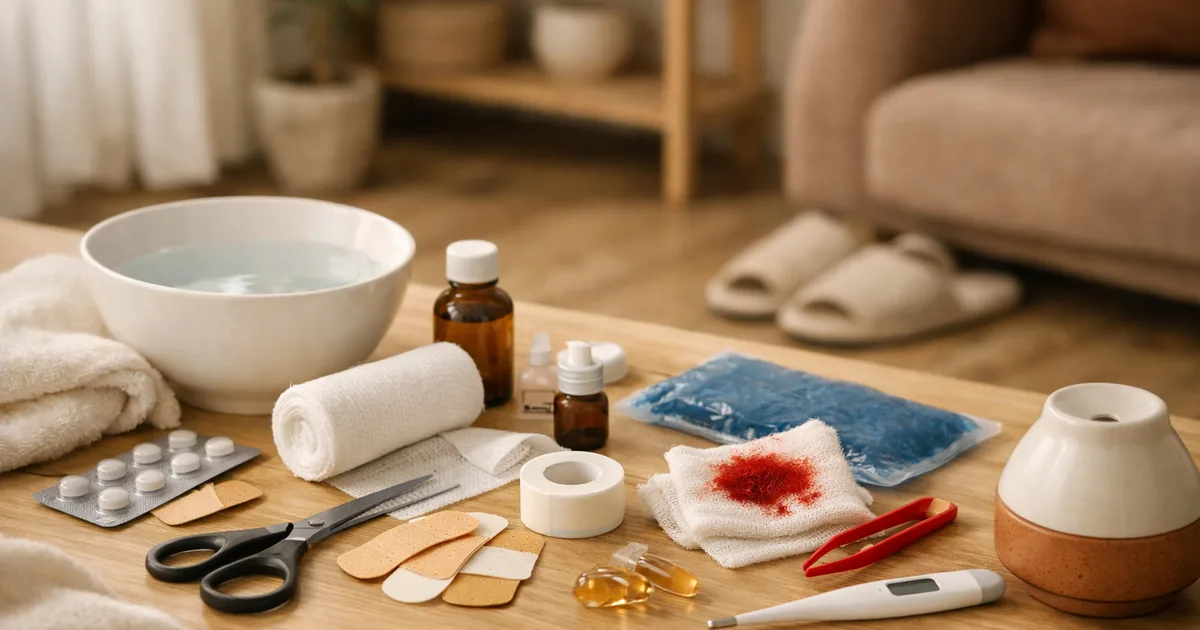
- ☐ First-aid kit stocked: sterile gauze, bandages, antiseptic, fever reducer (see our first-aid kit guide)
- ☐ Everyone in the family knows the emergency call script: address → symptoms → age/sex → follow instructions
- ☐ Medication list and allergies posted on the fridge (where paramedics look)
- ☐ Button batteries, magnets, and detergents stored out of children's reach
- ☐ For elderly family: non-slip bath mats and night lights installed
- ☐ At least one adult in the house has learned CPR
Key point. First aid isn't treatment — it's keeping things from getting worse until professionals take over. For burns, the NHS says not to put creams, oils or butter on them. Cool it, press it, keep them still, and call for advice.
TV and furniture tip-overs (TVs in 70% of child deaths) are in TV and furniture tip-overs.
Questions that remain
Povidone-iodine or hydrogen peroxide for cuts?
For minor wounds, washing with running water and soap comes first. If you disinfect, apply povidone-iodine around the wound. Hydrogen peroxide irritates healthy tissue and can slow healing, so it's no longer commonly recommended.
Can I put burn ointment on right away?
Cool it with water first. The NHS says not to put creams, oils or butter on burns, and to use an emollient if the area becomes itchy and dry as it heals. Don't burst blisters.
My child fell, cried, then went right back to playing. Hospital or not?
The NHS says an adult should stay with them for at least the first 24 hours after a head injury, and that they do not need to stay awake if tired. Vomiting or dizziness: get advice (NHS 111 in the UK); knocked out, unable to stay awake, or a seizure: emergency services. Symptoms can last up to 2 weeks; longer than that, see a doctor. When unsure, call your local medical advice line.
An elderly parent fell but insists they're fine.
The NHS says not to lift someone who has fallen yourself, and to keep them comfortable and warm. Call emergency services if they may have hurt the head, back, neck or hip or cannot get up; get advice (NHS 111 in the UK) if they may be in pain or injured. Anyone who has had a fall should see a GP about balance and mobility. For prevention, see our guide on preventing falls in older adults.
Home first aid comes down to: cool it, press it, roll them sideways, and never force things out or force vomiting. And when you're not sure — call and ask.
Two things to read before winter — KDCA figures showing cold-related illness happens indoors too are in cold-related illness, and whether an extinguisher is a legal duty at home or in your car is in fire extinguishers.
For a nosebleed, the NHS says to sit, lean forward and pinch above the nostrils for 10 to 15 minutes — longer than that, go to A&E (how to stop a nosebleed).
The NHS says to cool a burn for 20 minutes, within 3 hours, then cover it with cling film (burns and scalds).
Sources
- US Centers for Disease Control and Prevention — carbon monoxide poisoning (checked July 2026). Source for “more than 400 Americans die… more than 100,000 visit an emergency department, and more than 14,000 are hospitalized,” the symptom list and the word “flu-like,” the household sources, “near every sleeping area in your home,” and “following the manufacturer's instructions or every 5 years.”
- US Centers for Disease Control and Prevention — falls data (checked July 2026). Source for “over 14 million, or 1 in 4,” “about 37%… required medical treatment or restricted their activity,” and the age-adjusted fall death rate of 64.7 (2018) rising to 78.4 (2024), a 21% increase.
- Our own calculation. 37% of 14 million ≈ 5.2 million is our multiplication of those two figures, and so is the observation that it does not match the CDC's own “nine million.”
- NHS — Burns and scalds (page shows: reviewed 31 March 2026; checked 14 October 2026). Source for cooling a burn under cool running water for “20 minutes”, “within 3 hours”. This post first said “15–20 minutes” without a source; on 14 October 2026 we aligned it with the NHS figure. On 15 October 2026 we removed unsourced lines — “ice worsens tissue damage”, toothpaste and folk remedies, “larger than the palm”, “bigger than a large coin”, and “pour water over stuck clothing and cut it away” — and replaced them with the same page's wording (no creams, oils or butter; leave anything stuck; cover with cling film; the 999 and A&E criteria). The nosebleed “10 minutes” and “20 minutes” now follow the NHS nosebleed page's “10 to 15 minutes” (checked 15 October 2026). Details in burns and scalds.
- NHS — Sprains and strains (reviewed 23 April 2024), Cuts and grazes (2 April 2026), Head injury and concussion (29 May 2025), Stroke symptoms (12 September 2024), Poisoning (12 June 2025) — all checked 15 October 2026. Source for PRICE and for the bleeding, head, stroke and poisoning emergency criteria. This post first gave, without a source, “pressure does 90%”, “at least 10 minutes”, “stitches within hours”, “48 hours of RICE, 15–20 minutes”, “watch 24–48 hours”, “don't let them sleep”, the stroke treatment window and “burns the esophagus”. Some differed from the NHS (it says sleeping after a head injury is fine) and others were not in it, so on 15 October 2026 we replaced them. Later that day we also read NHS Falls (reviewed 6 March 2025), What to do if someone has a seizure (19 December 2023) and How to stop a child from choking (28 October 2024), and rewrote the fall, seizure and choking rows and the older-adult fall answer from them — “hold the body down”, “coins, magnets and button batteries need a hospital even without symptoms” and “falls often hide hip fractures” were not in them and were removed.
Where to check further
- Home-accident statistics for your own country. Every figure here is US CDC data — treat the proportions as indicative and do not transplant the counts. Korea's equivalents are in National Fire Agency and KDCA National Injury Information Portal statistics.
- Local carbon monoxide alarm requirements. The “one outside each sleeping area” and “replace every 5 years” here are US standards. Korea's rules are set out provision by provision in our CO alarm article — ordinary homes are not a mandated category there.
- A figure that does not reconcile inside the CDC page. 37% of 14 million is 5.2 million, yet the same sentence says “about 9 million.” Counting repeat fallers would explain it, but no explanation is given, so the 9 million is not used here. Worth knowing if you read the original.
As of July 2026. The carbon monoxide and falls figures come from CDC source text; catching the arithmetic that does not add up is ours. This is general first-aid information and does not replace professional medical care. In a real emergency, follow emergency services and medical staff.