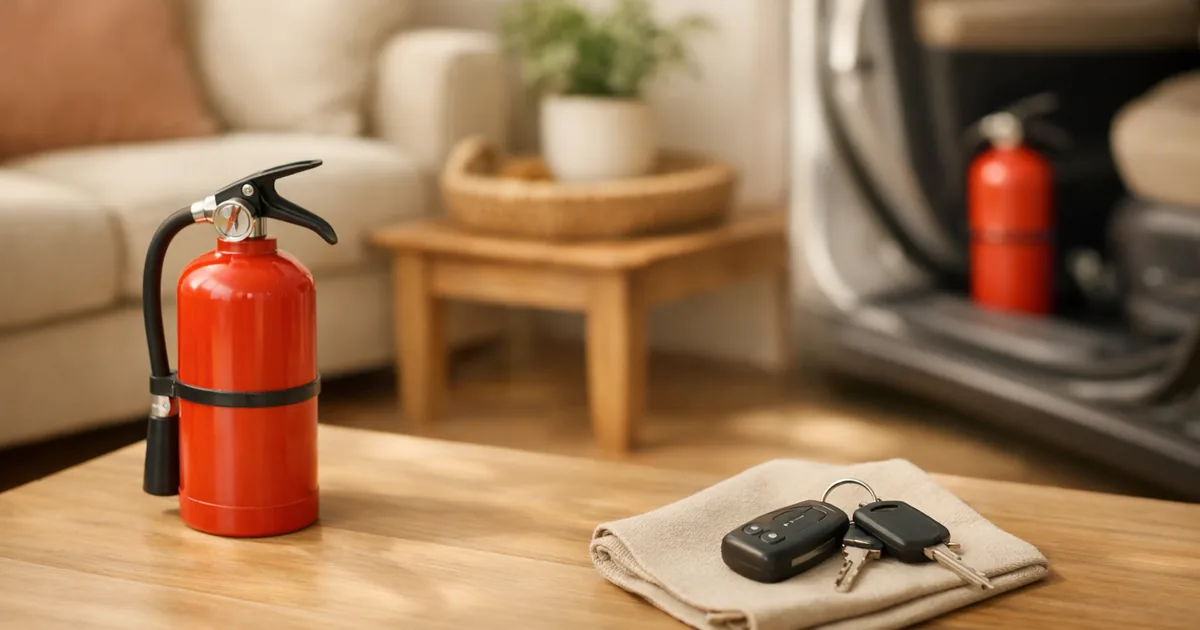
As winter approaches you often hear “keep a fire extinguisher at home”. It sounds like advice, but Korean law makes it a legal duty for some homes — and not for others. Cars work the same way: the car you have driven for years carries no duty, yet whoever buys it from you second-hand does. This article reads two articles of Korea’s Act on the Installation and Management of Firefighting Systems, with its Decree and the annex to its Rule.
1. Apartments are excluded. Owners of detached and multi-unit houses must install a fire extinguisher and a stand-alone smoke alarm, but the Act adds in brackets “excluding apartments and dormitories”. Row houses, multi-household villas and detached houses are covered.
2. For cars, the registration date decides. The duty to carry a vehicle extinguisher in passenger cars with five or more seats (and other vehicles) started on 1 December 2024, and applies to vehicles made or sold after that date and vehicles re-registered after a change of ownership.
3. There is no fine. The list of fines in article 61 of the same Act does not include breaches of either duty — yet 34.9% of fire deaths fall in December to February.
For foreign residents: these duties attach to the owner of the house or car, not the nationality of the person. If you rent a villa, the duty sits with your landlord.
Is my home covered? One bracket in the Act
Article 10 (Firefighting systems installed in housing) (1) The owner of any of the following houses shall install firefighting systems prescribed by Presidential Decree, such as fire extinguishers (“residential firefighting systems”):
1. a detached house under the Building Act;
2. a multi-unit house under the Building Act (excluding apartments and dormitories).
(3) Installation standards and voluntary safety management for residential firefighting systems … shall be prescribed by the ordinances of the metropolitan cities and provinces.
Article 10 of the Enforcement Decree then fixes those systems as “fire extinguishers and stand-alone smoke alarms” — just the two.
| Where you live | Covered by article 10? | What must be there |
|---|---|---|
| Detached house (incl. multi-household dagagu) | Yes | Extinguisher + stand-alone smoke alarm |
| Row house or multi-unit villa (yeollip, dasedae) | Yes | Extinguisher + stand-alone smoke alarm |
| Apartment | No | Follows the building-wide fire system standards instead |
| Dormitory | No | As above |
Under the Building Act classification, a multi-household dagagu house counts as detached housing and row houses and villas as multi-unit housing. The duty falls on the owner, not the tenant. How many and where is left to provincial ordinances, which were not opened for this article.
A tenant can use this: before renting a villa or dagagu unit, check that an extinguisher and a smoke alarm are there. The duty is the landlord’s, so their absence is a fair thing to raise. What else to check on a lease is in the lease checklist. If the home has a gas boiler, the carbon monoxide alarm is a separate standard worth reading too.
Is my car covered? Two routes after 1 December 2024
Article 11 (Extinguishers installed or carried in vehicles) (1) A person who intends to manufacture, assemble, import or sell any of the following vehicles, or the owner of such a vehicle, shall install or carry a vehicle fire extinguisher:
1. passenger cars with five or more seats; 2. vans and buses; 3. trucks; 4. special vehicles.
The article came in with the full revision of 30 November 2021, but the proviso to article 1 of the addenda says “article 11 enters into force three years after promulgation” — 1 December 2024. Article 3 of the addenda says whom it applies to:
Addenda, article 3 (Application) Article 11 applies from vehicles manufactured, assembled, imported or sold after it enters into force and vehicles registered following a change of ownership under the Motor Vehicle Management Act.
| Your car | Article 11 applies? | Why |
|---|---|---|
| Bought new after 1 December 2024 | Yes | Sold after entry into force |
| Bought second-hand after 1 December 2024 and re-registered | Yes | Registered after a change of ownership |
| Owned by the same person since before then | No | Neither route in addenda article 3 |
| Passenger car with four seats or fewer | No | Item 1 covers five seats or more |
So the car you have long owned carries no duty, but when you sell it the buyer takes on the duty the moment they re-register it. That is why an extinguisher belongs in any used-car deal. Paragraph (3) has the transport ministry check for it at the periodic vehicle inspection and report the results to the fire agency by 31 December each year. Car taxes and running costs are in the car tax guide.
How many and what kind — Annex 2 of the Rule
Article 14 of the Enforcement Rule refers to Annex 2, whose first sentence matters: vehicles must carry a “vehicle fire extinguisher that has received type approval”. A household extinguisher is not enough; it must be type-approved for vehicles.
| Vehicle | Standard | Where |
|---|---|---|
| Passenger car | At least one of rating 1 or above | Somewhere easy to use |
| Light van | At least one of rating 1 or above | Somewhere easy to use |
| Van/bus up to 15 seats | One of rating 2+ or two of rating 1+ | 11+ seats: at least one by the driver’s (or adjacent) seat |
| Bus 16–35 seats | Two of rating 2 or above | Over 23 seats and 2.3 m wide: one near the driver |
| Bus 36+ seats | One of rating 3+ and one of rating 2+ | Double-deckers: an extra rating 3+ upstairs |
| Truck/special, medium or smaller | At least one of rating 1 or above | Somewhere easy to use |
| Truck/special, large or bigger | One of rating 2+ or two of rating 1+ | Somewhere easy to use |
Enforcement Rule [Annex 2], standards for installing or carrying vehicle fire extinguishers. Special vehicles carrying hazardous materials or high-pressure gas follow the Hazardous Materials Safety Control Act rules instead.
For an ordinary car the answer is simple — one type-approved vehicle extinguisher, within reach. Buried at the back of the boot, it does not meet “somewhere easy to use”.
Why before winter — the fire agency’s figures
Five-year (2020–2024) figures from the National Fire Agency’s winter prevention plan of 3 November 2025:
| Item | Winter (Dec–Feb) | Meaning |
|---|---|---|
| Fires per year | 10,884 | 28.2% of the year’s fires |
| Share of fire deaths | 34.9% | Three months, over a third of deaths |
| 2025–26 target | 10% fewer fire deaths | 131 → 117 |
Three winter months are 25% of the year but 28.2% of fires and 34.9% of deaths (the 25% is our comparison). In the same plan the agency listed wider provision of residential fire systems (alarms and extinguishers) and a “make a home escape plan” campaign. Holiday fire figures from cooking and electrical causes are in holiday safety accidents.
Three worked cases
- Owner of a dagagu studio building — as the owner, article 10 applies. How many per unit and where depends on the provincial ordinance.
- A family in an apartment — not covered by article 10. The winter figure of 34.9% of deaths still applies; an extinguisher is a choice, not a duty.
- Bought a used SUV in spring 2025 — re-registered after 1 December 2024, so article 11 applies: one type-approved vehicle extinguisher within reach of the driver.
Checklist
- ☐ Is your home detached, dagagu, row house or villa? (Apartments and dormitories are outside article 10)
- ☐ Are both an extinguisher and a stand-alone smoke alarm there?
- ☐ Renting? Check with the landlord before signing — the duty is the owner’s
- ☐ Did you acquire your car (new or used) after 1 December 2024?
- ☐ Is the extinguisher in the car type-approved for vehicles?
- ☐ Keep it within reach, not deep in the boot
- ☐ Gas boiler at home? A carbon monoxide alarm is a separate item
Questions that remain
Why are apartments exempt?
Article 10(1)(2) excludes “apartments and dormitories” from multi-unit housing. Apartments follow building-wide fire system standards, which this article does not cover.
Is there a fine for not having one?
The list of fines in article 61 (paragraph 1, items 1–15) does not include breaches of article 10 or 11 (current Act as of 29 September 2026). Article 11 does, however, have compliance checked at vehicle inspections.
Can I put my household extinguisher in the car?
Annex 2 requires a “vehicle fire extinguisher that has received type approval”. Check the label for the vehicle approval.
Does it cover small cars?
Passenger cars are covered from five seats. The seat count is on your vehicle registration certificate. Light vans have their own line in the annex.
Must I buy one for a car I have owned for years?
Under addenda article 3, a car held by the same person since before 1 December 2024 is not covered. The duty arrives when it is sold or you buy another. Being prepared for fire is a separate, voluntary choice.
Sources
- Act on the Installation and Management of Firefighting Systems [in force 1 Dec 2024] [Act No. 18522] — statute text (checked 29 September 2026). Source for article 10 (residential systems; apartments and dormitories excluded; provincial ordinances), article 11 (vehicle extinguishers; five seats and up; checks at inspection), article 61 (list of fines), and addenda articles 1 (three-year delay) and 3 (application).
- Enforcement Decree [in force 1 Jul 2026] — article 10, “fire extinguishers and stand-alone smoke alarms”.
- Enforcement Rule [in force 1 Jul 2026] — article 14 and [Annex 2] vehicle extinguisher standards.
- National Fire Agency release — winter fire prevention plan, aiming at 10% fewer fire deaths (3 November 2025). Source for 10,884 winter fires a year, 28.2%, 34.9% of deaths, the 131 → 117 target, residential fire systems and the home escape plan campaign.
- Our arithmetic. Three months being 25% of the year is our comparison.
Where to check further
- Number and placement of home devices — set by provincial ordinance; ask your local fire station or check the provincial website.
- Apartment fire system standards — the building management office is quickest.
- Vehicle type approval — look for the vehicle marking on the product label.
Written 29 September 2026. Statute text is as published on the National Law Information Center; the tables and examples are ours. In a house fire, escaping and calling 119 come before the extinguisher. Other household emergencies are in emergencies at home and the home medicine kit.