Cooking is the biggest cause of home fires. The US Fire Administration (USFA) says cooking is the leading cause of home fires and home fire injuries; in 2021 US fire departments attended about 170,000 home cooking fires, with about 135 deaths and 3,000 injuries. The top factor in cooking fires that spread was unattended equipment (37%). This sets out the USFA tips and how to smother a small pan fire.
1. Stay by your pan, and turn the burner off if you leave. 37% of spreading cooking fires involved unattended equipment.
2. See smoke or boiling grease? Turn the burner off.
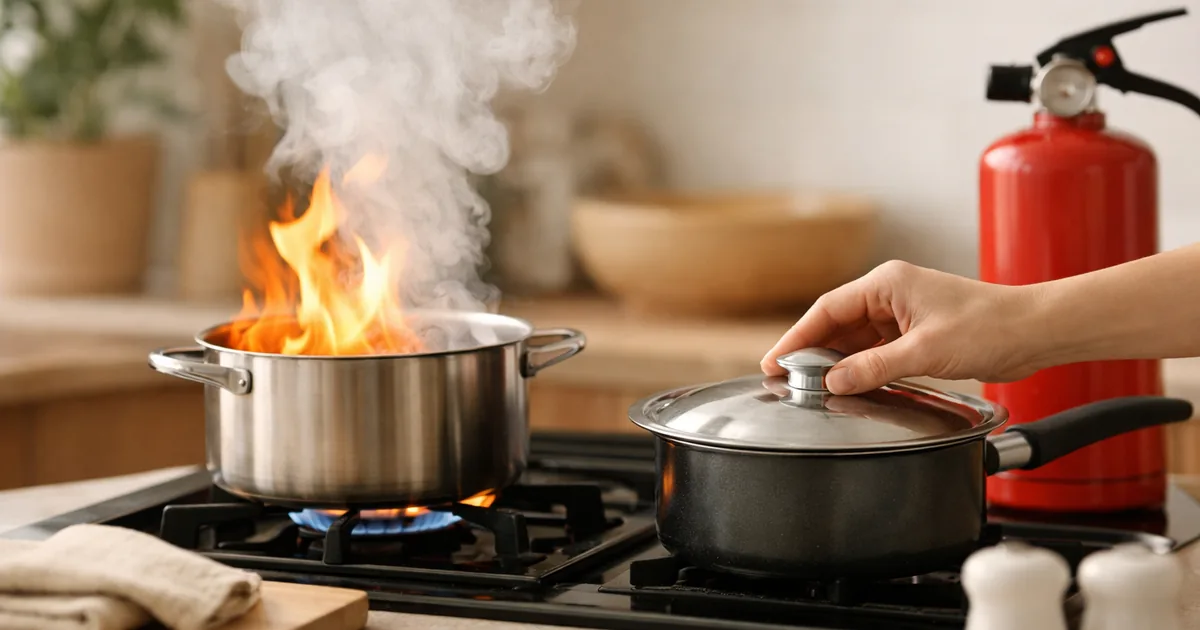
3. Smother a small pan fire by sliding a lid or baking sheet over it.
Cooking safety — USFA
| Type | What the source says | Worth noting (ours) |
|---|---|---|
| Stay | Stay by your pan; if you leave, turn it off | — |
| Heat | Fires often start when heat is too high; smoke or boiling grease means turn it off | — |
| Handles | Turn handles to the back so they can’t be bumped or pulled | — |
| Clear | Keep anything that can burn away from the stovetop | Tea towels, paper towels (our note) |
| Alarm | A smoke alarm about 10 feet from the stove (USFA graphic) | About 3 m (our conversion) |
| Cords | No extension cords for kitchen appliances | — |
A small pan fire — USFA
The USFA says to keep a pan lid or baking sheet nearby and, if a fire starts, slide it over the pan, which will put it out. This page doesn’t cover water, oven or microwave fires, or when to evacuate.
When to use an extinguisher — USFA
| Type | What the source says | Worth noting (ours) |
|---|---|---|
| 1 | Others in the building have been alerted | — |
| 2 | Someone has called the fire department | 119 in Korea (our note) |
| 3 | You’re physically able — not young children or older adults | — |
| 4 | The fire is small and contained to one object (a pan, a wastebasket) | — |
| 5 | You’re safe from toxic smoke | — |
| 6 | There’s a clear way out | — |
If any answer is no, or you’re unsure, alert others, leave and call, says the USFA. To use one: PASS — Pull the pin, Aim low at the base of the fire, Squeeze slowly and evenly, Sweep side to side. Grease is class B; most homes suit an A-B-C multipurpose extinguisher (USFA extinguisher page, reviewed 1 April 2023).
Cooking fires in numbers — USFA (US, 2021)
| Item | USFA figure | Worth noting (ours) |
|---|---|---|
| Home cooking fires attended | About 170,000 | US figures |
| Deaths | About 135 | — |
| Injuries | About 3,000 | — |
| Property loss | Over $494 million | — |
| Top factor in spreading cooking fires | Unattended equipment, 37% | — |
Extinguishers are in home and car extinguishers; first aid for burns in burns and scalds; alarm care in smoke alarm testing.
Checklist
- ☐ Never leave the hob on unattended
- ☐ Smoke or boiling grease: turn it off
- ☐ Handles turned in
- ☐ Nothing flammable near the stove
- ☐ A lid or baking sheet within reach
Tree, light and candle safety is in holiday decorating safety.
Questions that remain
Can I pour water on a grease fire?
This USFA page only says to slide a lid over it; it doesn’t address water. See the extinguisher post for extinguisher types.
Are Korean figures similar?
These are US figures for 2021; we didn’t read Korean fire statistics this time.
Sources
- US Fire Administration (USFA) — Cooking Fire Safety — source (reviewed 28 September 2026; checked 19 October 2026). 2021 cooking fire statistics, six safety tips, smothering a small pan fire. The six conditions and PASS come from the USFA Fire Extinguishers page (reviewed 1 April 2023).
- Not read. USFA pages on appliances, extinguishers and burns; Korean statistics.
- What we added. The “worth noting” column and the Korean everyday gloss.
Where to check further
- Your local fire station — kitchen extinguishers and evacuation.
Written on 19 October 2026. The content is from the source; the glosses are ours.