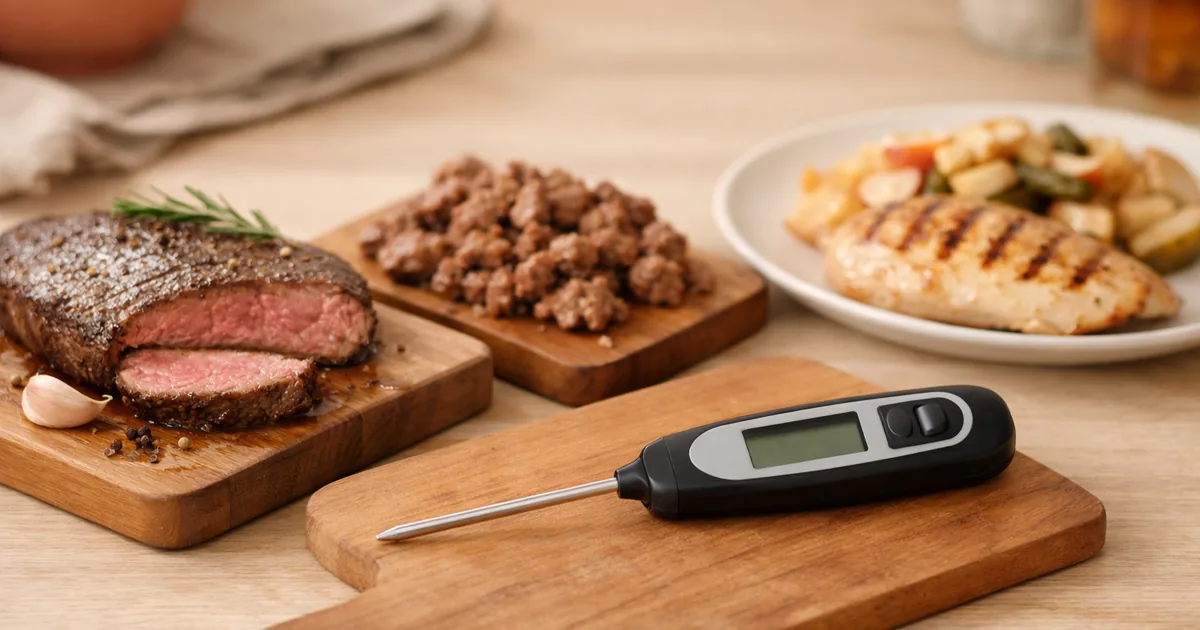
Is meat done when it looks brown? FoodSafety.gov, the US government food safety site, says check with a food thermometer, not colour or juices, and keeps a chart of safe minimum internal temperatures. Beef and pork steaks and fish: 145°F (63°C); ground meat and egg dishes: 160°F (71°C); all poultry and leftovers: 165°F (74°C). Steaks, chops and raw ham then rest for 3 minutes. Our checker gives the target and judges your thermometer reading.
1. 145°F (63°C) — beef, pork, lamb steaks, roasts, chops (rest 3 minutes); fish.
2. 160°F (71°C) — ground meat and sausage, egg dishes, rabbit and venison.
3. 165°F (74°C) — all poultry, casseroles, reheated leftovers.
Updates as you choose. Values are copied from the FoodSafety.gov chart; Celsius is the chart’s own rounded figure, so check in the unit you choose. Shellfish has no temperature on the chart and is left out.
Minimum internal temperatures — FoodSafety.gov
| Food | Minimum | Worth noting (ours) |
|---|---|---|
| Beef, veal, lamb steaks, roasts, chops | 145°F (63°C), rest 3 minutes | 145°F = 62.8°C (our sum) |
| Ground meat and sausage (beef, pork, veal, lamb) | 160°F (71°C) | Grinding mixes surface germs in (ours) |
| Pork steaks, chops, roasts | 145°F (63°C), rest 3 minutes | Ground pork is 160°F |
| Raw ham / precooked ham | Raw 145°F (63°C), 3 minutes / reheat 165°F (74°C) | USDA-plant packaged: 140°F (60°C) |
| All poultry (incl. ground, stuffing) | 165°F (74°C) | 165°F = 73.9°C (our sum) |
| Eggs / egg dishes | Until yolk and white are firm / 160°F (71°C) | — |
| Casseroles, leftovers | 165°F (74°C) | See the leftovers link below |
| Fin fish | 145°F (63°C) or opaque and flakes with a fork | — |
| Shrimp, lobster, crab, scallops | Flesh pearly and opaque | No number given |
| Clams, oysters, mussels | Until shells open | — |
| Rabbit, venison | 160°F (71°C) | — |
Fahrenheit is the original; Celsius is the chart’s rounding. Converted, 145°F is 62.8°C, 160°F is 71.1°C and 165°F is 73.9°C (our sums), so the checker compares in the unit you choose.
Why “rest 3 minutes” (our reading)
Rest time is how long meat stands after leaving the heat. The chart attaches 3 minutes only to steaks, roasts, chops and raw ham, not to ground meat, poultry or egg dishes, which instead have higher targets (71°C, 74°C). “63°C plus 3 minutes” and “71°C or 74°C straight away” are separate rules for different foods, not interchangeable.
Using a thermometer — the “4 steps” page
The same site’s 4 Steps to Food Safety says put the thermometer in the thickest part, keep hot food at 140°F (60°C) or above, and microwave to 165°F (74°C), stirring and letting it stand. The danger zone is 40–140°F (4–60°C). The four steps are in four steps to food safety.
In a Korean kitchen (ours)
Most meat thermometers sold in Korea read in Celsius, so leave the checker on °C. Thin-sliced pork belly is hard to probe and the chart has no thin-cut rule; measuring the thickest slice is the closest reading of “thickest part”. Chicken is 74°C whatever the cut; dumpling filling of ground pork is 71°C.
How long to keep and how to reheat leftovers is in leftovers; cooking fires in kitchen fire safety.
Checklist
- ☐ Thermometer, not colour or juices
- ☐ Thickest part
- ☐ Steaks, chops, raw ham: 63°C then 3 minutes
- ☐ Ground meat 71°C; poultry and leftovers 74°C
- ☐ Hot food held at 60°C or above
Questions that remain
What about medium-rare steak?
The chart gives only the 63°C minimum and 3-minute rest; nothing lower.
Which thermometer?
The page doesn’t recommend a type.
Sources
- FoodSafety.gov (US HHS) — Safe Minimum Internal Temperatures — source (reviewed 21 November 2024; checked 20 October 2026). Minimum temperatures and rest times, shellfish doneness, two kinds of ham.
- FoodSafety.gov — 4 Steps to Food Safety — source (reviewed 18 September 2023; checked 20 October 2026). Thickest part, holding at 60°C, danger zone, microwave to 74°C.
- Not read. Individual USDA FSIS pages; Korean MFDS cooking rules.
- What we added. The “worth noting” column and the Korean everyday gloss.
Written on 20 October 2026. The content is from the source; the glosses are ours.