A house fire leaves less time than you think. On its “Home Fire Escape Plans” page the US Fire Administration (USFA) says residents could have less than 2 minutes to escape a home fire once the smoke alarm sounds, and that modern contents and open layouts make home fires more severe, so people must be ready to leave immediately. It asks households to make an escape plan and practise it together, and its “Plan 2 Ways Out!” infographic sets out 7 steps, built around 2 ways out of every room. Here they are, with the USFA high-rise rules and what to do if fire or smoke keeps you in.
1. Less than 2 minutes after the alarm — leave at once by the route you planned.
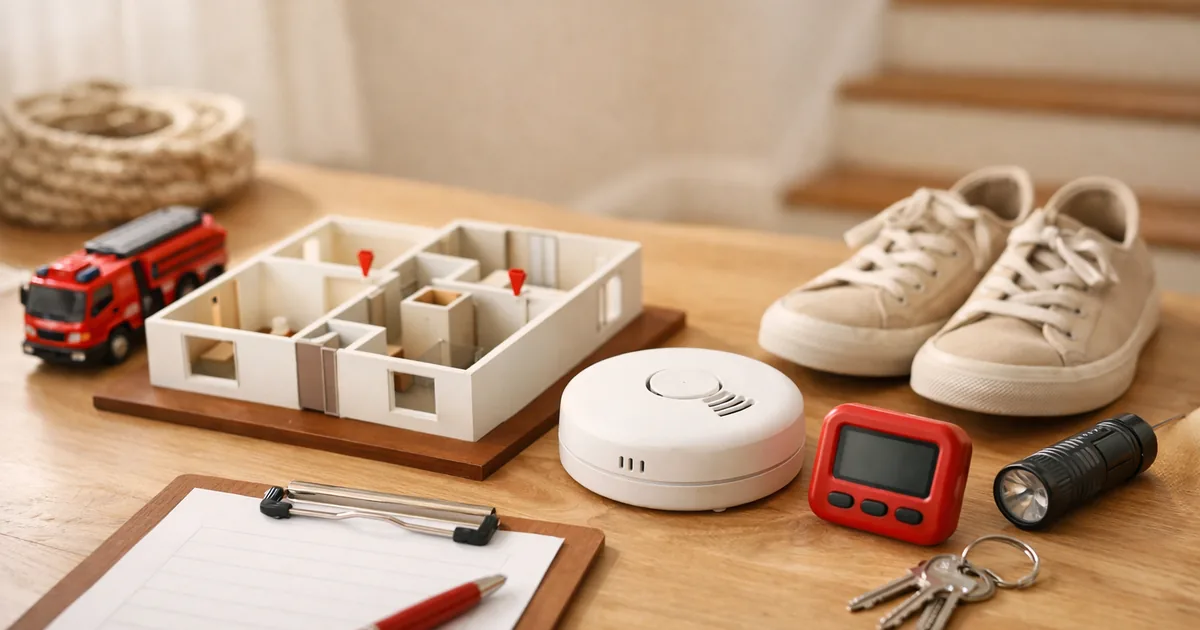
2. Draw a home map, find 2 ways out of every room, pick an outside meeting place in front of the home, and practise together.
3. In an apartment: close the door behind you, pull the fire alarm, take the stairs — no elevator unless the fire department says so.
Seven steps — USFA “Plan 2 Ways Out!”
| Step | What the USFA says | Worth noting (ours) |
|---|---|---|
| 1 | Draw a map of your home, with all doors and windows | — |
| 2 | Find two ways out of every room | A door, plus a window or balcony side |
| 3 | Make sure doors and windows aren’t blocked | Watch windows behind boxes or furniture |
| 4 | Choose an outside meeting place in front of your home | For an apartment, one agreed spot in the complex |
| 5 | Push the test button to sound the smoke alarm | Can everyone hear and recognise it? |
| 6 | Practise your drill with everyone in the home | — |
| 7 | Get outside to your meeting place | — |
The USFA page lists the same seven points, in the same order, under “making and practicing your fire escape plan”. The infographic asks “How fast does fire move? Very fast” before the 2 minutes. Two minutes is 120 seconds (our conversion). Those 2 minutes start only if the alarm works, which links to the monthly test in smoke alarms.
Apartments and high-rises — USFA
The USFA says fires in high-rise and condominium buildings are especially dangerous, and asks residents to know where all the exit stairs are.
| Type | What the source says | Worth noting (ours) |
|---|---|---|
| Leave | Leave your apartment and close the door behind you | — |
| Alarm | Pull the fire alarm on your way out to alert the fire department and neighbours | The manual call point in Korean blocks (ours) |
| Stairs | Use the stairs; no elevator unless the fire department directs | — |
| Meeting place | Go to your outside meeting place and stay there; call the fire department and tell them if anyone is trapped | 119 in Korea |
If you can’t get out — USFA high-rise infographic
| Type | What the source says | Worth noting (ours) |
|---|---|---|
| Keep smoke out | If fire, smoke or a disability stops you leaving, stuff wet towels or sheets around the door and vents | — |
| Call | Call 911 and say where you are; clearing the building can take a while, so stay on the phone to help them find you | 119 in Korea (ours) |
| Signal | Open a window slightly and hang a bright cloth outside | — |
| Close it | Close the window again so air doesn’t pull smoke into the room | — |
Whether to use an extinguisher or just get out is in home and car fire extinguishers.
Applied to a Korean apartment — our note
The USFA rules assume US houses, but the high-rise rules fit Korean apartments directly. Three things to try at home, as we see it: mark two ways out of every room on a home map with the family; make sure everyone knows where the exit stairs are; and talk through the wet-towel, call, signal order for when you can’t get out. Korean-only features such as breakable partition walls and refuge spaces aren’t covered here; see building management (our note).
Checklist
- ☐ Home map with doors, windows and 2 ways out of every room
- ☐ Doors and windows not blocked
- ☐ Outside meeting place in front of the home
- ☐ Drill with everyone, started by the alarm test button
- ☐ Apartment: exit stairs, close the door, pull the alarm, no elevator
- ☐ Trapped: wet towels, call and stay on the line, bright cloth
Questions that remain
How often should we practise?
Neither the USFA page nor the infographic we read gives a number; “practice with everyone in the home” is as far as it goes.
What about children, older people or family with disabilities?
The USFA page links separate pages for them, which we didn’t read this time. The high-rise infographic says that if a disability stops you leaving, you should still keep smoke out, call and signal.
Sources
- US Fire Administration (USFA) — Home Fire Escape Plans — source (page last reviewed 10 April 2025; checked 27 October 2026). Less than 2 minutes after the alarm, why home fires are more severe, seven plan-and-practise points, four high-rise rules.
- USFA — Every Second Counts: Plan 2 Ways Out! (infographic) — PDF (undated; checked 27 October 2026). 2 minutes, 7 steps.
- USFA — High-Rise Apartment and Condominium Fire Safety (infographic) — PDF (undated; checked 27 October 2026). Exit stairs, how to leave, and wet towels, calling, a bright cloth and closing the window if you can’t.
- Not read. The linked pages on children, older adults, disabilities and hoarding; videos; Korean apartment evacuation standards.
- What we added. The “worth noting” column and the Korean everyday gloss.
Where to check further
- Building management — exit stairs, refuge spaces, alarm points.
- Your local fire station — fire safety education and drills.
Written on 27 October 2026. The content is from the source; the glosses are ours.