Winter, with heaters running, is when electrical fires stack up. The US Fire Administration (USFA) electrical fire safety infographic says home electrical fire deaths peak in December and January, and between midnight and 8 a.m. Its “Appliance and Electrical Fire Safety” page says that in 2021 an estimated 24,200 residential building electrical fires were reported to US fire departments, causing an estimated 295 deaths, 900 injuries and over $1.2 billion in property loss. Here are the USFA rules on outlets, extension cords, power strips and appliances, plus the infographic’s rule of one heat-producing appliance per wall outlet at a time.
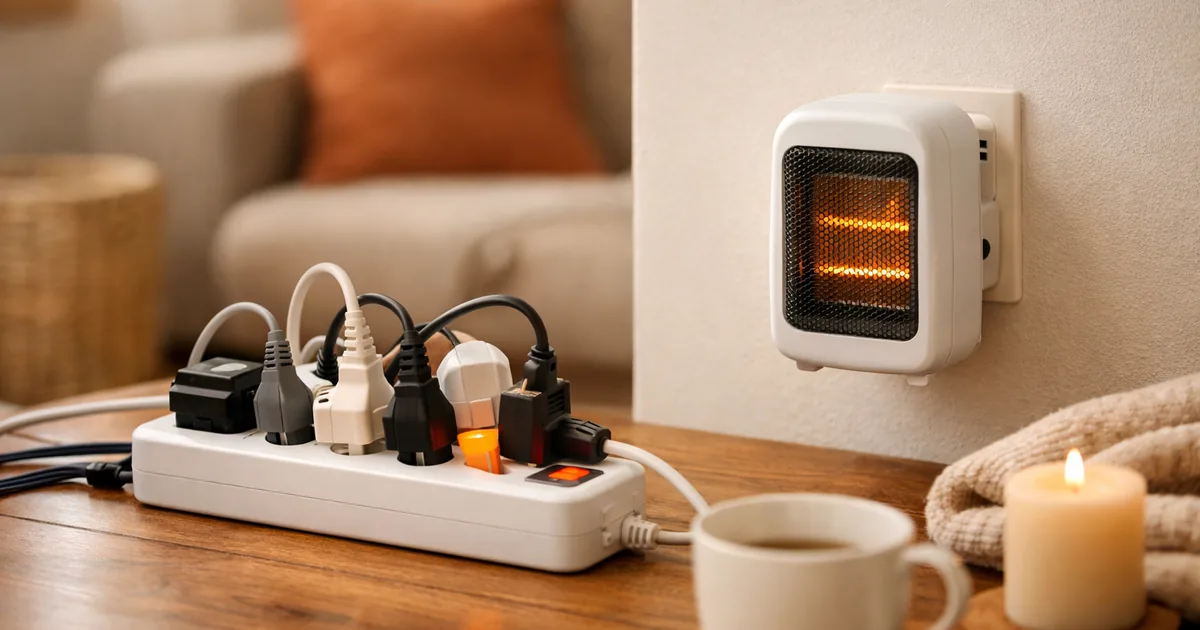
1. Don’t overload outlets or power strips — use strips with internal overload protection.
2. Plug only 1 heat-producing appliance — coffee maker, space heater, microwave — into a wall outlet at a time, never on an extension cord.
3. Replace worn or damaged extension cords right away; keep cords out from under carpets and rugs.
The numbers — USFA
| Figure | What the USFA says | Worth noting (ours) |
|---|---|---|
| Residential building electrical fires, 2021 | About 24,200; about 295 deaths, 900 injuries, over $1.2 billion loss | About 66 a day; about 12.2 deaths per 1,000 fires (our sums) |
| Home electrical fires a year (infographic) | About 47,000 | No year or basis given, so it seems to count differently from 24,200 (ours) |
| Cause | Half involve home wiring or lighting equipment | — |
| Time and month | Deaths peak midnight to 8 a.m., and in December and January | Sleeping hours and heating season |
Outlets — USFA
| Type | What the source says | Worth noting (ours) |
|---|---|---|
| Overload | Don’t overload outlets | — |
| Plugging in | Insert plugs fully | — |
| 3-prong | Never force a 3-prong cord into a 2-slot outlet | In Korea, think grounded plug and socket (ours) |
| Children | Install tamper-resistant outlets with young children | — |
| Loose fit | Replace outlets where plugs don’t fit snugly | — |
Extension cords, power strips, surge protection — USFA
| Type | What the source says | Worth noting (ours) |
|---|---|---|
| Strip overload | Don’t overload power strips | — |
| Choosing a strip | Use strips with internal overload protection | — |
| Old cords | Replace worn, old or damaged extension cords right away | — |
| Where cords go | Not where they can be damaged or pinched, like under a carpet or rug | — |
| Temporary only | Extension cords only temporarily; have an electrician add wall outlets where needed (infographic) | — |
Appliances — USFA
| Type | What the source says | Worth noting (ours) |
|---|---|---|
| Major appliances | Refrigerators, stoves, washers and dryers straight into a wall outlet; never an extension cord — it can overheat and start a fire | — |
| Heat-producing | Coffee makers, space heaters, microwaves: only 1 at a time in a wall outlet; never on an extension cord (infographic) | Heaters and kettles pile up in winter |
| Small appliances | Unplug when not in use | — |
| Lighting | Keep things that burn away from lamps, fixtures and bulbs; use the recommended wattage | — |
| Damaged cords | Cracked, damaged or loose cord: replace the appliance; replace cords rather than repairing them (flyer) | — |
| Electrical work | Only a qualified electrician (flyer) | — |
Plugging heaters straight into the wall and keeping 3 feet clear are in space heater safety; dryer lint cleaning is in clothes dryer fire safety.
Applied to a Korean winter home — our note
The USFA rule a Korean winter home breaks most often is a heater, kettle and electric blanket on one power strip. The infographic says one heat-producing appliance per wall outlet at a time, and extension cords only temporarily. Short of outlets? The USFA answer is an electrician adding wall outlets, not more strips. Deaths clustering between midnight and 8 a.m. tie in with unplugging small appliances before bed (our note).
Checklist
- ☐ No overloaded outlets or strips; strips with overload protection
- ☐ 1 heat-producing appliance per wall outlet, no extension cord
- ☐ Major appliances straight into the wall
- ☐ Replace worn cords at once; none under rugs
- ☐ Unplug small appliances not in use
- ☐ Replace loose outlets; electrical work by an electrician
Questions that remain
Why 24,200 and 47,000?
24,200 is the page’s figure for 2021 residential building fires reported to fire departments; 47,000 is the infographic’s “approximately … each year”, with no year or basis. We couldn’t reconcile them.
Is a strip with individual switches fine?
The USFA sets the line at not overloading and internal overload protection, not switches. For heat-producing appliances, the infographic says wall outlet only, whatever the strip.
Sources
- US Fire Administration (USFA) — Appliance and Electrical Fire Safety — source (page last reviewed 4 May 2023; checked 27 October 2026). 2021: 24,200 residential building electrical fires, 295 deaths, 900 injuries, over $1.2 billion; appliance, outlet and cord/strip/surge rules.
- USFA — Be fire smart with electricity in your home (infographic) — PDF (undated; checked 27 October 2026). About 47,000 a year, half wiring or lighting, midnight to 8 a.m., December and January, 1 heat-producing appliance at a time, cords temporarily.
- USFA — Prevent Home Electrical Fires (flyer) — PDF (undated; checked 27 October 2026). Qualified electricians, replace damaged cords, no overloading, appliances into wall outlets.
- Not read. Underlying NFPA data; Korean electrical fire statistics and wiring standards.
- What we added. The “worth noting” column and the Korean everyday gloss.
Where to check further
- Building management or an electrician — extra outlets and breaker checks.
- Appliance manuals — power rating and cord guidance.
Written on 27 October 2026. The content is from the source; the glosses are ours.