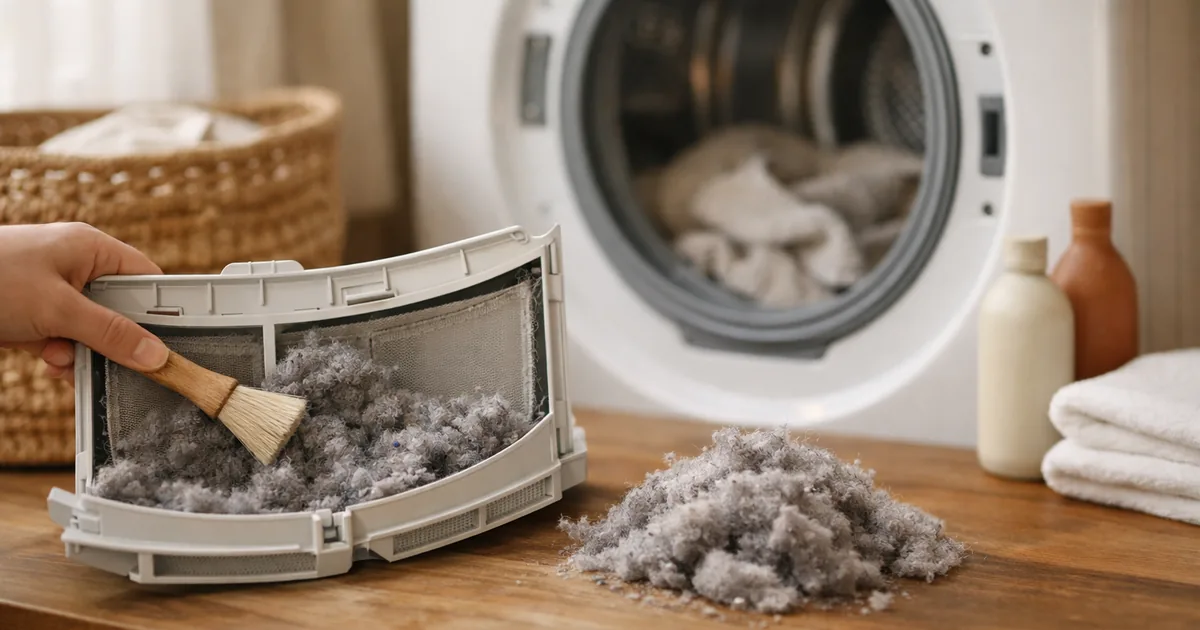
Winter means more loads in the clothes dryer. On its “Appliance and Electrical Fire Safety” page the US Fire Administration (USFA) says failure to clean (31%) was the leading factor contributing to the ignition of home clothes dryer fires in 2018–2020 (source: the National Fire Incident Reporting System, NFIRS). The USFA clothes dryer flyer says a dryer fire is more likely if the lint filter and dryer vents aren’t cleaned regularly, and that the filter should be cleaned before and after each load. The CPSC guide “Overheated Clothes Dryers Can Cause Fires” (No. 5022) explains why: lint build-up blocks airflow and causes excess heat. Here are both agencies’ tips in order.
1. Never run the dryer without the lint filter; clean it before and after each load (USFA).
2. Clear lint from the back, and check the vent behind the dryer isn’t damaged, crushed or blocked — and that the outdoor vent flap opens while it runs.
3. Plug the dryer straight into a wall outlet, never an extension cord — the cord can overheat and start a fire.
One number — USFA
Citing NFIRS, the USFA says failure to clean, at 31%, was the leading factor in the ignition of home dryer fires in 2018–2020. The other factors and their shares aren’t given on the page. On our reading, 31% means roughly three in ten dryer fires had cleaning as a way to prevent them (our note).
Dryer tips — USFA flyer
| Type | What the source says | Worth noting (ours) |
|---|---|---|
| Why it matters | A dryer fire is more likely if the lint filter and dryer vents aren’t cleaned regularly | — |
| Install, service | Have a professional install and service the dryer | Especially gas models (ours) |
| Filter | Never run it without the lint filter; clean the filter before and after each load | — |
| Back | Clean the lint at the back of the dryer | — |
| Vent path | Check the venting behind the dryer isn’t damaged, crushed or blocked | — |
| Outdoor vent | Make sure the outdoor vent flap opens while the dryer runs | Same idea for a Korean utility-room vent (ours) |
Airflow and ducts — CPSC guide 5022
| Type | What the CPSC says | Worth noting (ours) |
|---|---|---|
| How it happens | Lint in the dryer or exhaust duct blocks airflow and causes excess heat, which can start a fire | — |
| Warning sign | Clothes still damp at the end of a normal cycle, or longer drying times, may mean a blockage | The easiest sign to spot |
| Duct cleaning | Clean the vent and exhaust duct periodically; check air comes out of the outside vent while it runs | No interval in months is given |
| Inside | Clean behind the dryer; have a qualified service person clean the inside periodically | — |
| Duct material | Replace plastic or foil accordion ducting with rigid or corrugated semi-rigid metal duct — better airflow, less lint trapped | — |
| Oily clothes | Items with volatile chemicals such as gasoline, cooking oil or cleaners: wash more than once and preferably air-dry; if machine-dried, lowest heat with a cool-down cycle, and don’t leave dried items piled up | — |
The no-extension-cord rule comes from the USFA appliance tips on the same page: plug major appliances — refrigerators, stoves, washers and dryers — directly into a wall outlet, and never use an extension cord with them, because the cord can overheat and start a fire. All the cord and power-strip rules are in electrical fire safety.
Applied to a Korean home — our note
Both documents assume a US-style duct through the wall. Where a Korean apartment has the dryer in a utility room with a hose out to a window or vent, the CPSC point that lint blocks airflow and raises heat still applies. Three things you can do at once, as we see it: clean the filter every load, treat damp clothes as a blockage sign, and plug the dryer straight into the wall. Vent-less models such as heat-pump dryers aren’t covered by these documents; follow the manual’s cleaning steps (our note). Washing bulky items is in bulky laundry.
Checklist
- ☐ Clean the lint filter before and after each load; never run without it
- ☐ Clear lint from the back of the dryer
- ☐ Vent path not crushed or blocked
- ☐ Air comes out of the outside vent while running
- ☐ Damp clothes or slow drying: suspect a blockage
- ☐ Wall outlet only, no extension cord
- ☐ Air-dry items with oil or volatile chemicals
Questions that remain
How often should the duct be cleaned?
The USFA flyer says “regularly” and the CPSC guide “periodically”; neither gives months. The CPSC treats damp clothes as the signal.
Can I run the dryer while I’m out?
Neither the USFA flyer nor the CPSC guide we read says anything about running a dryer while out or asleep, so we don’t add a rule.
Sources
- US Fire Administration (USFA) — Appliance and Electrical Fire Safety — source (page last reviewed 4 May 2023; checked 27 October 2026). Failure to clean at 31% in 2018–2020 dryer fires (NFIRS); major appliances straight into the wall, never extension cords.
- USFA — Clothes Dryer Fire Safety (flyer) — PDF (undated; checked 27 October 2026). Professional install and service, never without the filter, clean before and after each load, lint at the back, vent check, outdoor flap.
- CPSC — Overheated Clothes Dryers Can Cause Fires (No. 5022) — PDF (undated; checked 27 October 2026). Blocked airflow and overheating, warning signs, duct cleaning, servicing, metal duct, items with volatile chemicals.
- Not read. CPSC fire statistics, Korean dryer fire data, heat-pump dryer care.
- What we added. The “worth noting” column and the Korean everyday gloss.
Where to check further
- Your dryer manual — filter and heat-exchanger cleaning.
- The maker’s service centre — internal cleaning and venting.
Written on 27 October 2026. The content is from the source; the glosses are ours.