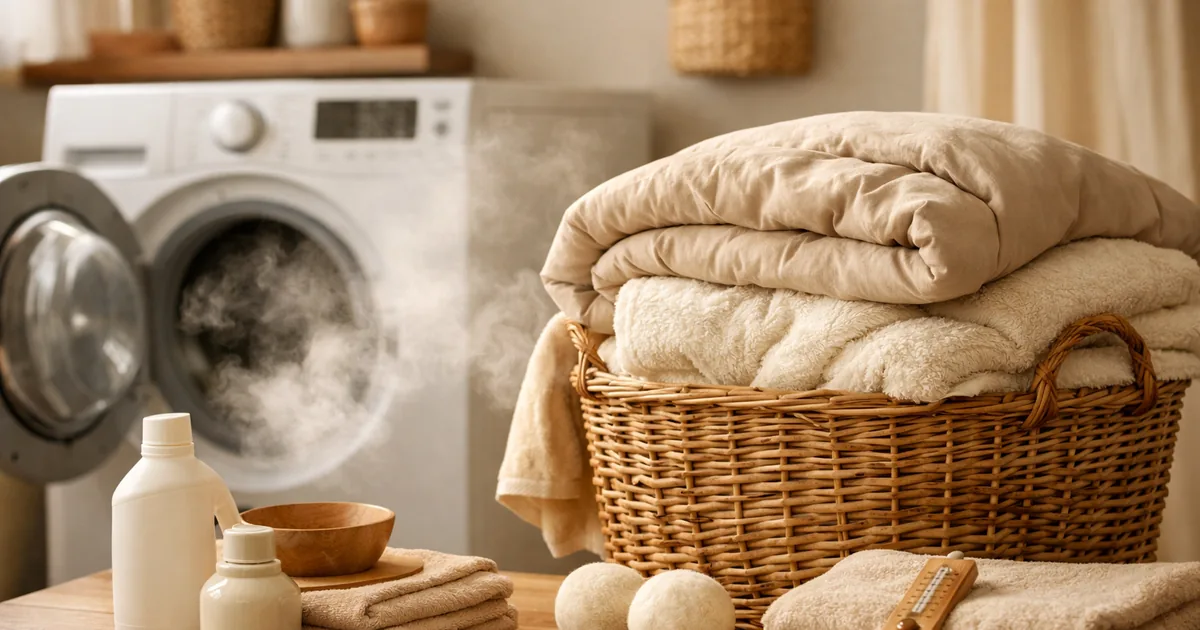
The Korea Energy Agency puts it plainly in its washing machine guidance: “90% of the energy a washing machine uses goes into heating the water.” Your machine's electricity bill is set by water temperature, not by the motor. The same guidance states that washing at 40°C cuts energy use to roughly a third, and that consolidating loads from 12 to 8 per month saves 2.02 kWh and ₩246 monthly.
1. What it saves. 90% of a washing machine's energy goes into heating water — dropping to 40°C cuts energy use to roughly a third, and going from 12 loads a month to 8 saves 2.02 kWh and ₩246 (Korea Energy Agency).
2. What people miss. A sour smell on clean laundry usually comes from the drum, not the clothes — detergent residue and scale build up on the outer face of the drum you cannot see through the door. On front-loaders the folds of the door gasket go first. And stiff towels are usually the fabric softener.
3. What to do. For bulky items the test is not “does it fit” but “will the fabric survive water.” Duvets to 70% of capacity (our own rule) — pack it full and water and detergent cannot circulate, so you wash it twice.
Below: looking after the machine, then not ruining large items.
Water temperature sets the bill
The Korea Energy Agency's efficiency guidance, tabulated. The figures below are for a 500 W class machine.
| Change | Effect | Source |
|---|---|---|
| Hot → cold wash | 90% of washing energy is water heating, so most of it disappears | Korea Energy Agency |
| Hot → 40°C wash | Energy use falls to about one third | Korea Energy Agency |
| Consolidate loads (12 → 8 per month) | 2.02 kWh and ₩246 a month, 1 kg CO₂ avoided | Korea Energy Agency |
| Fill the drum to about 80% | Avoids overloading while keeping cleaning performance | Korea Energy Agency |
| Spin for under 5 minutes | Avoids wasted power and fabric wear | Korea Energy Agency |
The first two rows are where the money is. Modern detergents mean everyday soiling comes out in cold water. Hot water earns its cost for a specific purpose — greasy kitchen cloths, baby clothes, sanitising bedding. The habit of “hot water gets it properly clean” is generating most of the bill.
The ₩246 in the third row looks small, but that is four fewer cycles alone; switching from hot to cold is a far larger lever. For the shape of your household bill overall, enter your usage in the Korea electricity bill calculator.

That sour smell is usually the machine
If clothes come out smelling despite a clean wash, suspect the drum rather than the clothes. Detergent residue, scale and moisture accumulate on the outer face of the drum — the part you cannot see with the door open — and mould and bacteria grow there. Every cycle, that water touches your laundry.

| Part | What builds up | How | How often |
|---|---|---|---|
| Outer drum | Detergent residue, scale, mould | Drum-clean cycle with a cleaner or percarbonate at the hottest setting. No such cycle? Soak in hot water for a few hours, then rinse and spin | Check the manufacturer's interval |
| Detergent drawer | Hardened detergent and softener | Remove, soak, scrub | With the drum clean |
| Door seal (front loader) | Trapped water, black mould | Open the fold and wipe with a dry cloth | Often |
| Drain filter | Lint, debris, coins | Locate per the manual, remove and rinse | Check the manufacturer's interval |
The last column says “check the manufacturer's interval” deliberately. “Once a month” circulates widely, but no public-agency source could be found to support it. The right interval depends on the model, how often you wash and at what temperature, so follow the manual. For the same reason, bacterial counts inside drums are not quoted here — no credible test data was available.
Habit beats cleaning. Leave the door open after a cycle so the interior dries, and don't leave wet laundry sitting inside. Those are the two habits we suggest before any cleaning. Seasonal humidity management continues in managing humidity and mould in monsoon season.

Towels go stiff because of softener
New towels are plush; a few washes later they are board-like. The cause is residue built up in the fibres — and the main contributor is the very thing people reach for as the fix: fabric softener.
Softener coats fibres with a thin film to create a soft feel. The problem is that a towel's job is absorption. As the film accumulates it repels water, and incompletely rinsed residue hardens, which makes the towel stiffer, not softer. It is the same reason softener ruins technical outerwear.
| Symptom | Cause | Change |
|---|---|---|
| Stiff, won't absorb | Softener and detergent residue | Drop the softener or use it rarely. Add one rinse |
| Smells sour despite washing | Dirty drum, or not fully dried | Drum clean plus complete drying |
| Rough surface | Excessive hot drying | Stop short of bone dry; shake before hanging |
Recovery means dissolving the residue out. A cup of white vinegar in the rinse (instead of softener) neutralises alkaline residue so it washes away — this is our suggestion; we found no agency test of it. Using slightly less detergent than the marked dose has the same effect. Finally, snapping the towel sharply before hanging lifts the flattened pile and restores the feel.
Duvets, pillows and padded jackets
For bulky items the question is not “does it fit in the drum” but “does the filling survive water”. Some things fit and still cannot be washed.

| Item | Home washable | How | Never |
|---|---|---|---|
| Polyester-filled duvet | Usually yes | Bedding cycle or mesh bag. Less detergent, generous rinse | Fill the drum |
| Microfibre, thin quilt | Yes | Softener sparingly | Heavy softener — kills absorbency |
| Cotton-wadding or wool duvet | Not advised | Check the label; use a specialist | Machine washing — the filling clumps permanently |
| Polyester or bead pillows | Yes | Two at a time to keep the drum balanced | A single pillow on a fast spin |
| Memory foam, latex pillows | No | Wash the cover, air the core | Water — the core breaks down and never dries |
| Padded jackets | Only if the label allows | Neutral detergent, on its own. Add dryer balls or tennis balls when drying | Softener — the filling mats together |
Three points matter most.
- 70% of capacity, maximum (our own rule — the Korea Energy Agency gives 80% for ordinary loads). A wet duvet is heavy and stops tumbling. Without circulation the detergent reaches the outside only and the inside stays dirty — so you wash again, spending double the water and power.
- Memory foam and latex never go in water. The open-cell structure absorbs water, the interior breaks down, and even when the surface feels dry the core stays wet for days. Mould grows in there.
- No softener on padding; use balls when drying. Wet filling clumps, and softener sets the clumps. Dryer balls or tennis balls keep striking the jacket so the filling redistributes and lofts. Air-drying? Shake it out by hand several times during drying.
Across all of them, the critical step is drying completely. Bulky items take a long time to dry through, and folding one away slightly damp creates the starting point for mould and odour. A dry surface is not the test — press the middle and check.

Mistakes you cannot undo
- Washing memory foam or latex — the core disintegrates. There is no recovery.
- Machine-washing a cotton-wadding or wool duvet — the filling clumps and never returns to its original loft.
- Softener on padded jackets — the filling sets matted and loses insulating power.
- Storing something slightly damp — mould marks and odour rarely wash out afterwards.
- Neglecting the drum for years — hardened scale on the outer face doesn't come off in a single clean cycle.
Rules for the garments themselves are in the fabric care guide, and stains and dye transfer in the stain and discolouration guide. For summer cooling costs alongside this, see cutting air conditioner electricity costs.
Questions that remain
What should I change first to cut the machine's running cost?
The water temperature. The Korea Energy Agency states that 90% of the energy a washing machine uses goes into heating water. Washing at 40°C cuts energy use to roughly a third, and switching from hot to cold removes most of that 90% outright. Consolidating loads from 12 to 8 a month saves 2.02 kWh and ₩246 — and the reason ₩246 looks small is that of the agency's three measures, only the smallest one carries a price tag at all.
Should I run a drum clean once a month?
No public-agency source supporting that interval could be found, so this article does not put a number on it. It depends on the model, how often you wash and at what temperature, so the manufacturer's recommended interval is the accurate answer. Figures like bacterial counts inside the drum were left out for the same reason. What is clear is which habits pay: leave the door open after a cycle so the inside dries, and do not leave wet laundry sitting in the machine.
My towels went stiff, so I added more softener and they got worse.
Softener is the cause, not the cure. It coats the fibres with a thin film to create a soft feel, but a towel's job is absorption. As the film builds up it repels water, and residue that was never fully rinsed out hardens, which leaves the towel stiffer than before. Drop the softener and add an extra rinse. A cup of white vinegar in the rinse neutralises alkaline residue so it washes away, and snapping the towel sharply before hanging lifts the flattened pile.
If a duvet fits in the machine, does that mean I can wash it?
The test is not whether it fits but whether the filling survives water. Cotton-wadded and wool duvets fit, and the filling clumps and never returns to its original loft. Memory foam and latex pillows are porous: once they take on water the structure breaks down inside, and the core is still damp days later. Even for the things you can wash, fill the drum to no more than 70%. Pack it full and water and detergent cannot circulate, so only the outside gets clean — and rewashing costs you double the water and power.
I washed a padded jacket and the filling has clumped.
If softener went in, start there. Wet filling clumps on its own, and softener sets the clumps. Wash padded items alone with a neutral detergent, and add dryer balls or tennis balls when drying so the filling is beaten apart and lofts up again. If you are air-drying, shake the jacket out by hand several times as it dries. And with any bulky item, a dry surface does not mean it is done — press the middle with your hand to check.
Sources and where to verify
- Korea Energy Agency — household appliance energy saving guidance (90% of washing energy is water heating; one third at 40°C; 2.02 kWh and ₩246 saved going from 12 to 8 loads a month)
- Korea Energy Agency — efficiency management regulation notice
- Consumer24 — preventing textile product damage
Written as of July 2026. The savings figures are the Korea Energy Agency's, based on a 500 W class machine, so your own savings will vary with the model and your habits. Recommended drum-cleaning intervals and bacterial counts inside drums are not included, because no public-agency basis could be verified — the manufacturer's manual is cited instead. Comparisons of insulating performance between washing methods for down jackets were also excluded, as the testing body could not be identified.