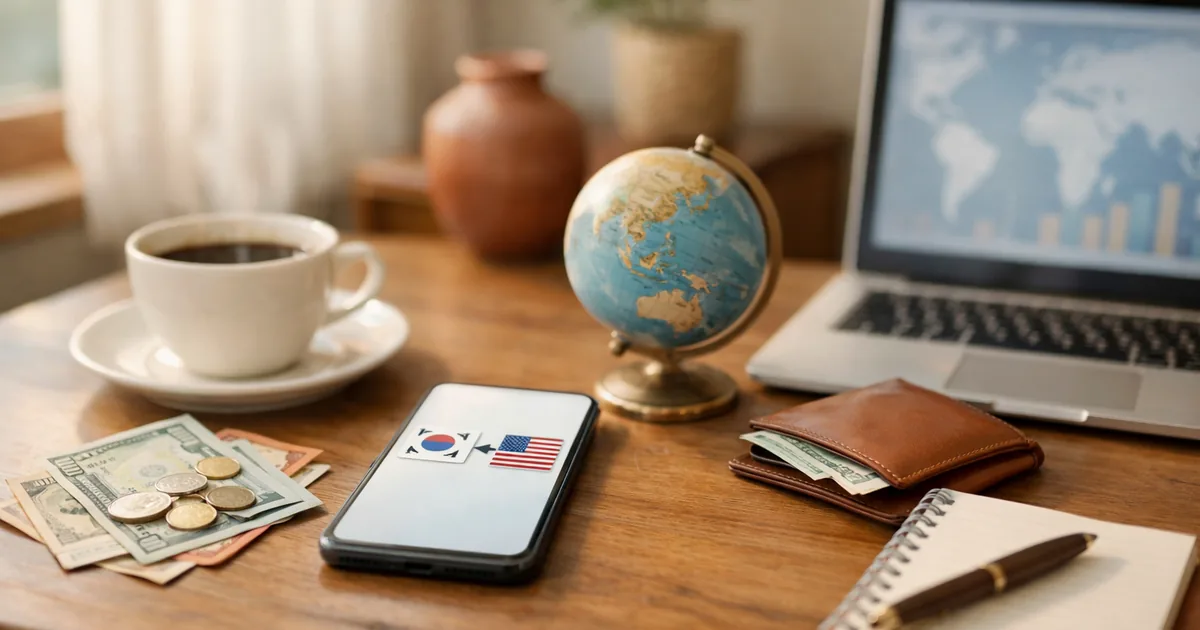
Terminals abroad ask whether you would like to pay in your home currency. It feels safer, so people tap yes — but the foreign transaction fee still applies. The regulatory wording makes the reason plain.
“A transaction charge imposed by the card issuer for the use of the card for purchases includes any fee imposed by the issuer for purchases in a foreign currency, or that take place outside the United States, or with a foreign merchant.”
— Consumer Financial Protection Bureau, Regulation Z § 1026.60 commentary (credit card application and solicitation disclosures)
The conditions are joined by “or.” Meeting any one of them brings the fee. Switching the payment currency clears the first condition — but “outside the United States” and “with a foreign merchant” are still standing.
1. What it costs. Korea's Financial Supervisory Service writes that dynamic currency conversion adds a “home-currency conversion fee of roughly 3–8%.” On a ₩100,000 purchase that is ₩3,000–8,000 — on top of the 1–1.5% your issuer takes.
2. Where the risk sits. In tapping yes at the terminal. Switching to your home currency does not remove the foreign transaction fee; it stacks 3–8% on top of it.
3. What to do. Before you travel, register the DCC block with your issuer — app, website or call centre. Once it is on, the terminal stops asking.
So paying in your home currency just adds a conversion
| Choice | Conversions | Fee that remains |
|---|---|---|
| Pay in local currency | One — your issuer converts | The foreign transaction fee |
| Pay in home currency (DCC) | Two — converted at the terminal, then settled | The foreign transaction fee, unchanged + the local conversion |
Dynamic currency conversion is not a way to remove a fee — it is a way to add a conversion step. And the rate for that extra step is set not by your card issuer but by the merchant (or its terminal provider).
Home-currency amounts are harder to audit. Once the receipt already shows your own currency, working backwards to “what rate was that?” becomes difficult. Pay in local currency and you can check the applied rate on the statement later. Comparability itself changes.
What the fee actually is — CFPB's definition
CFPB defines it while explaining prepaid card fees; the name and nature are the same across credit, debit and prepaid.
“A foreign transaction fee is charged when you use your card in a foreign country or make an international purchase from the United States. This fee, sometimes called a currency conversion fee, is usually a percentage of your purchase, withdrawal, or other transaction, rather than a flat fee.”
— Consumer Financial Protection Bureau, What types of fees do prepaid cards typically charge? (November 4, 2024)
Note “or make an international purchase from the United States.” You do not have to leave home — ordering from an overseas store from your sofa qualifies. Reading “foreign transaction” as “foreign travel” is what loses this one.
| Situation | Fee applies? | Why |
|---|---|---|
| Abroad, paying in local currency | Yes | Foreign currency, abroad, foreign merchant — all three |
| Abroad, paying in home currency | Still yes | “Outside the US” and “foreign merchant” remain |
| At home, ordering from an overseas store | Yes | CFPB — also charged on “an international purchase from” home |

But the rate varies by card
The regulation does not say how much to charge — it says disclose how much. So the rate differs by card, and what attaches instead is a disclosure duty.
If an issuer charges different foreign transaction fees for purchases versus cash advances, it “must revise the foreign transaction fee language… to disclose clearly and conspicuously the amount of the foreign transaction fee that applies to purchases and the amount… that applies to cash advances.”
— Consumer Financial Protection Bureau, Regulation Z § 1026.60
The regulation assumes purchases and cash advances may carry different rates. Pulling cash from an ATM abroad and tapping the card are not necessarily the same percentage. Which means the place to look is not the marketing page but the fee table in your card's terms.
| Check | What | Basis |
|---|---|---|
| ① Your card's rate | The foreign transaction fee line in the terms | CFPB Regulation Z |
| ② Purchases vs cash advances | They can differ — check each | CFPB Regulation Z |
| ③ Pay in local currency | Home-currency payment adds a conversion | Derived from the wording |
| ④ Overseas online orders count | Charged on “an international purchase from” home too | CFPB text |
| ⑤ Check the applied rate on the statement | Only possible if you paid in local currency | Conventional practice |
The fee has two layers, not one
US regulation stops at “disclose what it is.” A Korean card issuer's overseas-use guidance actually publishes the numbers — and what everyone calls “the foreign transaction fee” turns out to be two separate charges.
| Layer | Who charges it | Disclosed rate |
|---|---|---|
| ① International card fee | The network (Visa, Mastercard, etc.) | Mastercard 1.0% / Visa 1.0–1.1% / UPI 0–0.8% / Amex 1.4% BC Global and JCB: none |
| ② Overseas-use fee | The issuer / bank | 0.0% to 0.35% of the won amount (varies by bank) |
“Amounts used overseas are converted into US dollars through the international card company (for all sales currencies, including won), and the amount inclusive of the international card fee is converted into won using the telegraphic transfer selling rate as of our receipt date, then billed together with an overseas-use fee of 0.0% to 0.35% of the won amount.”
— BC Card, Customer Center > Card Use Guide > Overseas Use > Overseas Billing (issuer disclosure)
That single sentence erases two of our open questions — how the network's cut and the issuer's cut divide, and roughly how large each is. Added together they typically land somewhere around 1% to 1.5%.
Pay in euros and it still routes through dollars
The most unexpected line in the same disclosure:
“No matter which country you use the card in, every transaction's approval currency is converted into US dollars and then billed in won.”
“For example, if you pay in euros in Europe, the international card company converts it into US dollars before notifying BC Card.”
— BC Card, Overseas Billing guidance
| Payment | Actual conversion path | Conversions |
|---|---|---|
| In the US, in dollars | USD → KRW | 1 |
| In Europe, in euros | EUR → USD → KRW | 2 |
| In Europe, in won (DCC) | EUR → KRW → USD → KRW | 3 |
Earlier we called paying in your home currency “adding one more conversion.” Outside the dollar zone there were already two. DCC makes it three. The further your currency is from the dollar, the more this structure costs.

The rate is set on the processing date, not the purchase date
| Item | Issuer's disclosed wording |
|---|---|
| Reference date | “The rate applied for won conversion is based on the international card company's processing date” |
| Which rate | “The first published telegraphic transfer selling rate as of the international processing date, from our designated settlement bank” |
| Weekends | “On weekends, Friday's rate applies” |
| Public holidays | “On public holidays, the previous business day's rate applies” |
| Cash advances | “For short-term card loans, a fee on the amount used is charged separately” |
“Processing date” is the operative phrase. The day you tap the card and the day the network processes it can be several days apart. If the rate moves in between, the same local-currency amount produces a different bill. That is usually the answer to “I checked that day's rate — why doesn't it match?”
And the last row lines up exactly with the CFPB regulation above. Regulation Z assumes an issuer may charge different fees for purchases and cash advances — and the Korean disclosure says the same thing in its own words: “for short-term card loans, charged separately.” The structure US regulation anticipated shows up concretely in a Korean disclosure. The same guidance separately notes a 1.0% international card fee on ATM cash advances and cash withdrawals.
These figures are one issuer's disclosure. Issuers and banks differ — the overseas-use fee itself is written as “0.0% to 0.35% by bank.” Check your own card's product disclosure.
The number the financial regulator does print — 3–8%
Everything so far came from US regulation and one issuer's disclosure. Neither answers the question people actually have: how much does saying yes cost? Issuer disclosures stop at their own cut, because the DCC markup is set at the merchant end.
Korea's Financial Supervisory Service puts a number on it.
“When you use a credit card abroad and settle in won rather than the local currency — that is, when you use DCC — a home-currency conversion fee of roughly 3–8% is added.”
— Financial Supervisory Service, “200 financial tips: what to know at each stage of a holiday trip”
Set beside the earlier table, the scale becomes obvious.
| Layer | Who takes it | Rate | On ₩100,000 |
|---|---|---|---|
| ① Network fee | Visa, Mastercard etc. | 1.0–1.4% | ₩1,000–1,400 |
| ② Overseas-use fee | Issuer / bank | 0.0–0.35% | ₩0–350 |
| ③ DCC conversion fee | Merchant / terminal side | about 3–8% | ₩3,000–8,000 |
Layers ① and ② together come to 1–1.75%, while ③ alone is 3–8% — at the narrowest ③ is 1.7 times the other two, at the widest eight times (our calculation). If “foreign card fees” made you think of something in the 1% range, the large layer was the one created by your own tap at the terminal.

How to stop the terminal from asking
The same FSS material gives the block.
“From 4 July 2018, consumers who do not want overseas home-currency settlement may register for the DCC pre-block service by whichever route is convenient — the issuer's website, call centre or mobile app.”
— Financial Supervisory Service, same material
The procedure changed once more. In June 2021 the FSS announced that from 1 July 2021 anyone applying for a new credit or debit card usable abroad must choose on the application whether to block DCC (renewals and reissues from 1 January 2022), and that text reminders go out before the summer holidays and before Seollal and Chuseok. If you ticked “don’t block” when the card was issued, it is still open — worth checking before you fly. The Credit Finance Association’s card guide describes the same service as preventing “an additional fee (about 3–8%)” on won settlement (our translation), the same figure the FSS uses.
And what to do if it already happened:
“If, after paying, the card receipt shows a won (KRW) amount alongside the local-currency amount, DCC was applied — you should ask that business to void it and re-run the payment in local currency.”
“Some overseas hotel booking sites and airline websites accessed from Korea have DCC set automatically, so check with the business before paying.”
— Financial Supervisory Service, same material
Note who you ask: the business, not your card issuer. The merchant applied DCC, so the agency's remedy is voiding and re-running it on the spot. Nothing in the material says an issuer will reverse an already-approved transaction.
There is a second layer on the regulatory side. From 1 July 2021, anyone applying for a new credit or debit card usable abroad must be told the DCC fee and must choose on the application form whether to switch the block on; from 1 January 2022 the same applies to renewals and reissues. If you got a card recently, you may already have chosen — worth checking.
Questions this raises
Is paying in home currency always worse?
Nothing in this material supports “always.” What is certain is that the foreign transaction fee does not disappear (the wording is “or”), and that an extra conversion step is created. Extra steps generally carry cost.
What percentage is the fee?
On a Korean issuer's disclosure you have to add the two layers — the network fee (Mastercard 1.0%, Visa 1.0–1.1%, Amex 1.4%, UPI 0–0.8%) plus the overseas-use fee (0.0–0.35% of the won amount). It still varies by issuer and bank, and CFPB itself says only “a percentage… rather than a flat fee.” Check your own card's terms.
What makes Visa 1.0% or 1.1%?
When the card product launched. One issuer footnotes it as “1.1% applies to new Visa products launched after April 2020 (existing products: 1.0%)”; another writes “1% applies until further notice, with 1.1% to follow.” We found no agency or association source — only issuer notices — so check your own card's product disclosure.
Are ATM withdrawals abroad the same?
The regulation presumes purchases and cash advances may carry different fees — so do not assume they match. And the ATM operator adds its own charge: CFPB writes that “Usually, when you use another bank or credit union's ATM, both the operator of the ATM and your bank or credit union charge you a fee,” and that “The ATM operator must disclose its fee in writing at the ATM itself.” That text describes US domestic ATMs, though — we again found no agency source addressing ATMs abroad specifically. Still, the on-screen fee notice is something you can read and cancel out of, right there.
Does it apply to overseas online shopping?
Yes. CFPB states it is charged on “an international purchase from” your own country too. Even if the checkout shows your currency, a foreign merchant satisfies the condition.
Isn't this a US regulation?
It is. The definition and the disclosure duty above are US Regulation Z. But the structure — which conditions trigger the fee — is worth borrowing because card networks are international. Confirm your own rates and rules with your issuer.
Paying in your home currency does not remove a fee — it adds a conversion. The wording reads “foreign currency, or outside the country, or with a foreign merchant,” so switching the currency leaves nowhere to escape to.
If you shop from overseas into Korea, duty may apply on top of fees — the 150-dollar exemption is measured on the goods price without freight, and supplements and medicines are excluded from the US 200-dollar concession (overseas shopping and customs duty).
Some of it can be cut at the booking stage — see cheap flights, which also covers refund thresholds for delays, and booking hotels cheaply, on all-in pricing and how the card you use changes the fee.
Fees and exchange margins when sending money abroad can be compared by amount received in the remittance calculator. Your rights when something bought on card instalments goes wrong are in card instalment withdrawal and defence rights.
Sources
- Consumer Financial Protection Bureau — Regulation Z § 1026.60 — Credit and charge card applications and solicitations. Source for “any fee imposed by the issuer for purchases in a foreign currency or that take place outside the United States or with a foreign merchant,” and the requirement to disclose purchase and cash-advance foreign transaction fees separately where they differ.
- Consumer Financial Protection Bureau — What types of fees do prepaid cards typically charge? (November 4, 2024). Source for the definition of the foreign transaction fee — charged “in a foreign country or make an international purchase from the United States,” “sometimes called a currency conversion fee,” “a percentage… rather than a flat fee” — and the fee list and packaging disclosure chart.
- Consumer Financial Protection Bureau — Circular 2024-02 (March 27, 2024). Source for the statement that cost can be imposed through exchange rate spreads.
- Financial Supervisory Service (Korea) — “200 financial tips: what to know at each stage of a holiday trip.” Source for the roughly 3–8% home-currency conversion fee, the DCC pre-block routes (website, call centre, mobile app), the instruction to ask the business to void and re-run in local currency, and the warning about automatic DCC on overseas hotel and airline sites.
- Financial Supervisory Service (Korea) — “Consumer guidance on card DCC is being strengthened” (via KDI Economic Information and Education Center) (checked August 2026). Source for the compulsory block-or-not choice on new applications from 1 July 2021, and renewals and reissues from 1 January 2022.
- Consumer Financial Protection Bureau — How do I avoid ATM fees? (checked August 2026). Source for both the ATM operator and your own bank charging a fee, and the operator's duty to disclose it in writing at the machine. US domestic ATMs; ATMs abroad are not addressed.
- BC Card (issuer disclosure — not an agency source) — Customer Center > Card Use Guide > Overseas Use > Overseas Billing. Source for the international card fees (Mastercard 1.0% / Visa 1.0–1.1% / UPI 0–0.8% / Amex 1.4% / BC Global and JCB none / 1.0% on BC Global ATM cash advances and withdrawals), the 0.0–0.35% overseas-use fee (by bank), “every transaction's approval currency is converted into US dollars and then billed in won” with the euro example, “based on the international card company's processing date” and “first published telegraphic transfer selling rate,” the Friday-rate weekend and previous-business-day holiday rules, and “for short-term card loans, a fee… charged separately.” One issuer's own disclosure — other issuers and banks may differ.
- Financial Supervisory Service (via KDI Economic Information and Education Center) — Stronger consumer notice on card DCC (17 June 2021, Korean). Source of the mandatory block choice on new applications (1 July 2021), renewals (1 January 2022) and holiday text reminders.
- Credit Finance Association disclosure portal — card product guide (DCC pre-block service, extra fee about 3–8%) and card fee rates by product (no overseas-use fee column). Checked 22 September 2026 (Korean).
Where to check further
- Your own card's actual rate. The figures above are one issuer's disclosure, and the overseas-use fee is written only as “0.0–0.35% by bank.” There is no official comparison that puts issuers' overseas-use fees on one screen — the FSS's integrated product comparison covers deposits, loans and insurance, and on 22 September we also opened the Credit Finance Association's disclosure portal: its fee-rate table by product covers cash advances, instalments, card loans, revolving and late-payment rates only, and none of its other menus carries an overseas-use fee column. For now, your card's product disclosure is the accurate source.
- How the “first published telegraphic transfer selling rate” is derived. The issuer disclosure does not say how the settlement bank sets it. Its relation to the base rate is covered in the exchange rate spread.
- Whether an already-approved DCC charge can be reversed later. The FSS guidance goes as far as asking the merchant to void it on the spot. We found no agency source saying an issuer will refund one after approval — if you spot it after getting home, call your issuer first.
Written as of August 2026. The 3–8% fee and the block-and-void procedure come from Financial Supervisory Service material; the definition and triggering conditions come from CFPB regulation and guidance; the actual rates and rate-setting rules come from a Korean issuer's disclosure. That disclosure is not an agency source and reflects one company — stated as such in the body. The won amounts and the “1.7 to eight times” comparison are ours. For cost hidden in the rate see the exchange rate spread; for transfers, sending money abroad. For trip prep generally see packing, and for falling ill abroad, the travel health kit. This is general information, not financial advice.