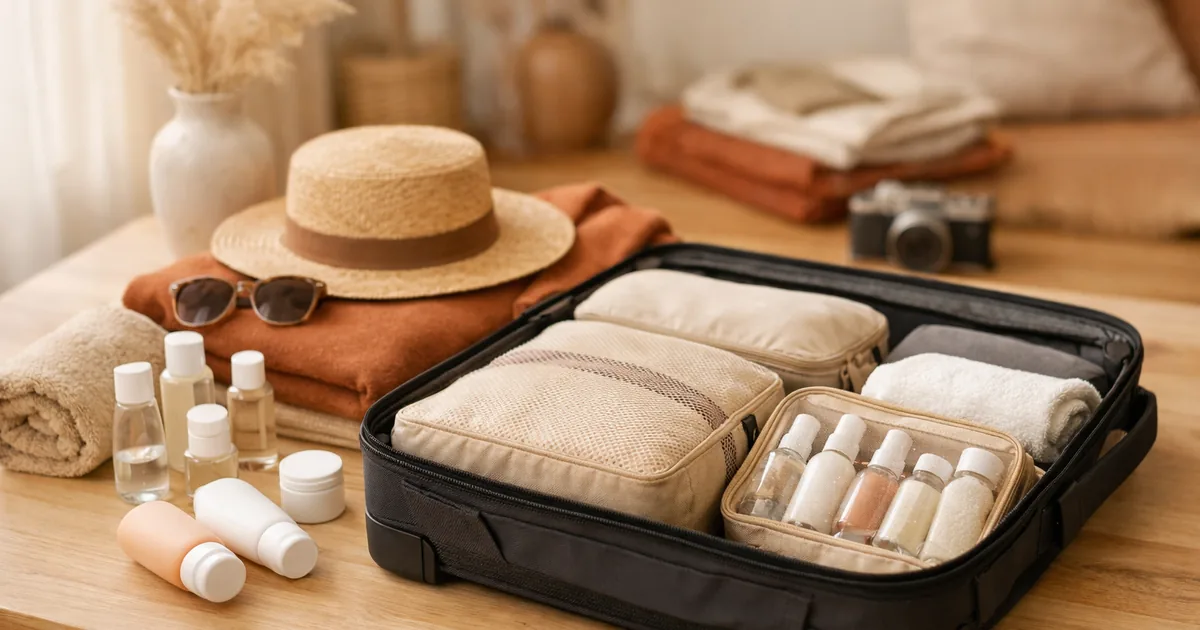
The night before a trip, you stare into an open suitcase wondering “will this all fit?”, forget something anyway, and then lose your toiletries at security. Packing is less about clever folding than about order and rules.
The liquid rules come from Korea’s transport-ministry notice (international departures from Korea), and the power-bank and lighter rules from the US FAA. Foreign airports and airlines set their own rules, so check with them last.
1. What to get right. Two things — liquids in containers of 100ml or less inside one 1L clear zip bag, and power banks in your carry-on, never checked. They are the two things security checks first, so we put them up front.
2. What packing lists miss. They list objects. Of the 26 items the CDC tells travellers to carry, five are not objects at all — documents and contact details. Those are what you actually need when something goes missing.
3. How to approach it. Order and rules before folding tricks. The rules here were checked against Korea’s transport-ministry notice and the US FAA and TSA; foreign airports follow their own country’s rules.
One item in five is a piece of paper
Packing lists almost always list things. The list an agency publishes is weighted differently.
The US Centers for Disease Control and Prevention names 26 items in total (9 medicines, 12 first-aid supplies, 5 documents and contacts — our count), and five of them are not objects at all.

| The five documents | As written in the source |
|---|---|
| Identity | Copies of your passport and travel documents |
| Prescriptions | Copies of all prescriptions — medications, glasses, or medical supplies |
| Insurance | Health insurance card and documents |
| Vaccination | Proof of yellow fever vaccination, if required |
| Emergency contacts | Family · healthcare providers · lodging · hospitals and clinics · the embassy or consulate |
The detail that earns this table its place is “glasses.”
The source says “copies of all prescriptions (medications, glasses, or medical supplies).” If you lose your glasses on a trip, without the prescription you cannot have a new pair made where you are.
Note too that three of the five contact types are about being ill: your doctor, local hospitals, and the embassy.
Photographs will do. What the source asks for is a copy, not the original. It does not say what form of copy is accepted.
1. Carry-on or checked?
| Item | Carry-on / checked |
| Passport, wallet, cash | Always carry-on |
| Power banks, e-cigarettes | Carry-on only (banned in checked bags) |
| Laptop, camera | Carry-on (damage and loss risk) |
| Prescription medication | Carry-on, with a photo of the prescription |
| Liquids over 100ml | Checked |
| Nail clippers, scissors, razor blades | Checked |
| Lighters | One, in carry-on or on you; not in checked bags; torch lighters nowhere (US FAA) |
Why must power banks fly with you? Lithium batteries can catch fire, and a fire in the hold can't be reached. In the cabin, crew can respond. Under US FAA rules, up to 100Wh is fine in the cabin, 101–160Wh needs airline approval and is limited to two per person, and anything larger cannot go. Airlines may be stricter, so check yours.
2. The liquid rule — as the transport-ministry notice sets it
| Container size | 100ml (100g) or less each |
| Total | One clear zip bag of 1L or less |
| Bag | A clear bag of 1L or less — the notice sets no dimensions |
| Per passenger | One bag only |
| What counts | Liquids, gels, creams, sprays — toothpaste and sunscreen included |
The classic mistake — the limit applies to the container's stated size, not how much is left. A nearly empty 200ml bottle is still refused. Decant into travel bottles.
This table matches art. 5(1) of the transport ministry's notice on liquids, aerosols and gels carried on board (No. 2021-864): containers of 100ml or less, no partly filled larger containers (empty ones are fine), one clear bag of up to 1 litre, one per passenger. Art. 4(2) exempts medicines and special dietary items such as baby food. The notice applies to international flights departing Korean airports, transfers included (art. 3(1)). Checked 23 September 2026.
Recognized exceptions
- Prescription medicine — allowed beyond the limit. Declare it at screening with labels or a prescription.
- Baby formula, milk and food — reasonable quantities are permitted when travelling with an infant. Declare it too.
- Duty-free purchases — allowed inside a sealed security bag with the receipt visible. Never open it early, and expect re-screening on transfers.
- Solid products — bar soap, shampoo bars and solid toothpaste aren't liquids, so no limit. A great way to cut bulk.
Foreign and transfer airports follow their own country’s rules, so packing to the 100ml rule is our suggestion.

3. Doubling your space
| Method | Best for · effect |
| Rolling | T-shirts, trousers, underwear → saves space, fewer creases |
| Folding | Shirts, jackets → garments that need structure |
| Compression bags | Winter coats → half the bulk, but the same weight |
| Packing cubes | Sorting → nothing collapses when you take one item out |
| Stuffing shoes | Socks, chargers → uses dead space |
Weight distribution matters
- Heaviest near the wheels — shoes, toiletries, books
- Clothes in the middle
- Light and frequently used items on top
Top-heavy cases tip over constantly and strain your wrist. Weight low means it rolls properly.
4. How many clothes by trip length
The counts below are our own guide.
| Length | Tops / bottoms / underwear sets |
| 2–3 days | 3 / 2 / 3 |
| 4–7 days | 4–5 / 2–3 / 7 |
| 8–14 days | 5–6 / 3 / 7 + one laundry stop |
| 15+ days | One week's worth + laundry on location |
The key trick — choose colours that all work together. Four tops and two bottoms that mix freely give eight outfits. And you can always buy something there.

5. Final checklist
| When | Check |
| 1 week out | Passport validity (check the destination’s rule), visa, name spelling on tickets |
| 3 days out | Destination weather, plug adapter, prescriptions |
| 1 day out | Liquid bag, power bank into carry-on, weigh the case |
| Departure day | Passport, cards, cash, roaming or SIM, gas and power at home |
How much validity a passport needs on entry differs by country — we did not confirm it from an official source this time, so check the destination’s embassy.
6. Planning for loss
- Store photos of your passport on your phone and in email
- Put a name tag outside and contact details inside the case
- Never check valuables — compensation limits are low
- Photograph your suitcase so you can describe it if lost
- Split essentials between carry-on and checked, including a change of clothes
Questions that remain
What's the carry-on weight limit?
It varies by airline. We give no number because there is no official standard — check your airline’s baggage page.
Can I bring several power banks?
Under FAA rules there is no count limit up to 100Wh; 101–160Wh is two per person with airline approval. Airlines may be stricter. Terminals must be protected from short circuit (retail packaging, tape, or separate bags).
Can I bring food?
Solid food is generally fine onboard, but quarantine rules differ by country — check the destination’s quarantine agency for what is banned.
What if my bag is overweight?
Your airline’s excess fee applies. Wear the heavy clothes and move books and electronics into your carry-on at the counter.
Packing isn't about fitting more in — it's about clearing security and arriving with everything. Handle liquids and batteries and you're halfway there.
Before packing comes booking — see cheap flights and booking hotels cheaply, which uses free cancellation.
Which medicines to pack can be chosen by ingredient in choosing OTC medicine by symptom.
Before the bags, check the passport’s expiry date — a 10-year passport is 40,000 won for 58 pages plus a 12,000 won contribution, and under 18 it runs 5 years (Korean passport costs).
Correction (15 October 2026). “Up to 100Wh is fine, above that needs airline approval” was only half right — under FAA rules approval covers up to 160Wh and two per person. Unsourced lines — the 20.5×20.5cm bag size, the six-month passport rule for “many countries”, carry-on weight “commonly 7–10kg”, CT-scanner trials — are gone or now say “check”, the clothing table is marked as our guide, and the line citing ICAO now names the sources actually checked.
Sources
- US Federal Aviation Administration PackSafe — Lithium Batteries and Lighters (checked 15 October 2026). Source for power banks in the cabin only, up to 100Wh and 101–160Wh with approval (two per person), terminal protection, and one lighter per passenger, none in checked bags, no torch lighters.
- US Transportation Security Administration — Liquids, Aerosols, and Gels Rule (checked 15 October 2026). Source for the name “3-1-1”, 3.4 ounces (100ml) and one quart-size bag.
- US CDC Travelers' Health — “Pack Smart” (checked July 2026). Source for the five documents and contacts, “copies of all prescriptions (medications, glasses, or medical supplies),” the five contact types, and the nine medicines and twelve supplies.
- US CDC Travelers' Health — “Jet Lag” (checked July 2026). Source for “arrive at your destination at least 2 days before any important events.”
- Our own calculation. The total of 26 and the 21-versus-5 split are our tally of that list.
Where to check further
- The liquid rules at your return and transfer airports. The 100ml, 1L and one-bag figures are confirmed from the Korean notice, but it covers only international departures from Korea — foreign airports follow their own rules, so check each airport's security page.
- Checked baggage weight and size. Not covered, because it differs by airline — and going over means paying at the desk. Your airline's baggage page lists it by route.
- What form of copy counts. The CDC source says only “a copy” — not whether paper, photo or cloud qualifies. A paper copy and a photo on your phone is the safe pairing.
As of July 2026. The document list comes from CDC source text; the counts are ours. Liquid rules and baggage limits vary by country and airline — check before you fly. Medicines are covered in the first-aid kit and drugstore part one, time zones in jet lag recovery, and falling ill abroad in emergencies overseas.