The timeline of muscle loss and the activity targets below come from the US National Institute on Aging (NIA). One of them runs against the common version of the story: muscle does not start declining in your sixties. It peaks in your mid-thirties.
Here is how NIA puts it, citing the Baltimore Longitudinal Study of Aging.
“Muscle mass and strength increase steadily from birth and reach their peak at around 30 to 35 years of age.”
After that, “muscle power and performance decline slowly and linearly at first, and then faster after age 65 for women and 70 for men.”
— National Institute on Aging, How can strength training build healthier bodies as we age? (June 30, 2022)
Which means there is a thirty-year gentle slope between the peak and the drop-off.
1. When does it start. Muscle does not begin declining in your sixties — it peaks at 30 to 35. After that it falls slowly, then faster after 65 for women and 70 for men. For thirty years in between, nothing appears to be happening.
2. Where things stand. On KDCA figures, sarcopenia prevalence among Koreans aged 65+ is 6.6% in men and 9.2% in women, with reduced grip strength at 14.2% and 18.8%. It was higher with age, in women, and in lower-income groups.
3. What to do. NIA splits activity into three kinds with separate targets — none of them substitutes for another. Aerobic work is 150 minutes a week at moderate intensity; strength training is a separate two days a week.
The problem is that most people do nothing during that gentle stretch.
What sarcopenia is, as NIA defines it
| Item | What NIA says |
|---|---|
| Definition | “A decline in muscle mass, strength, and function” — from the Greek words for flesh and loss |
| Who | “Often associated with older adults” |
| How it shows up | Connected to “weakness; fatigue; lower energy levels; and difficulty standing, walking, and climbing stairs” |
| Peak | Muscle mass and strength peak at 30–35 |
| Acceleration | Decline speeds up after 65 for women, 70 for men |

“Difficulty standing, walking, and climbing stairs” is NIA's own phrasing. Sarcopenia is hard to catch on a scale or in a mirror — it shows up in movements first. If you have started pushing off your knees or the armrest to stand, that may be the signal.
Three types of exercise — none substitutes for another
NIA splits activity into three kinds and gives each its own target.
| Type | NIA's definition | Target |
|---|---|---|
| Aerobic | “Moving the body's large muscles for extended periods of time” | 150 min/week moderate, or 75 min vigorous |
| Strength | “Activities that require the muscles to contract, often to lift a heavy object against the pull of gravity” | At least two days a week, major muscle groups |
| Balance | “Maintaining the body's stability while still or in motion” | About three sessions a week |
Worth noticing: balance work carries its own target too (three sessions a week). It is the one people fold into “well, I walk” — but NIA stands it up as a separate third category. Why it matters is in fall prevention.

What counts as strength work — NIA's examples
“Arm circles, leg raises, pushups, pullups, planks, squats, or lunges”
and “using resistance bands, weight machines, or hand-held weights”
— National Institute on Aging, Three Types of Exercise Can Improve Your Health and Physical Ability (reviewed January 14, 2025)
The first half of that list — arm circles, leg raises, planks, squats — needs no equipment at all. A gym membership is not the entry requirement.
Getting started — the order NIA gives
| Step | What NIA says | Basis |
|---|---|---|
| ① Build up slowly | “Increase your amount of physical activity gradually over a period of weeks to months” | NIA text |
| ② Make the goal a number | “A measurable and actionable goal, such as to go for a 10-minute walk three times per week” | NIA text |
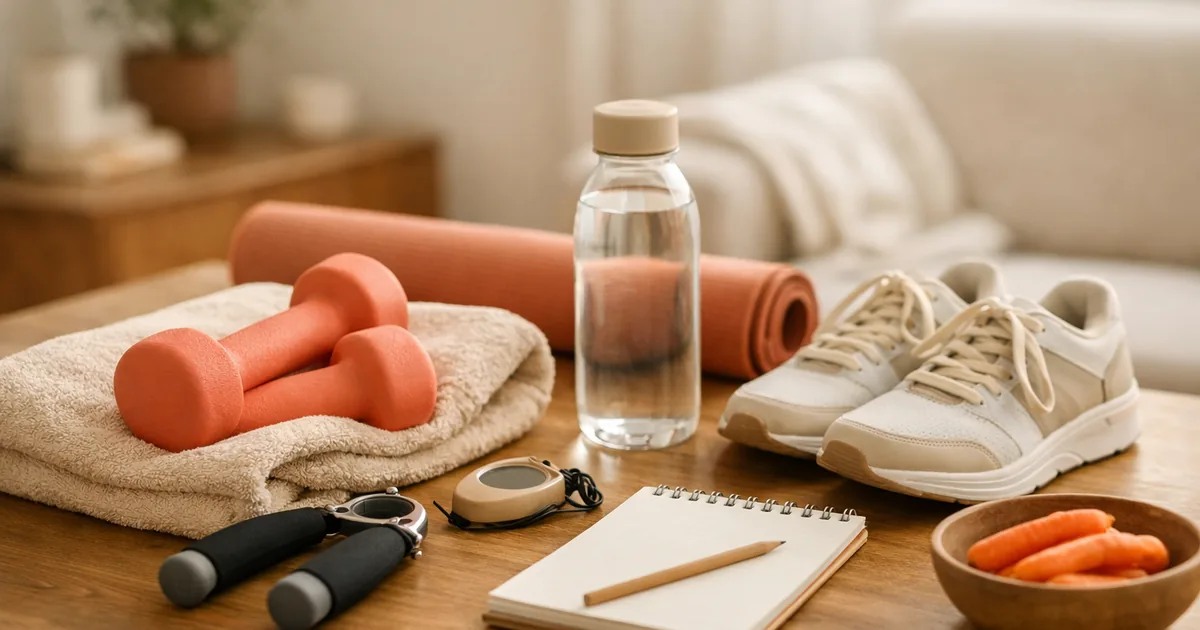
| ③ Track it | “A device (for example, a step counter) or keep a written log” | NIA text |
| ④ Do it with people | “Exercise classes, walking groups, or exercise buddy systems” | NIA text |
| ⑤ Shoes | Shoes that “fit well and provide proper support” with “nonskid soles” | NIA text |
| Warm up and cool down | “Recommended to help prevent injuries and other negative health events, such as heart attack or stroke” | NIA text |
Do I need to ask a doctor first? NIA splits the answer. With a chronic condition, “talk with your doctor about exercising with chronic conditions.” Without one, people “generally do not need to talk with a doctor” as long as they increase activity gradually. In other words, a check-up is not a prerequisite for starting.
Note that “a 10-minute walk three times per week” is NIA's own worked example. The agency's target is 150 minutes a week; its starting example is 30. Closing that gap in one step is not the instruction. How the agencies' targets differ is in the activity-target comparison.
Why strength work specifically — NIA's explanation
NIA describes what resistance training does inside the body this way.
Resistance training burns through ATP reserves, triggering “short-term chemical changes in the DNA of muscle tissue that make them more tuned to specific proteins supporting sugar and fat metabolism.” The effects linger “in the body for hours after exercise.”
— NIA, How can strength training build healthier bodies as we age? (June 30, 2022)
The combination that same article recommends is “150 minutes per week of moderate-level exercise, with strength training in the mix one to two times per week.” That differs slightly from the table above — the page reviewed in 2025 says “at least two days per week,” the 2022 article says “one to two times.” We have left both standing rather than picking one.
How many people, in Korea — the KDCA survey
Everything above comes from US agencies. We found the Korean figures — a surveillance report in the Korea Disease Control and Prevention Agency's own journal.
“In 2022, among those aged 65 and over, the rate of low handgrip strength was 14.2% in men and 18.8% in women, and sarcopenia prevalence was 6.6% in men and 9.2% in women. Sarcopenia prevalence was higher at older ages, higher in women than men, and higher in lower-income groups.”
— KDCA, “Prevalence of sarcopenia in Korea,” Public Health Weekly Report 2024;17(24):1055-1067 (published online May 16, 2024)
| Indicator (aged 65+, 2022) | Men | Women |
|---|---|---|
| Low handgrip strength | 14.2% | 18.8% |
| Sarcopenia prevalence | 6.6% | 9.2% |
The gap between the two rows matters. Low grip strength runs 14.2% and 18.8%, but sarcopenia is less than half of that — because sarcopenia is not diagnosed on grip alone. The study classified handgrip and bioelectrical-impedance muscle mass data according to the 2019 Asian Working Group for Sarcopenia criteria. Strength and mass together.
This points the same way as NIA's curve. NIA wrote that decline “accelerates past 65 in women and 70 in men”; the Korean survey finds women above men at 65+. The shape in the US material and the numbers in the Korean material do not contradict each other.
And one more line from the study — “higher in lower-income groups.” The authors conclude that because “older age and lower income confer vulnerability to sarcopenia, early detection and prevention and management programs need to be focused on those groups.” It is not only a question of exercise.

Questions this raises
How much protein?
The NIA material we opened does not give a protein figure. It is the number most sarcopenia articles lead with, but we could not verify it against agency text, so it is not here. What NIA named as the method was resistance training.
Isn't walking enough?
In NIA's taxonomy walking is aerobic. Strength is defined separately as lifting against gravity and carries its own target (two days a week). Walking does not substitute for it.
At what age should I start caring?
Strictly, from the peak at 30–35 onward. The point where the gradient changes is 65 for women and 70 for men — so whatever you banked before that is what carries you after.
How long until it works?
No “X% in Y weeks” figure appears in this material. What NIA states is that the effect of resistance training “lingers in the body for hours after exercise” — and no further.
Muscle peaks in the mid-thirties. The next thirty years feel like nothing is happening, and then the gradient changes at 65 for women and 70 for men. What you did during the quiet part decides the rest.
Need strength exercises to start at home? The NHS sets out seven chair-and-wall moves at least twice a week, such as 5 sit-to-stands and 3 sets of 5-10 wall press-ups (strength exercises for older adults).
Sources
- National Institute on Aging — How can strength training build healthier bodies as we age? (June 30, 2022). Source for “peak at around 30 to 35 years of age,” “faster after age 65 for women and 70 for men” (Baltimore Longitudinal Study of Aging), the definition of sarcopenia and its functional signs, the ATP / DNA explanation, and “150 minutes per week… strength training one to two times per week.”
- National Institute on Aging — Three Types of Exercise Can Improve Your Health and Physical Ability (reviewed January 14, 2025). Source for the definitions of aerobic, strength and balance work, 150 / 75 minutes, strength at least two days a week, balance about three sessions a week, and the strength-exercise examples.
- National Institute on Aging — Tips for Getting and Staying Active as You Age (reviewed January 14, 2025). Source for gradual progression, the “10-minute walk three times per week” goal example, tracking, buddies, footwear, warm-up and cool-down, and the split on whether to consult a doctor first.
- Korea Disease Control and Prevention Agency — Kim D, Oh K (Division of Health and Nutrition Survey and Analysis), “Prevalence of sarcopenia in Korea”, Public Health Weekly Report 2024;17(24):1055-1067 (published online May 16, 2024). Source for the 2022 KNHANES figures for those aged 65+ — low handgrip strength 14.2% (men) and 18.8% (women), sarcopenia prevalence 6.6% and 9.2% — the use of the 2019 AWGS criteria, and the finding that prevalence was “higher at older ages, higher in women than men, and higher in lower-income groups.”
Where to check further
- Daily protein target. Almost every article on sarcopenia carries a number, but it was not on the NIA pages we opened, and the NIH Office of Dietary Supplements has no consumer fact sheet for protein, so none appears here. National dietary reference intakes give it per kilogram of body weight.
- The diagnostic cut-offs. The Korean survey used the 2019 Asian Working Group criteria, but the grip-strength and muscle-mass thresholds are in neither that summary nor the NIA pages, so no self-assessment table was built. Actual measurement is available through body-composition and grip-strength testing at a clinic or public health centre.
- Strength training frequency differs between sources. NIA's 2025 reviewed page says “at least 2 days a week” while a 2022 article says “1 to 2 times a week”; both are reproduced. Taking the more recent figure is the safer default.
Written as of July 2026. The peak age, the acceleration points, and the three activity targets come from NIA source text. For balance and falls see fall prevention; for the bone side see osteoporosis. If you take several medicines, see managing them as well. This is general health information and does not replace medical diagnosis or treatment. If you have a chronic condition, talk to a clinician before starting.