The World Health Organization recommends muscle-strengthening activities on 2 or more days a week for people 65 and over too. But what, and how many times? The UK National Health Service sets out seven moves that need only a chair and a wall, with repetitions — 5 sit-to-stands, 3 sets of 5–10 wall press-ups and so on. We quoted the text as written.
1. At least twice a week, building up slowly. The NHS advises doing these at least twice a week and gradually increasing the repetitions.
2. Most are 5 repetitions. Sit-to-stand, mini-squats, calf raises and sideways leg lifts are 5 each, and leg extensions are held for 5 seconds × 5 per leg.
3. Arms get 3 sets. Wall press-ups are 3 sets of 5–10, and biceps curls with light weights 3 sets of 5 per arm.
How much — WHO and NHS
| Item | WHO (65+) | NHS (strength guide) |
|---|---|---|
| Frequency | Muscle strengthening of major groups on 2 or more days | At least twice a week, combined with the other routines in the series |
| Progression | — | Build up slowly and gradually increase repetitions |
| Alongside | 150 minutes of moderate aerobic activity · balance on 3 days with poor mobility | Balance and flexibility routines |
Seven moves — NHS
| Move | How | How many |
|---|---|---|
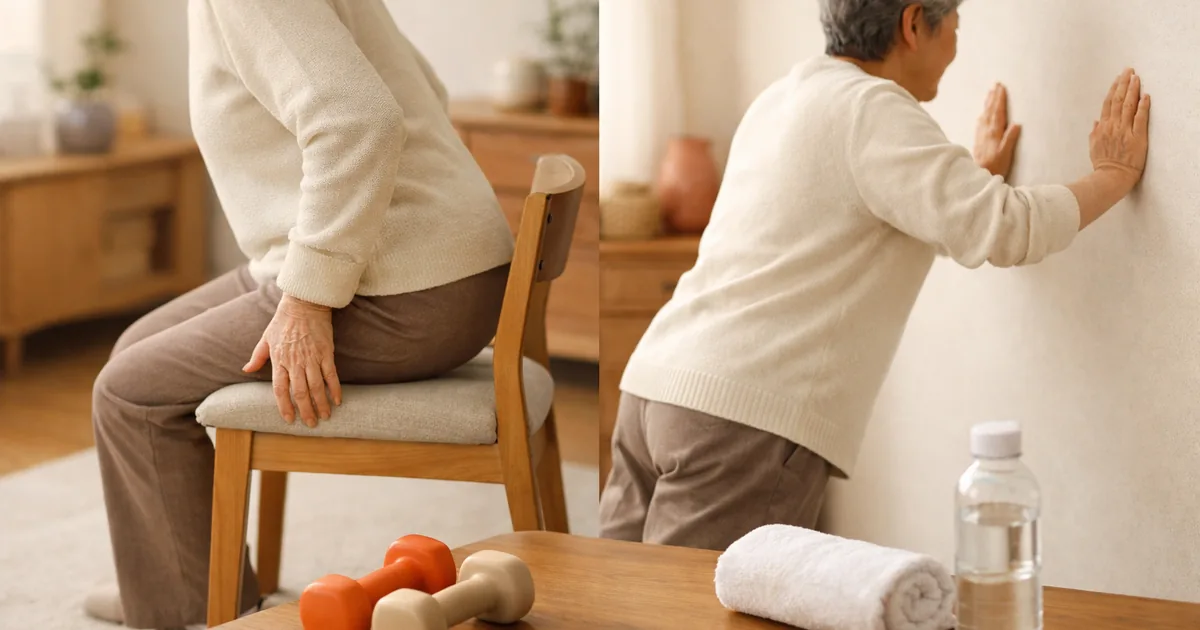
| 1. Sit-to-stand | Sit at the front of a chair, feet hip-width apart, leaning slightly forward; looking ahead, stand using your legs only, then sit back down | 5 — the slower the better |
| 2. Mini-squats | Hold the chair back, feet hip-width apart, bend your knees slowly as far as comfortable with knees facing forward, then squeeze your buttocks as you stand | 5 |
| 3. Calf raises | Hold the chair back and lift both heels as far as comfortable, slowly and with control | 5 |
| 4. Sideways leg lift | Holding the chair, raise each leg to the side without tilting | 5 per leg |
| 5. Leg extension | Holding the chair back, raise one leg backwards keeping it straight, without arching your back | Hold 5 seconds × 5 per leg |
| 6. Wall press-up | Stand arm’s length from a wall, hands flat at chest height, bend your arms to bring your body toward the wall, then push back | 3 sets of 5–10 |
| 7. Biceps curls | Holding light weights, feet hip-width apart, bend your arms slowly until the weight reaches your shoulder, then lower slowly | 3 sets of 5 per arm |
The NHS page is the version reviewed on 28 February 2024. It describes these moves as “gentle and easy to follow,” but stop and see a doctor if you feel pain or dizziness.
Fitting it into a week — an example
For example, doing the seven strength moves on Tuesday and Saturday and the five balance moves on Monday, Wednesday and Friday meets both WHO’s “strength on 2 days” and “balance on 3 days” (our example). Aerobic activity such as walking counts separately toward 150 minutes a week.
Checklist
- ☐ A sturdy chair and a clear wall
- ☐ At least twice a week — increase repetitions slowly
- ☐ Sit-to-stand: the slower the better
- ☐ Do not arch your back on leg extensions
- ☐ Stop if you feel pain or dizziness
Questions that remain
What if I do not have dumbbells?
The NHS text says only “light weights.” With no set weight, starting with something light you can lift easily and building up fits the guide’s “build up slowly.”
What about harder moves?
Chair workouts for general adults are in chair home workout, and knees in knee strengthening.
Sources
- World Health Organization (WHO) — Physical activity (Be Healthy) (checked 30 September 2026). Source for strength on 2 days, 150 aerobic minutes and balance on 3 days for 65+.
- UK National Health Service (NHS) — Strength exercises (reviewed 28 February 2024). Source for twice a week, building up slowly, and the seven moves with their numbers.
Where to check further
- Balance exercises — balance exercises for older adults.
- Sarcopenia — sarcopenia.
Written on 30 September 2026. We quoted the agencies’ own texts; the tables and example are ours.