The 30-Second Chair Stand in STEADI, the fall-prevention toolkit from the US Centers for Disease Control and Prevention (CDC), tests leg strength and endurance. You sit on a chair without arm rests with your arms crossed and count how many times you come to a full stand in 30 seconds. The CDC sheet gives a “below average” cut-off for each age and sex — at 60–64, fewer than 14 stands for men and fewer than 12 for women — and says “a below average score indicates a risk for falls.” We set out the sheet and added a checker that compares your age, sex and count with the table.
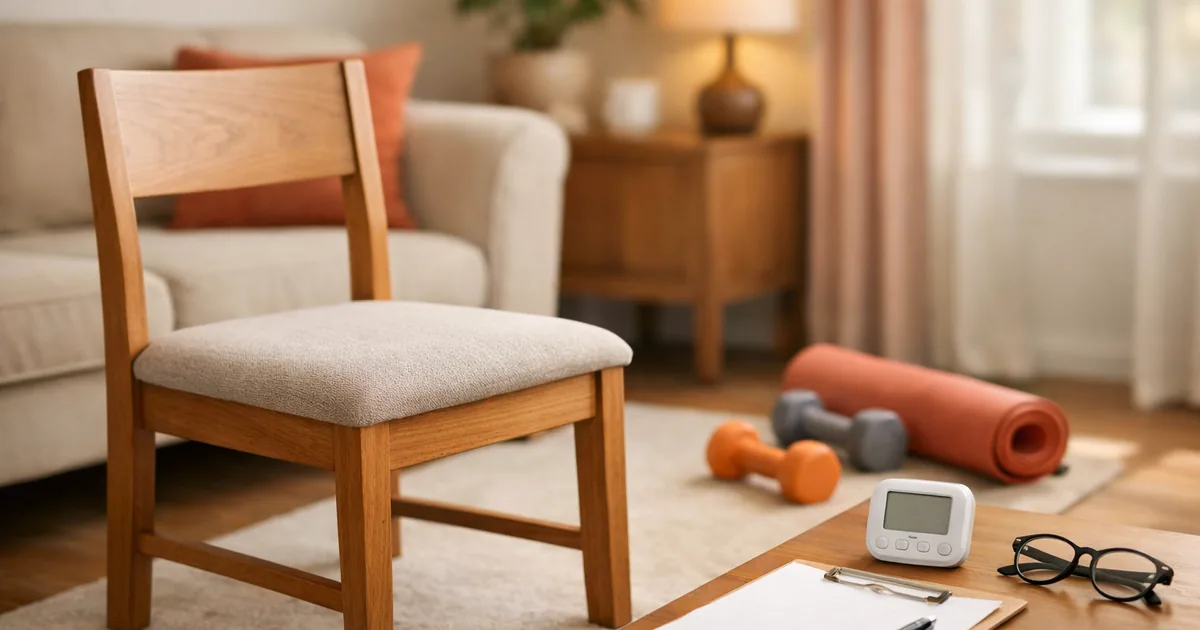
1. Full stands in 30 seconds. A straight-backed chair without arm rests (seat 17 inches high) and a stopwatch. Hands on the opposite shoulders, crossed at the wrists.
2. If you must use your arms to stand, the test stops and the score is “0”. Over halfway up when 30 seconds end counts as a stand.
3. Below average is fewer than 14 stands for men and 12 for women at 60–64, and fewer than 7 and 4 at 90–94. A 72-year-old woman with 9 stands is under the cut-off of 10, so below average (our example).
How the test is done — as the CDC sheet says
| Item | CDC wording | Worth noting (our reading) |
|---|---|---|
| Purpose | To test leg strength and endurance | A test that measures, not a workout |
| Equipment | A chair with a straight back without arm rests (seat 17 inches high), and a stopwatch | 17 inches is about 43 cm (our conversion: 17 × 2.54 = 43.18) |
| Sitting position | Sit in the middle of the chair · hands on the opposite shoulder, crossed at the wrists · feet flat on the floor · back straight, arms against the chest | Keeps the arms from pushing you up |
| What you do | On “Go,” rise to a full standing position, then sit back down again; repeat for 30 seconds | Only a full stand counts |
| The tester | Begin timing on “Go” · if the patient must use their arms to stand, stop the test and record “0” for the number and score · count the full stands in 30 seconds · over halfway up when 30 seconds have elapsed counts as a stand | Even the last half-stand is settled |
| Safety | Stand next to the patient for safety | Trying it at home, having someone stand beside you is closest to the sheet (our reading) |
The CDC says STEADI (Stopping Elderly Accidents, Deaths & Injuries) “was created for healthcare providers who treat older adults who are at risk of falling, or who may have fallen in the past.” This sheet is written as something a clinician does with a patient. This page sets out the method and the table; it does not diagnose fall risk.
The cut-offs by age and sex — fewer than this is below average
| Age | Men | Women |
|---|---|---|
| 60–64 | fewer than 14 | fewer than 12 |
| 65–69 | fewer than 12 | fewer than 11 |
| 70–74 | fewer than 12 | fewer than 10 |
| 75–79 | fewer than 11 | fewer than 10 |
| 80–84 | fewer than 10 | fewer than 9 |
| 85–89 | fewer than 8 | fewer than 8 |
| 90–94 | fewer than 7 | fewer than 4 |
Beside the table the CDC sheet says “A below average score indicates a risk for falls.” We read “<14” as 13 or fewer being below average and 14 or more not. The table covers ages 60 to 94 only, so other ages have no cut-off.
Read down the table, the men’s cut-off falls from 14 at 60–64 to 7 at 90–94 and the women’s from 12 to 4. At 85–89 both are 8, and at 90–94 the women’s 4 is 3 below the men’s 7 (our summary). The sheet does not say how the table was set.
Checker
Compares as you type. The cut-offs are the CDC table; “fewer than” means a count below the cut-off (our reading). If you had to use your arms, the count is 0 as the sheet says. Count a last stand that was over halfway up when 30 seconds ended. Under 60 and 95 or over have no cut-off in the table, so no verdict is given.
Five comparisons — our examples
| Example (ours) | Cut-off | Result (our arithmetic) |
|---|---|---|
| Woman, 72, 9 stands | fewer than 10 | Below average — 1 short of the cut-off |
| Woman, 72, 10 stands | fewer than 10 | Not below average — equal to the cut-off |
| Man, 63, 13 stands | fewer than 14 | Below average — the same 13 for a woman of 63 (fewer than 12) is not |
| Man, 78, had to use arms | fewer than 11 | Recorded as 0, below average |
| Woman, 92, 4 stands | fewer than 4 | Not below average — a man of 92 with 4 is under 7, so below average |
The checker opens on a 72-year-old woman with 9 stands, arms crossed: cut-off 10, “below average”. Every cut-off in the table is 4 or more, so a 0 for using the arms is below average at every age from 60 to 94 (our arithmetic).
Checklist
- ☐ A straight-backed chair without arm rests, seat 17 inches (about 43 cm)
- ☐ The chair against a wall or someone holding it — the sheet says “stand next to the patient”
- ☐ Hands on the opposite shoulders, crossed at the wrists · feet flat
- ☐ Only full stands count, plus a last one over halfway up
- ☐ Had to use arms? Stop there and score 0
Putting the chair against a wall is our suggestion, not on the sheet. The only safety step the sheet gives is to stand next to the person.
Questions that remain
What if I score below average?
The sheet says a below average score indicates a risk for falls and that CDC’s STEADI tools can help clinicians screen, assess and intervene to reduce fall risk. What to do next is not on the sheet — showing the result to your doctor fits its intent (our reading). Everyday fall-prevention steps are in falls in older adults.
Exercises to build leg strength?
The NHS strength exercises for older people (including sit-to-stand) are in strength exercises for older adults, and a whole-body routine with one chair is in the chair workout. The balance test from the same STEADI set is in the 4-Stage Balance Test.
Can I try it under 60?
The table starts at 60, so there is nothing to compare an under-60 score with, and the checker gives no verdict below 60.
Sources
- CDC STEADI — Assessment: 30-Second Chair Stand — original (PDF) (sheet dated 2017; checked 11 November 2026). Purpose, equipment (17 inches), patient and tester instructions, “stand next to the patient,” the age and sex table, “a below average score indicates a risk for falls.”
- CDC STEADI — Clinical Resources — original (last reviewed 28 July 2025; checked 11 November 2026). Lists the 30-Second Chair Stand, 4-Stage Balance and TUG sheets.
- CDC — STEADI — original (last reviewed 28 July 2025; checked 11 November 2026). Created for healthcare providers who treat older adults at risk of falling or who may have fallen.
- Not read. The demonstration video (2:08), the STEADI screening algorithm PDF, the TUG (Timed Up and Go) sheet, the research behind the table, Korean norms.
- What we added. The cm conversion, the reading of “fewer than”, the table summary and examples, the wall suggestion, the checker.
Where to check further
- Your doctor — if you scored below average or have fallen recently.
- Activity guidelines at 65 and over — NHS guidelines for older adults.
Written on 11 November 2026. The method and the table are from the CDC; the conversion, examples and checker are ours.