The 4-Stage Balance Test in STEADI, the fall-prevention toolkit from the US Centers for Disease Control and Prevention (CDC), assesses static balance — balance while standing still. You hold four standing positions that get progressively harder, for 10 seconds each, and the test stops at the first one you cannot hold. The CDC sheet has one interpretation sentence: “An older adult who cannot hold the tandem stand for at least 10 seconds is at increased risk of falling.” We set out the sheet and added a checker: enter the seconds held at each stage to see where the test stops and whether the tandem stand reached 10 seconds.
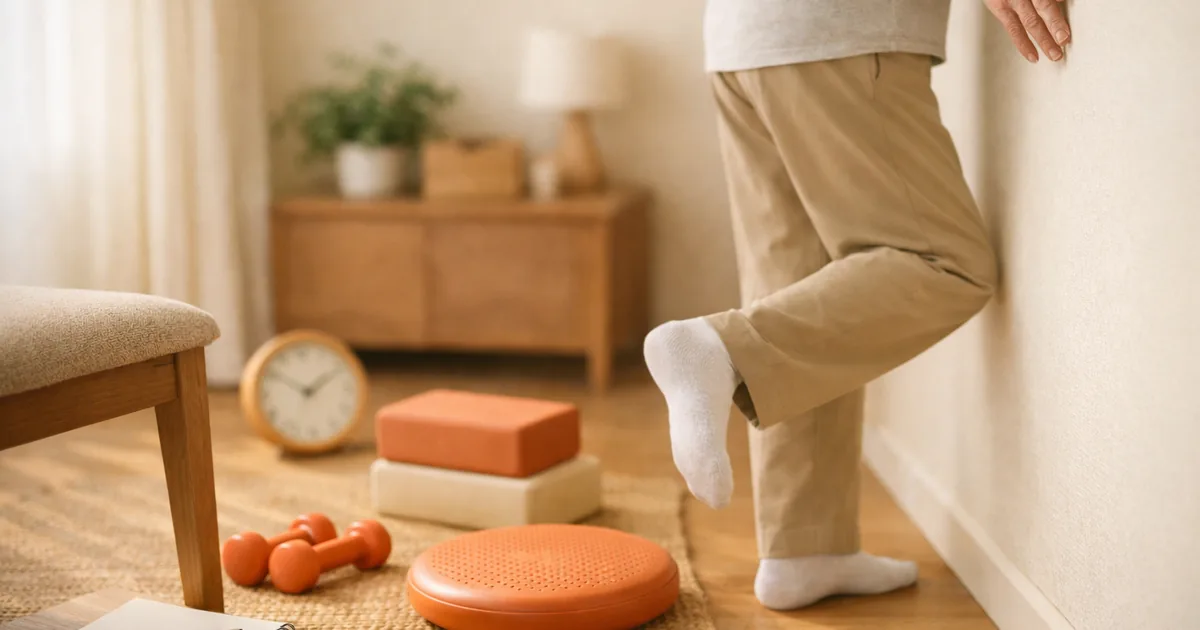
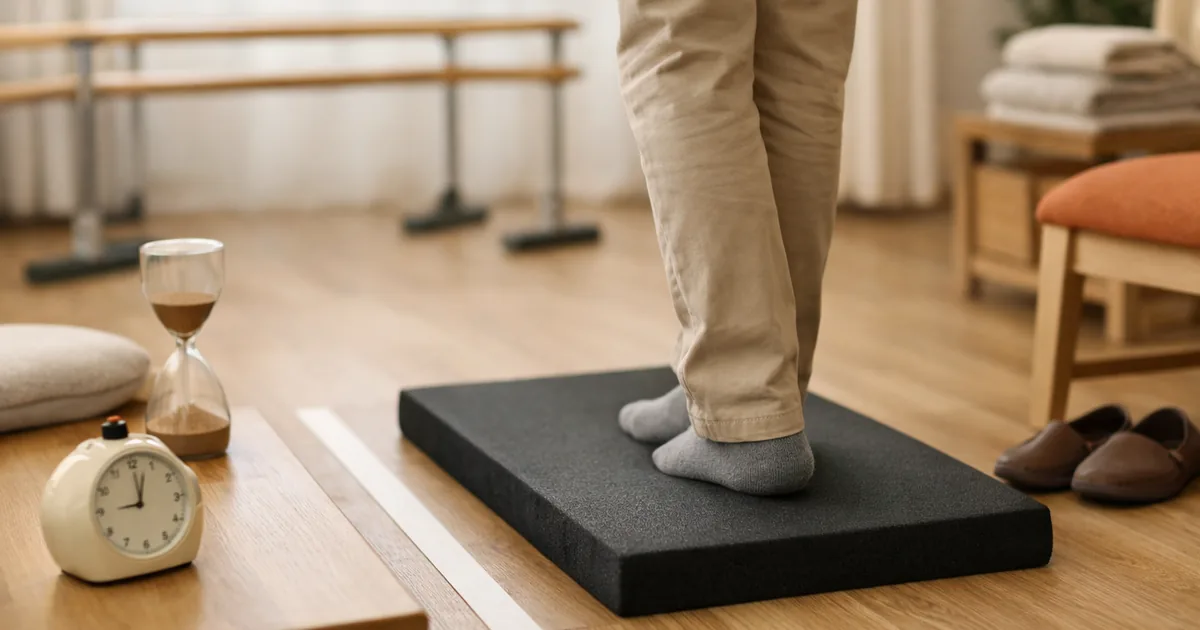
1. Four positions, 10 seconds each. Feet side by side → the instep of one foot touching the big toe of the other → tandem stand (heel touching toe) → standing on one foot.
2. Hold 10 seconds without moving the feet or needing support and go on; if not, stop the test. No cane or walker, eyes open; holding the arms out or moving the body is allowed.
3. Under 10 seconds in the tandem stand means increased risk of falling (CDC). If the feet moved after 6 seconds in the tandem stand, stages 1 and 2 are passed and the sentence applies (our example).
The four positions — as the CDC sheet says
| Stage | CDC wording | Worth noting (our reading) |
|---|---|---|
| Stage 1 | Stand with your feet side-by-side | The easiest position |
| Stage 2 | Place the instep of one foot so it is touching the big toe of the other foot | A half-staggered (semi-tandem) stance |
| Stage 3 | Tandem stand: place one foot in front of the other, heel touching toe | The position the interpretation sentence is about |
| Stage 4 | Stand on one foot | The sheet gives no separate cut-off here |
The record box has one line per stage, “Time: ___ seconds.” The sheet does not say which foot goes in front or which foot to stand on.
How the test is done — the tester and the person standing
| Who | CDC wording | Worth noting (our reading) |
|---|---|---|
| Purpose · equipment | To assess static balance · a stopwatch | No chair or mat needed |
| The tester | Four positions that get progressively harder · describe and demonstrate each one · stand next to the patient, hold their arm and help them into position · when steady, let go and time how long they hold it, ready to assist if they lose balance | The 10 seconds start when the hand lets go |
| Going on · stopping | If the patient can hold a position for 10 seconds without moving their feet or needing support, go on to the next; if not, stop the test | Nothing after the failed stage is done |
| Conditions | No assistive device (cane or walker), eyes open | Not an eyes-closed test |
| To the person standing | “I’m going to show you four positions” · try to stand in each for 10 seconds · you can hold your arms out or move your body to keep your balance, but don’t move your feet · timing starts at “Ready, begin” and ends with “Stop” after 10 seconds | Arms and body may move; the feet are what counts |
The CDC says STEADI “was created for healthcare providers who treat older adults who are at risk of falling, or who may have fallen in the past,” and the sheet has a clinician holding the patient’s arm. Trying it at home, having someone beside you ready to catch you is closest to the sheet (our reading). This page sets out the method and the sentence; it does not diagnose fall risk.
Checker
Updates as you choose. “10 s” means held without moving the feet or needing support. As the sheet says, the test stops at the first stage under 10 seconds and later choices are ignored. Stopping at stage 1 or 2, before the tandem stand, we read as not holding the tandem stand for 10 seconds (our reading). The sheet gives no cut-off for the one-foot stand, so it is not used in the verdict.
Five cases — our examples
| Example (ours) | Last stage held | Result (our reading) |
|---|---|---|
| 10 s · 10 s · tandem 6 s | Stage 2 | Tandem under 10 seconds — the CDC sentence applies; no one-foot stand |
| 10 s · 10 s · 10 s · one foot 3 s | Stage 3 | Tandem held 10 seconds — the sentence does not apply; no cut-off for the 3 s |
| All four for 10 s | Stage 4 | The sentence does not apply |
| 10 s · stage 2 for 7 s | Stage 1 | Stopped before the tandem stand — read as not holding it for 10 seconds |
| Stage 1 for 4 s | Stage 0 | Stopped at the first position — the same reading |
The checker opens on 10 s, 10 s and a 6-second tandem stand: stage 2 passed, “tandem stand 6 seconds, under 10”. Holding all four for 10 seconds is 40 seconds of standing (our arithmetic) — the whole test takes under a minute.
Checklist
- ☐ A stopwatch and someone beside you ready to catch you
- ☐ No cane or walker, eyes open
- ☐ The 10 seconds start when the helping hand lets go
- ☐ Arms and body may move; if the feet move, stop at that stage
- ☐ The tandem stand (stage 3) for 10 seconds is the yardstick
Questions that remain
What if I cannot hold the tandem stand?
The sheet says only that the risk of falling is increased; it does not say what to do next. Showing the result to your doctor fits its intent (our reading). The NHS balance exercises for older people (five moves beside a wall and more) are in balance exercises for older adults.
Is leg strength tested separately?
Yes — the 30-Second Chair Stand from the same STEADI set tests leg strength and endurance, and that is the one with an age and sex table.
Is it worth doing when younger?
The interpretation sentence is about “an older adult,” and the sheet gives no age bands. Nothing on the sheet supports reading a younger person’s result against it.
Sources
- CDC STEADI — Assessment: The 4-Stage Balance Test — original (PDF) (sheet dated 2017; checked 11 November 2026). Purpose and equipment, tester and patient instructions, the four positions, no assistive device and eyes open, “an older adult who cannot hold the tandem stand for at least 10 seconds is at increased risk of falling.”
- CDC STEADI — Clinical Resources — original (last reviewed 28 July 2025; checked 11 November 2026). Lists the 4-Stage Balance Test sheet and its demonstration video.
- CDC — STEADI — original (last reviewed 28 July 2025; checked 11 November 2026). Created for healthcare providers.
- Not read. The demonstration video (2:06), the STEADI screening algorithm PDF, the TUG sheet, the research behind the 10-second line, any one-foot cut-off (none on the sheet), Korean data.
- What we added. The reading for stopping at stage 1 or 2, the examples, the 40-second sum, the checker.
Where to check further
- Your doctor — if you could not hold the tandem stand or have fallen recently.
- Reducing falls — falls in older adults.
Written on 11 November 2026. The method and the interpretation sentence are from the CDC; the reading, examples and checker are ours.