With age, balance needs as much attention as strength. The World Health Organization recommends balance activities on 3 or more days a week for people 65 and over with poor mobility, and the UK National Health Service sets out five moves to do beside a wall or chair at least twice a week. We quoted the WHO, NHS and US Centers for Disease Control and Prevention (CDC) texts as written.
1. With poor mobility, 3 or more days a week. WHO recommends activities that improve balance and prevent falls on 3 or more days for people 65+ with poor mobility. The NHS guide says at least twice a week.
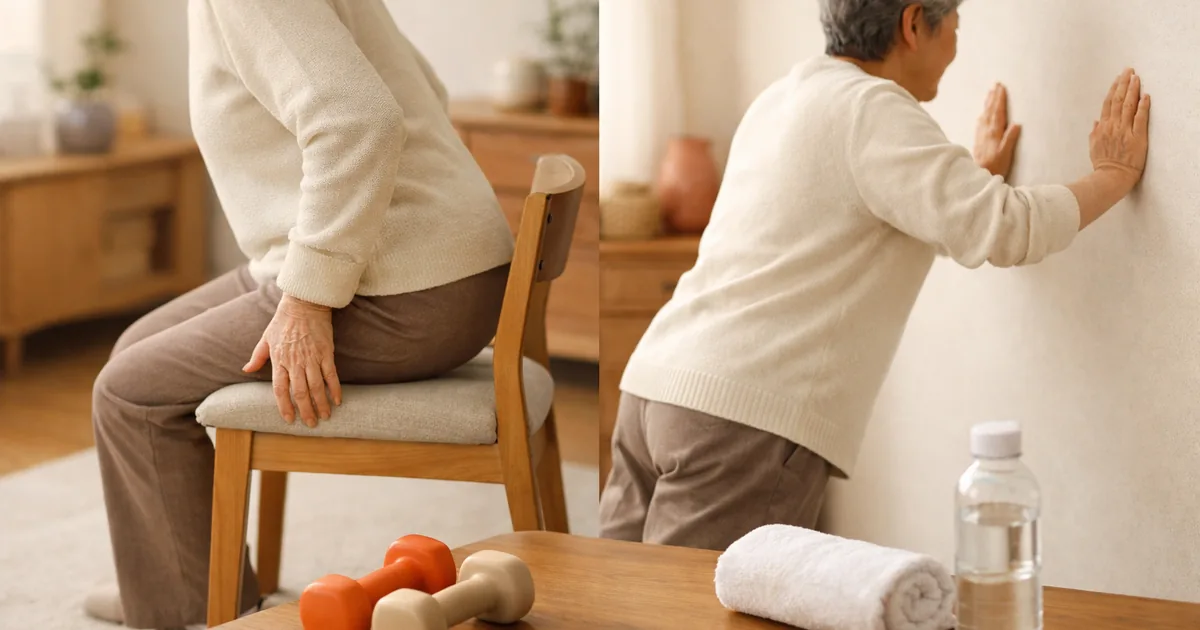
2. Do them beside a wall or a stable chair. That is the NHS guide’s first safety point, in case you lose your balance.
3. Five moves with set numbers. Sideways walking 10 steps each way, grapevine 5 each side, heel-to-toe walk at least 5 steps, one-leg stand 5–10 seconds × 3 each side, and step-ups 5 each leg.
How much — WHO and CDC
| Item | WHO (65+) | CDC (65+) |
|---|---|---|
| Aerobic | 150 moderate or 75 vigorous minutes a week, or a combination | The same |
| Strength | Major muscle groups on 2 or more days | 2 or more days |
| Balance | 3 or more days with poor mobility | Activities to improve balance — e.g. walking heel-to-toe, standing from a sitting position |
Five moves — NHS
| Move | How | How many |
|---|---|---|
| 1. Sideways walking | Feet together, knees slightly bent, step one foot to the side slowly and bring the other to join it | 10 steps each way (or across the room) |
| 2. Simple grapevine | Cross the right foot over the left, then bring the left foot to join it — hold a wall if needed | 5 cross-steps each side |
| 3. Heel-to-toe walk | Standing upright, place the right heel directly in front of the left toe, then the same with the left — look ahead | At least 5 steps |
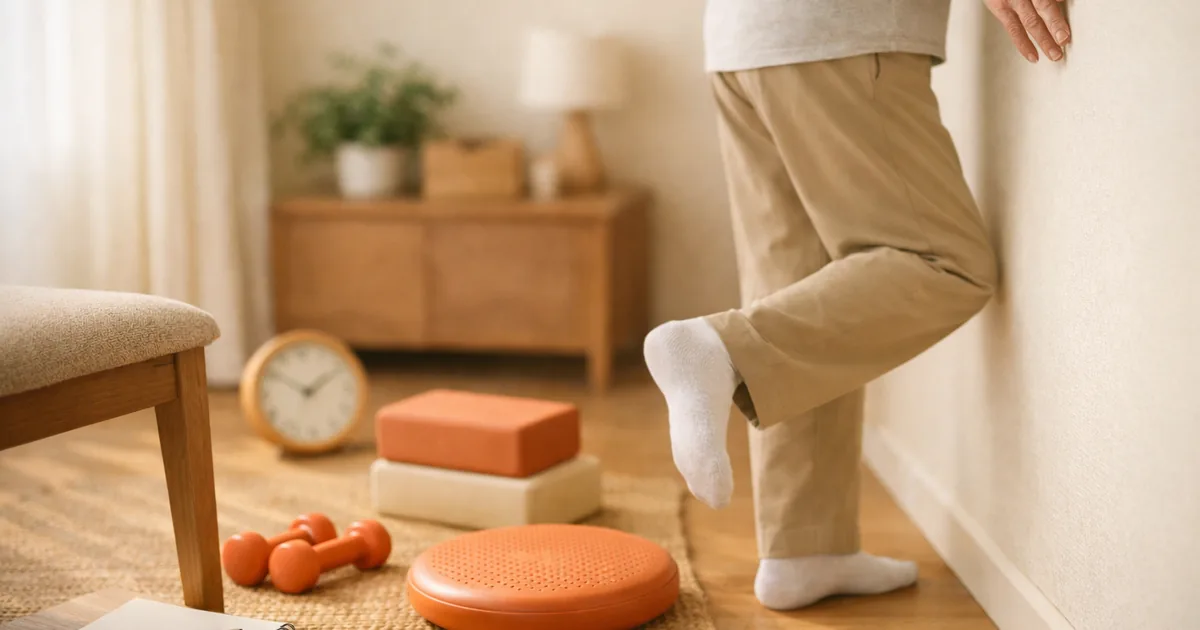
| 4. One-leg stand | Face a wall with arms out and fingertips on it, lift one leg keeping hips level, slight bend in the other knee | 5–10 seconds × 3 each side |
| 5. Step-up | Step up with the right leg, bring the left to join it, then step down to the start | Up to 5 with each leg |
The NHS page is the version reviewed on 7 November 2023.
Fitting it into a week — an example
To meet WHO’s “3 days,” you might do the five moves on Monday, Wednesday and Friday and keep two separate days for strength training (our example). Use the NHS numbers as given, and hold a wall or chair if you feel unsteady.
Checklist
- ☐ Beside a wall or stable chair — in case you lose your balance
- ☐ 3 or more days a week with poor mobility (WHO)
- ☐ One-leg stand 5–10 seconds × 3 each side
- ☐ Strength training on 2 separate days — knee strengthening
- ☐ Stop and see a doctor if you feel dizzy or in pain
Questions that remain
Twice a week (NHS) or 3 days (WHO)?
WHO’s 3 days is a recommendation for people 65+ “with poor mobility,” while the NHS twice a week is the minimum frequency for these five moves. The groups differ slightly, so with poor mobility, 3 days is the benchmark.
Other ways to prevent falls at home?
Home hazards and medication checks are covered in fall prevention for older adults.
Sources
- World Health Organization (WHO) — Physical activity (Be Healthy) (checked 30 September 2026). Source for 150 and 75 minutes for 65+, strength on 2 days and balance on 3 days with poor mobility.
- US Centers for Disease Control and Prevention (CDC) — Physical Activity Guidelines for Older Adults (updated 4 December 2025). Source for the balance examples.
- UK National Health Service (NHS) — Balance exercises (reviewed 7 November 2023). Source for twice a week, wall and chair, and the five moves with their numbers.
Where to check further
- Exercise intensity — measuring exercise intensity.
- Fitness tests — National Fitness 100 certification centres.
Written on 30 September 2026. We quoted the agencies’ own texts; the tables and example are ours.