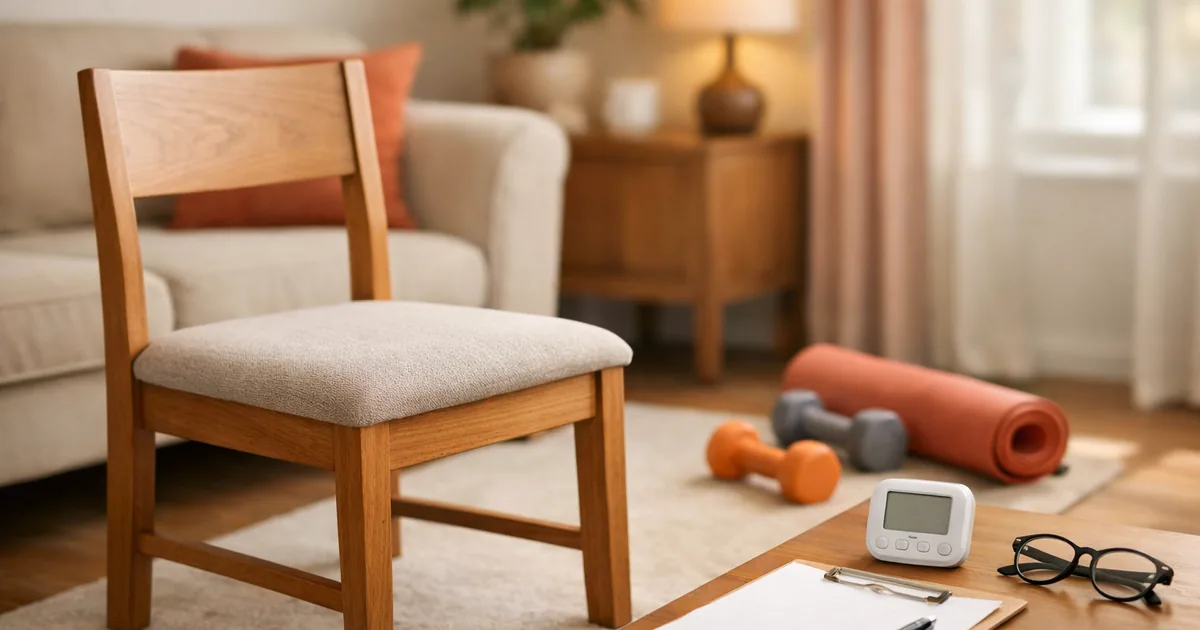
The US Centers for Disease Control and Prevention (CDC) gives the chair rise as a one-page “recommended exercise” sheet in STEADI, its falls-prevention toolkit. The Chair Rise strengthens the muscles in the thighs and buttocks, and the goal is to do it “eventually without using your hands”. The sheet says to do 10 to 15 repetitions, rest for 1 minute, then do a final set of 10 to 15, and to start with fewer and build up if that is too hard at first. We added a calculator that takes how many you can do in a set and how many days a week, and gives the count per session, per week and still to go to 10, and we set it next to the repetitions and sets in CDC’s “What counts” page and the NHS strength exercise page.
1. 10 to 15 → rest 1 minute → a final set of 10 to 15 — the CDC STEADI chair rise sheet (2017).
2. Sit near the front of a sturdy chair, breathe out as you stand up slowly, breathe in as you sit down slowly — do not drop into the chair; control the lowering all the way.
3. Fewer at first, hands less and less — 12 a set on 2 days a week makes 24 a session and 48 a week (our sum).
Calculator
Week total: - · still to go to 10 per set: -
Results update as you type. A “session” is two sets with a 1-minute rest between, as on the sheet, so it is our sum of “repetitions per set × 2”; a week is “session × days”. The chair rise sheet does not say how many days a week, so the default of 2 days comes from the CDC and NHS strength advice of “at least 2 days a week”.
For example, 12 a set on 2 days a week gives 24 a session and 48 a week (our sum). If you can do 6 a set now, that leaves 4 to go to 10, and the sheet says to start from those 6 and build up. At the top of the range, 15 a set on 3 days a week comes to 90 a week. If you are pushing on the chair with your hands, the sheet’s direction is to use your hands less as well as adding repetitions.
How to do it — the CDC sheet in 7 steps
| Step | CDC sheet | Worth noting (our gloss) |
|---|---|---|
| 1. Sit | Sit toward the front of a sturdy chair, knees bent, feet flat on the floor, shoulder-width apart | Avoid chairs on wheels (our addition) |
| 2. Hands and posture | Rest your hands lightly on the seat beside you. Back and neck straight, chest slightly forward | Hands rest, they do not push |
| 3. Lean | Breathe in and lean forward, shifting your weight to the front of your feet | — |
| 4. Stand | Breathe out and slowly stand up, using your hands as little as possible | — |
| 5. Pause | Pause for one full breath in and out | One breath standing |
| 6. Sit down | Breathe in as you slowly sit down. Do not drop into the chair; control the lowering as much as possible | Lowering is half the exercise |
| 7. Breathe out | Breathe out | — |
| Count | 10 to 15 → rest 1 minute → a final 10 to 15 | 2 sets, 20 to 30 a session (our sum) |
| At first | If 10 to 15 is too hard, start with fewer and work up. Use your hands less as you get stronger | Goal: no hands |
Next to other strength advice
| Source | Repetitions · sets · per week | Worth noting (our gloss) |
|---|---|---|
| CDC STEADI chair rise (2017) | 10 to 15 × 2 sets, 1 minute between. No days per week given | A sheet for one move only |
| CDC “What counts” (reviewed 6 December 2023) | Strength work on at least 2 days a week, 8 to 12 repetitions = 1 set, at least 1 set, 2 or 3 sets for more benefit. Until another repetition is hard without help | All major muscle groups: legs, hips, back, chest, abdomen, shoulders, arms |
| NHS “How to improve your strength and flexibility” (reviewed 21 July 2026) | At least 2 days a week, 8 to 12 repetitions = 1 set, at least 2 sets, 3 for more benefit. Build up gradually over several weeks | Body-weight examples: push-ups, sit-ups, squats, stair climbing |
Laid side by side, the sheet’s “two sets of 10 to 15” is a little more per set than the general strength advice (8 to 12, 1 to 3 sets). But the sheet puts its weight on “slowly, controlling the lowering” rather than “until another repetition is hard” (our reading). It works only the legs, so filling your 2 strength days with this alone falls short of the “all major muscle groups” CDC and the NHS ask for — arms and chest are in the push-up progression (starting at the wall), and the trunk in the standing core workout.
A test is not the exercise
STEADI also has a test using the same chair: how many times you can stand in 30 seconds — the cut-offs and a checker are in the 30-second chair stand test. The test is “fast, for 30 seconds”; this exercise is “slow, with the breath”, so the same move is counted differently (our gloss). If you would rather start with six moves holding a kitchen counter, strength and balance exercises NHS inform is one step earlier.
Checklist
- ☐ Front of a sturdy chair, feet shoulder-width apart on the floor
- ☐ Breathe in and lean → breathe out and stand → pause one breath → breathe in and sit slowly
- ☐ No dropping into the chair — control the lowering all the way
- ☐ 10 to 15, rest 1 minute, a final 10 to 15 (fewer at first)
- ☐ Use your hands less as you get stronger — the goal is no hands
- ☐ Strength work on at least 2 days a week, with arm and trunk exercises too
Questions that remain
What if I can do more than 15?
The sheet does not say to go above 15. The calculator counts whatever you enter and just flags anything over 15.
What if it hurts?
The chair rise sheet has no separate line on stopping with pain. If you have knee or hip pain or have fallen before, it is safer to talk to a doctor before starting (our addition).
What age is it for?
STEADI is an older-adult falls toolkit, but the sheet itself gives no age.
Sources
- CDC STEADI — Recommended Exercise: Chair Rise Exercise (2017) — source PDF (checked 16 November 2026). Thighs and buttocks, the no-hands goal, the 7 steps and breathing, 10 to 15, 1 minute, a final 10 to 15, fewer at first.
- CDC — What Counts as Physical Activity for Adults — source (page shows: reviewed 6 December 2023). Strength work at least 2 days a week, 8 to 12 = 1 set, at least 1 set or 2 to 3, major muscle groups.
- NHS — How to improve your strength and flexibility — source (page shows: reviewed 21 July 2026, next review 21 July 2029). At least 2 days a week, 8 to 12, at least 2 sets or 3, body-weight examples.
- Not read. STEADI’s other exercise sheets and the Spanish version, the STEADI provider toolkit itself, the research behind the chair rise counts, whether there is a revision after 2017, and Korean strength exercise guidance for older adults.
- What we added. The “worth noting” column, the calculator’s session, week and still-to-go sums, and the side-by-side reading of the three sources.
Where to check further
- Your doctor or a physiotherapist — with knee or hip pain, after surgery, or if you have fallen.
- Local exercise classes — strength and falls-prevention classes for older adults.
Written on 16 November 2026. The content is from the CDC and the NHS; the glosses and sums are ours.