NHS inform, Scotland’s national health information service, sets out falls-prevention exercise as six moves done holding something sturdy at home. Its “Strength and balance exercises” page says to hold a kitchen counter or a solid chair for easy marching, ankle movements, toe raises, toe walking, heel walking and sit to stand, starting with each exercise 2 or 3 times, building to about 5 after a couple of days and working up to 10 over a couple of weeks. With icy paths cutting down outdoor walking in winter, it is a good indoor set, so we added a checker that gives your next target from the number you do now and how you hold on.
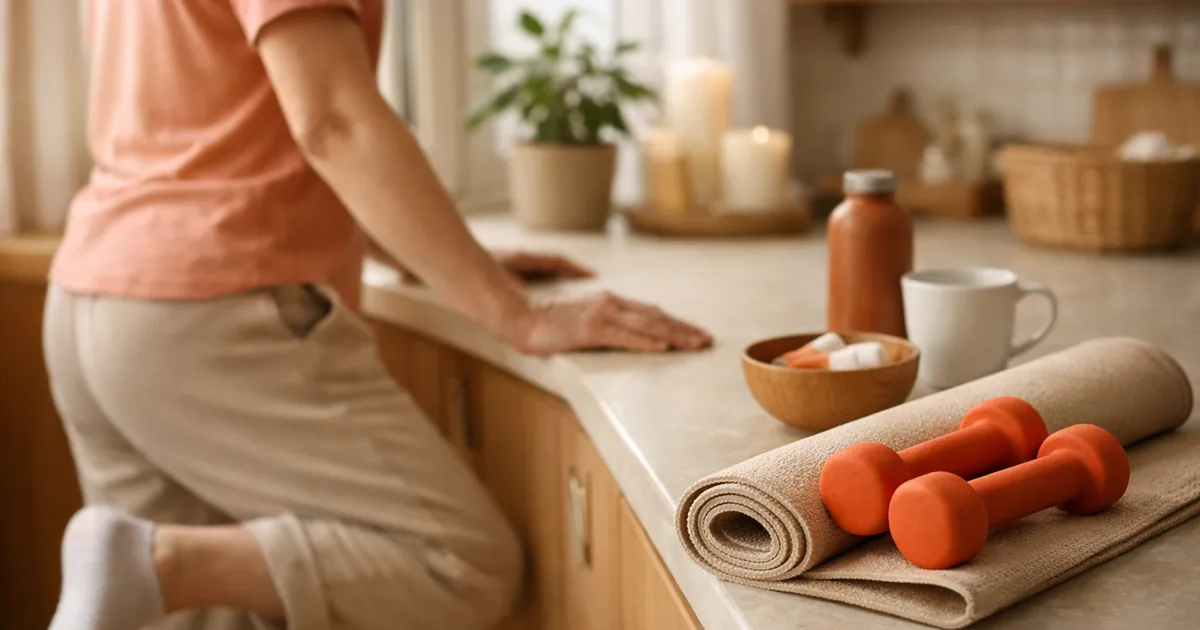
1. Hold on — a kitchen counter or a solid chair. Hold firmly at first, then a light fingertip touch, then a hand just above the support with a chair nearby.
2. 2 or 3 → about 5 → 10 — each exercise 2 or 3 times at first, about 5 after a couple of days, up to 10 over a couple of weeks.
3. 6 moves — easy marching (warm-up), ankles (up to 10 each leg), toe raises, toe walking and heel walking (10 steps each direction), sit to stand (up to 10).
Checker
Countable moves (ankles on both legs + toe raises + sit to stand): -
Results update as you type. The stages are our banding of the source’s “2 or 3 times at first, about 5 after a couple of days, up to 10 over a couple of weeks” (under 5 gives a next target of 5; 5 to 9 gives 10). “Countable moves” is our sum, assuming the same number of ankle movements on each leg and the same number of toe raises and sit-to-stands; the steps (10 each direction for toe and heel walking) are listed separately as the source gives them. Easy marching has no count in the source, so it is not counted.
For example, if you do 3 of each now, the next target is 5, and the countable moves that day come to 12 (3 ankle movements × 2 legs + 3 toe raises + 3 sit-to-stands, our sum). At 7, the next target is 10, and at 10 you reach 40, plus 40 steps of toe and heel walking (10 steps × 2 directions × 2 exercises). Once you reach 10, the source’s next step is to lighten your handhold rather than add more.
The six moves — NHS inform
| Move | NHS inform (position · movement · count) | Worth noting (our gloss) |
|---|---|---|
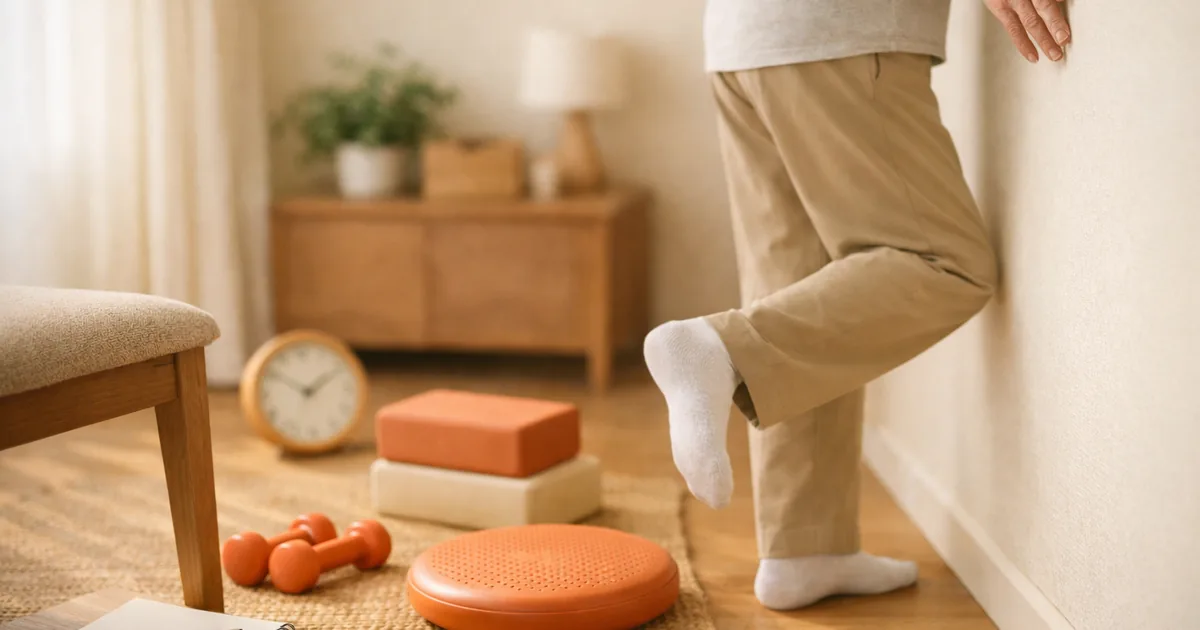
| 1. Easy marching | Feet about hip-width apart, relaxed, shoulders down. Walk on the spot, putting the ball of the foot down first and rolling through to the heel. Lift the knees higher as you warm up; take your hand off the support if confident | A warm-up before any exercise — no count or time in the source |
| 2. Ankle movements | Sit at the back of a chair, back supported, sitting tall. Lift one leg, slowly pull your toes towards your knee, then push them away. Up to 10 times each leg | Source: flexible ankles help with uneven pavements |
| 3. Toe raises | Hold a chair or counter and stand tall. Slowly bring your toes up towards your nose, as far as they go. Stomach tight, bottom tucked in | Source: the muscles at the front of the feet help lift your feet over obstacles. Wobbling is normal |
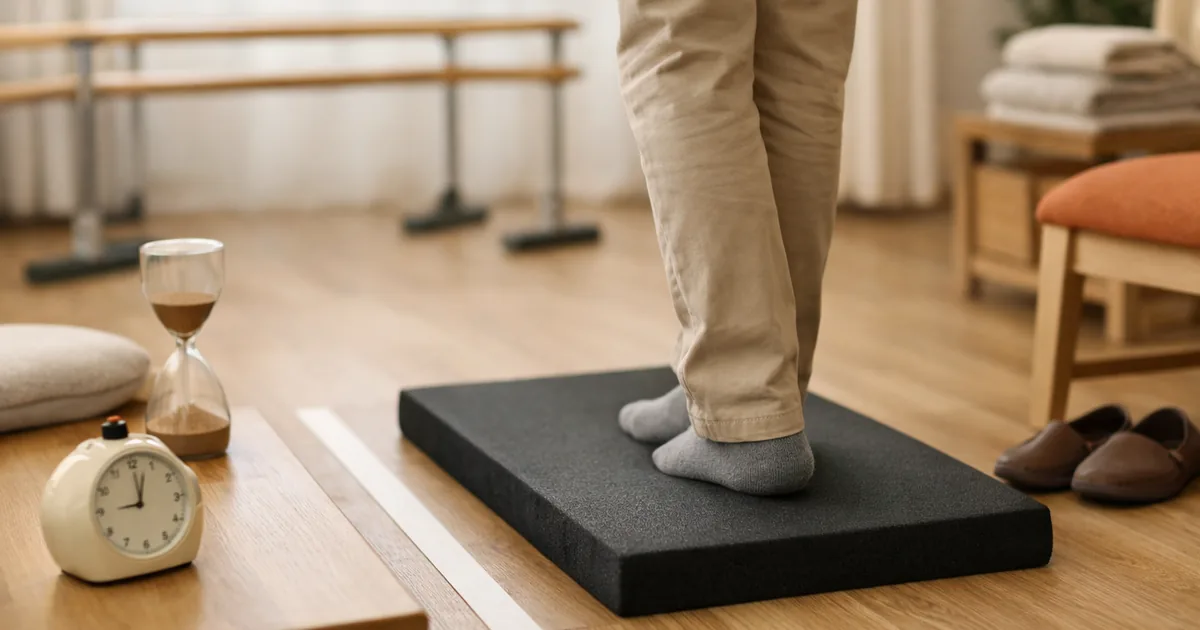
| 4. Toe walking | Stand tall with something to hold, tighten your stomach and slowly rise onto your toes. Take small, controlled steps with weight on the big and second toes, looking ahead. Lower your heels, turn towards your support and walk back. 10 steps each direction | A balance exercise |
| 5. Heel walking | Stand tall holding a solid support, pull your toes up towards your nose, stomach tight and bottom in, and take small steps on your heels with the toes raised throughout, looking ahead. 10 steps each direction | Source: a harder balance exercise — reduce the handhold over time |
| 6. Sit to stand | A solid chair. Use your back muscles to slide forward, toes back under the knees. Stand up slowly, shift your feet a little to get the blood flowing, and sit back down slowly with control. Up to 10 times | Both strength and balance; the source says it can be done anywhere in the home |
Of the six, four have a number in the source — ankles (up to 10 each leg), toe walking and heel walking (10 steps each direction) and sit to stand (up to 10). Easy marching and toe raises have no “how many”. That is why the checker uses the source’s overall sequence of 2 or 3 up to 10 for each exercise.
How to build up — repetitions and handhold
| What | What NHS inform says | Worth noting (our gloss) |
|---|---|---|
| Repetitions | Each exercise 2 or 3 times at first, about 5 after a couple of days, up to 10 over a couple of weeks | “A couple of days” and “a couple of weeks” are the source’s own rough wording — there is no dated schedule |
| Handhold 1 | Hold the counter or chair firmly | When starting out |
| Handhold 2 | A light fingertip touch | As confidence grows |
| Handhold 3 | Hand just above the support, with a chair nearby | A back-up in case you wobble |
| Sit to stand | Push firmly on the chair arms → fingertips → arms folded if confident | Folded arms is a step given only for this move |
| Then | When balance and strength feel better, you are ready to join a group or class | In Korea, public health centre or welfare centre exercise classes (our addition) |
The source does not say how many days a week. The weekly amounts for people aged 65 and over are in physical activity for adults 65 and over and balance exercises for older adults — this article does not repeat them.
Why look at this in winter
NHS inform says ankle movements help with “uneven pavements” and toe raises help you clear obstacles. When paths ice over and snow piles up, those are exactly where people fall (our gloss). How to walk on ice and what to wear is in snow and ice winter safety CDC, and what follows a fall, with the numbers, is in falls in older adults. The same standing-up move done as two sets of 10 to 15 from a CDC sheet is in chair rise exercise CDC.
Checklist
- ☐ Next to a kitchen counter or solid chair (hold firmly at first)
- ☐ Warm up with easy marching — ball of the foot first
- ☐ Start with 2 or 3 of each, about 5 after a couple of days, 10 over a couple of weeks
- ☐ Ankles up to 10 each leg; toe and heel walking 10 steps each direction
- ☐ Wobbling in toe raises is normal — stomach tight, bottom tucked in
- ☐ At 10, lighten the handhold: firm → fingertips → hand above, chair nearby
Questions that remain
How many days a week?
The page does not say. See the guidelines for adults 65 and over for weekly amounts.
What if it hurts or I feel dizzy?
This page has no separate “stop if” line. The NHS (England) Strength and Flex video page says to stop immediately if you feel any pain or become unwell — follow the same rule, and if you have fallen before or often feel dizzy, it is safer to talk to a doctor first (our addition).
Who are these exercises for?
The page sits in NHS inform’s falls-prevention section but does not give an age group.
Sources
- NHS inform — Strength and balance exercises (Preventing falls › Keeping well) — source (no review or update date shown on the page; checked 16 November 2026). 2 or 3 → about 5 → 10, the three handhold steps, the six moves’ position, movement and counts, groups and classes.
- NHS — Strength and Flex exercise plan: How-to videos — source (page shows: reviewed 19 August 2026). Stop immediately with pain or feeling unwell, and when to get advice first — used only in one line under “Questions that remain”.
- Not read. NHS inform’s “Keeping active to help prevent falls” (did not open) and “Moving around safely” pages, videos of these moves, the research NHS inform bases them on, and Korean public health centre or National Health Insurance Service falls-prevention exercise guidance.
- What we added. The “worth noting” column, the checker’s repetition bands and countable-moves sum, and the link to winter ice.
Where to check further
- Your GP or clinic — before starting if you have fallen, feel dizzy or have joint pain.
- Local exercise classes — the “group or class” the source points to.
Written on 16 November 2026. The content is from NHS inform; the glosses and sums are ours.