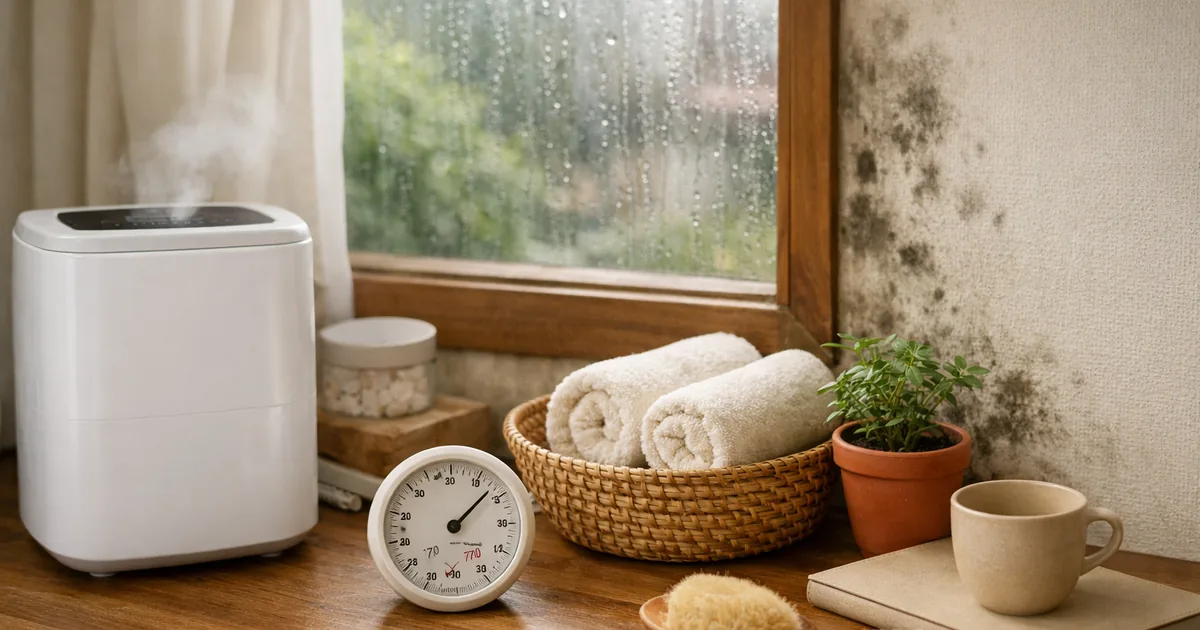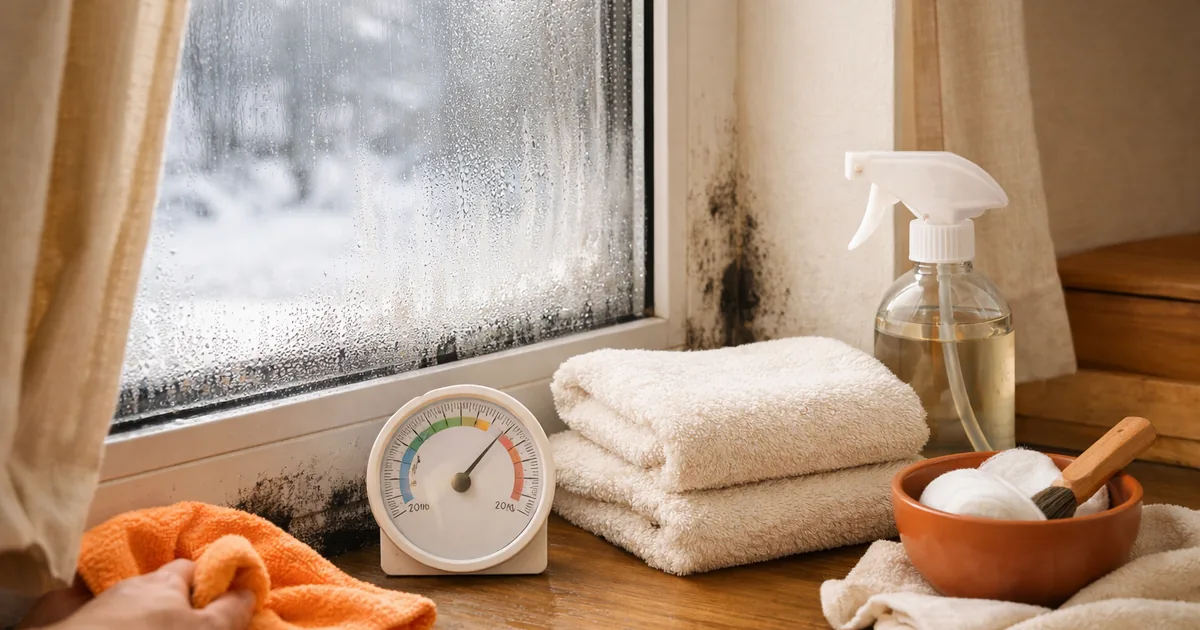
Water on the window frames on winter mornings and black spots spreading in a corner are condensation and mould. The US Environmental Protection Agency (EPA) says to keep indoor humidity below 60% if possible, ideally 30 to 50%. When water condenses on windows, walls or pipes, dry the surface quickly and reduce the moisture source. You can usually clean up mould yourself if it covers less than about 10 square feet; scrub hard surfaces with detergent and water and dry completely. Never mix bleach with ammonia cleaners, and don’t paint over mould. This sets out the EPA’s “A Brief Guide to Mold, Moisture and Your Home”.
1. Humidity below 60% if possible, ideally 30 to 50%. A cheap meter can measure it.
2. When water condenses, dry it fast and reduce the source — ventilate, run bathroom fans, insulate cold pipes.
3. Under about 10 square feet: detergent and water yourself — never mix bleach with ammonia; don’t paint over mould.
Humidity — EPA
The EPA says keep indoor relative humidity below 60% if possible, ideally between 30 and 50%, and that an inexpensive humidity meter can measure it.
EPA pages give different numbers: the humidifier page says don’t exceed 50%, and the mould cleanup page in our monsoon humidity and mould post says 50% or below. We carry each page’s figure as written.
When water condenses on windows, walls or pipes — EPA
| Type | What the source says | Worth noting (ours) |
|---|---|---|
| Straight away | Dry the wet surface quickly and reduce the moisture source | — |
| Lower humidity | Vent moisture-producing appliances outdoors; use air conditioners or dehumidifiers | — |
| Lower humidity | Run the bathroom fan or open a window when showering | — |
| Prevent it | Increase air circulation | — |
| Prevent it | Insulate cold surfaces such as cold water pipes | — |
If a humidifier makes windows run, the EPA humidifier page says move it or use it less (humidifier care).
Cleaning up mould — EPA
| Type | What the source says | Worth noting (ours) |
|---|---|---|
| Size | Usually DIY if less than about 10 square feet (roughly 3 ft by 3 ft) | About 0.93 m² (our conversion) |
| Hard surfaces | Scrub with detergent and water and dry completely | — |
| Absorbent materials | Ceiling tiles or carpet may have to be thrown away | — |
| Don’t | Mix chlorine bleach with cleaners containing ammonia | — |
| Don’t | Paint or caulk over mouldy surfaces | Paint is likely to peel |
When to call in help — EPA
| If | What to do | Worth noting (ours) |
|---|---|---|
| Lots of water damage, or mould over 10 square feet | A contractor experienced in mould cleanup | — |
| Soaked by contaminated water (such as sewage) | A professional experienced with that damage | — |
| You suspect the heating or cooling ducts are contaminated | Don’t run the system; check first | — |
| You have health concerns | See a health professional before cleaning | — |
The EPA says breathing in or touching mould can cause allergic reactions in sensitive people, can trigger asthma attacks in people with asthma who are allergic to mould, and can irritate the eyes, skin, nose, throat and lungs even in people without allergies.
Checklist
- ☐ Get a hygrometer — below 60%, ideally 30 to 50%
- ☐ Wipe and dry condensation on windows straight away
- ☐ Fan or window when showering; vent moist appliances outside
- ☐ Insulate cold pipes
- ☐ Mould: detergent and water; never bleach with ammonia; don’t paint over it
Questions that remain
Do I need bleach?
This page says scrub hard surfaces with detergent and water; bleach only appears in the warning not to mix it with ammonia cleaners.
Won’t ventilating in winter make it cold?
This page says to run a fan or open a window when showering but sets no ventilation time. WHO winter indoor temperature guidance is in 18°C indoors.
Sources
- US EPA — A Brief Guide to Mold, Moisture and Your Home — source (page shows: published 13 August 2014, updated 18 February 2026; checked 19 October 2026). Humidity, 5 condensation steps, mould cleanup and 10 square feet, 2 don’ts, 4 reasons for help, health effects.
- Also used. The 50% limit on the EPA humidifier page (humidifier care).
- Not read. Korean agency guidance on condensation and mould.
- What we added. The “worth noting” column and the m² conversion.
Where else to check
- Your building management office — if you suspect a leak in the wall or shared pipes (our pointer).
Written on 19 October 2026. The content is from the source; the glosses are ours.