When the heating goes on, many homes bring out a humidifier. The US Environmental Protection Agency (EPA) says that, if poorly maintained, humidifiers can spread microorganisms grown in the tank and minerals from the water into the air, and says to empty, dry and refill portable humidifiers daily and clean them every third day. It recommends bottled water labelled “distilled” and says don’t humidify above 50% relative humidity. If the area around it gets damp, turn it down or run it intermittently. This sets out the EPA page “Use and Care of Home Humidifiers”.
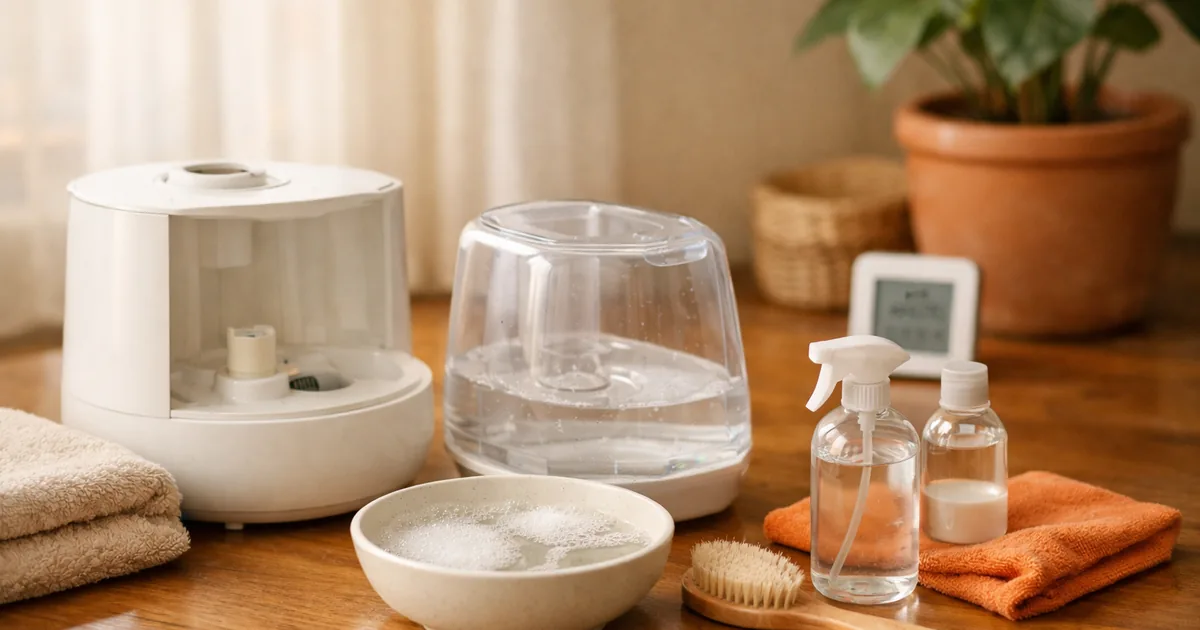
1. Empty, dry and refill daily — clean every third day. For portable humidifiers.
2. Bottled water labelled “distilled”. “White dust” is a sign minerals are being dispersed.
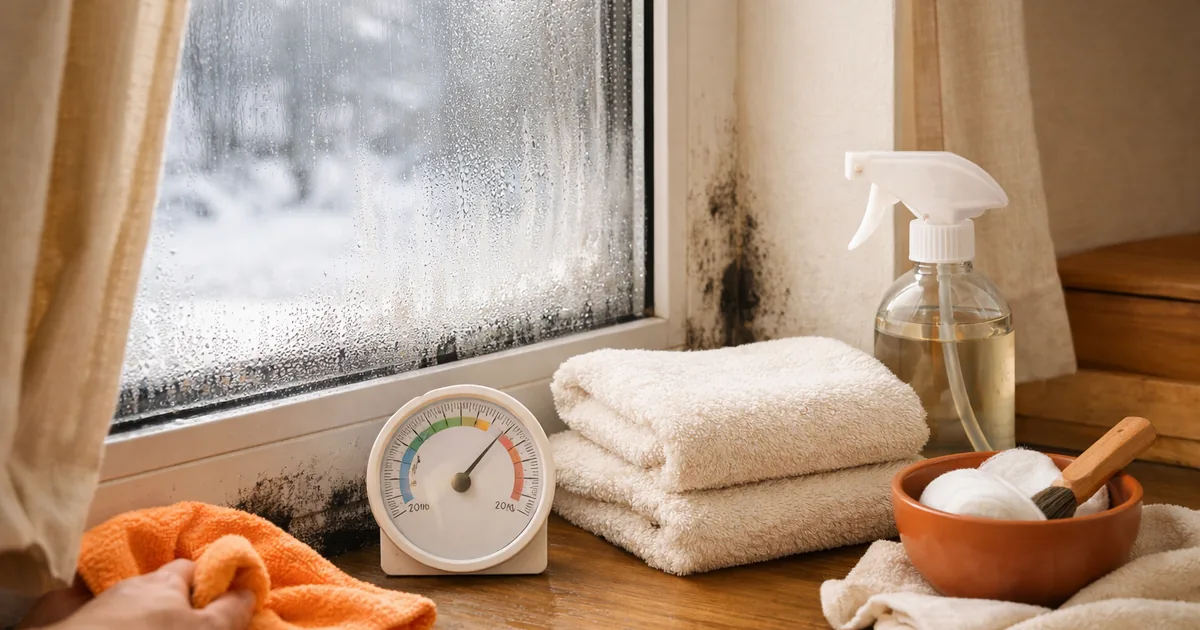
3. Keep indoor humidity at or below 50% — if water condenses on windows or walls, move it or use it less.
Types and what they disperse — EPA
| Type | What the EPA says | Worth noting (ours) |
|---|---|---|
| Ultrasonic and impeller (“cool mist”) | Disperse the most microorganisms and minerals | Check your manual for the type (our pointer) |
| Evaporative and steam | Can allow microorganisms to grow but generally disperse less; not expected to release substantial minerals | — |
| Form | Console (floor), portable, or central units built into heating and cooling | — |
The EPA says a “white dust” may appear on surfaces when these devices are used.
What water to use — EPA
| Type | What the source says | Worth noting (ours) |
|---|---|---|
| Recommended | Bottled water labelled “distilled” | Distillation is the most effective demineralisation |
| Less good | Deionised or reverse-osmosis water | Typically has more minerals than distilled |
| Not demineralised | Bottled “spring”, “artesian” or “mineral” water | — |
| Cartridges | Use demineralisation cartridges or filters if supplied | “White dust” means minerals aren’t being removed |
Daily, every third day, end of season — EPA
| When | What the EPA says | Worth noting (ours) |
|---|---|---|
| Daily | Unplug, empty the tank, wipe all surfaces dry and refill | Portable units |
| Every third day | Empty and scrub the tank to remove scale, deposits or film | — |
| Cleaning agent | Unless the maker says otherwise, clean water-contact surfaces with 3% hydrogen peroxide | — |
| Rinsing | After any cleaning agent, rinse thoroughly with several changes of tap water | — |
| End of season | Clean, make sure all parts are dry, store somewhere dry, and throw away used cartridges or filters | — |
| Supplies | Follow the manufacturer’s instructions for filters and other materials | — |
This page doesn’t tell you to run the unit with cleaner or disinfectant in the water; cleaning agents are for wiping, followed by several rinses (our reading).
Humidity and surroundings — EPA
| If | What to do | Worth noting (ours) |
|---|---|---|
| Setting the level | Don’t exceed 50% relative humidity; measure with a hygrometer | This page gives only the upper limit |
| Water condenses on windows or walls | Move the unit, lower the setting, or use it less | See winter condensation |
| The area around it gets damp | Turn it down, or run it intermittently | Keep carpets, curtains and tablecloths dry |
| A steam vaporiser | Keep it out of children’s reach — steam and boiling water can burn | — |
| Respiratory symptoms while using it | Stop using it and see a doctor | Even if you follow the care directions |
Condensation and mould are in winter condensation and mould; WHO indoor temperature guidance is in 18°C indoors.
Checklist
- ☐ Daily: unplug, empty, wipe dry, refill
- ☐ Every third day: scrub off scale; rinse several times after any cleaner
- ☐ “Distilled” bottled water; check if white dust appears
- ☐ Humidity at or below 50%; use less if windows run with water
- ☐ Steam units out of children’s reach
- ☐ End of season: dry completely before storing
Questions that remain
Can I use tap water?
The EPA recommends low-mineral “distilled” bottled water and treats white dust as a sign of minerals being dispersed. This page doesn’t say tap water is forbidden.
What humidity is best?
This page only sets an upper limit of 50%. The EPA mould guide says ideally 30 to 50%, which we cover in the winter condensation post.
Is it the same for Korean products?
We didn’t read Korean agency guidance this time. The EPA itself says follow the manufacturer’s instructions where they differ.
Sources
- US EPA — Use and Care of Home Humidifiers — source (page shows: published 30 March 2022, updated 29 April 2026; checked 19 October 2026). Types, water, daily, three-day and end-of-season care, 3% hydrogen peroxide, 50% humidity, damp surroundings, steam burns, respiratory symptoms.
- Not read. Korean agency guidance on humidifiers; Korean product standards.
- What we added. The “worth noting” column and the Korean device gloss.
Where else to check
- The product manual — cleaning agents and filter replacement.
Written on 19 October 2026. The content is from the source; the glosses are ours.