In winter the windows stay shut for longer. Radon, a radioactive gas that rises from the ground, has no smell or colour, so the US Centers for Disease Control and Prevention (CDC) says testing is the only way to know whether levels in your home are high. The Environmental Protection Agency (EPA) says radon is responsible for about 21,000 lung cancer deaths every year in the US, about 2,900 of them among people who have never smoked. The line: fix your home at 4 pCi/L (150 Bq/m³ as EPA writes it) or more, and consider fixing between 2 and 4 pCi/L. Tests are short-term, 2–90 days, or long-term, more than 90 days. We added a unit converter that shows the action band.
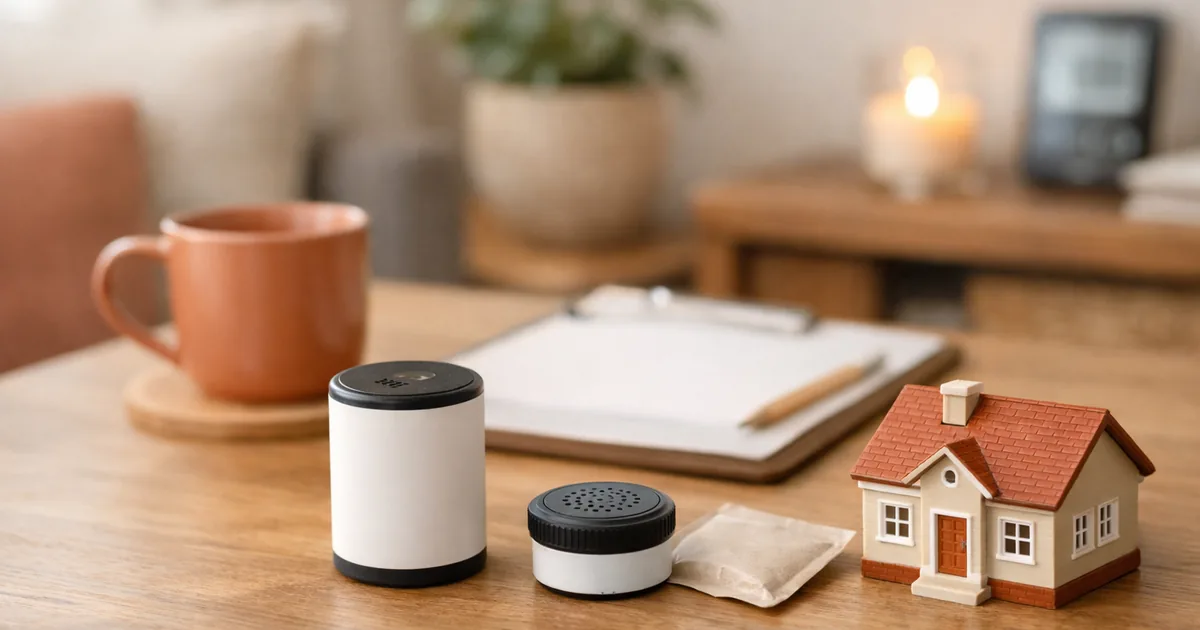
1. Testing is the only way — short-term 2–90 days, long-term over 90 days (closer to a year-round average).
2. 4 pCi/L or more → test again; if the average is 4 or more, install a reduction system. 2–4 pCi/L: consider it.
3. Lowest lived-in level, 3 feet (about 0.9 m) off the floor, middle of the room.
How big is the risk — EPA
| Type | What the source says | Worth noting (ours) |
|---|---|---|
| Deaths | About 21,000 lung cancer deaths a year in the US; about 2,900 among people who never smoked | 21,000 − 2,900 = 18,100 among people who smoked (ours) |
| Averages | Indoors 1.3 pCi/L (50 Bq/m³); outdoors 0.4 pCi/L (15 Bq/m³) | — |
| Action level | At 4 pCi/L or more, remedy as soon as possible, stressed by a former Surgeon General (2005 advisory) | 4 × 37 = 148 Bq/m³ (ours); EPA writes 150 |
| 2–4 pCi/L | Consider fixing between 2 and 4 pCi/L (75–150 Bq/m³); getting below 2 pCi/L is difficult | — |
Lifetime lung cancer per 1,000 exposed — EPA table
| Radon level | People who smoked | People who never smoked |
|---|---|---|
| 20 pCi/L (740 Bq/m³) | About 260 — fix | About 36 — fix |
| 10 pCi/L (370 Bq/m³) | About 150 — fix | About 18 — fix |
| 8 pCi/L (300 Bq/m³) | About 120 — fix | About 15 — fix |
| 4 pCi/L (150 Bq/m³) | About 62 — fix | About 7 — fix |
| 2 pCi/L (75 Bq/m³) | About 32 — consider between 2 and 4 | About 4 — consider between 2 and 4 |
| 1.3 pCi/L (50 Bq/m³) | About 20 — average indoor level | About 2 — average indoor level |
| 0.4 pCi/L (15 Bq/m³) | About 3 — average outdoor level | Not listed — average outdoor level |
EPA’s table tells smokers to stop smoking and fix the home, and compares the smoker’s risk at 4 pCi/L to 5 times the risk of dying in a car crash.
How to test — CDC
| Type | What the source says | Worth noting (ours) |
|---|---|---|
| When | Never tested or unknown; buying or selling; before and after renovations (especially radon repairs); before spending more time on a lower level | E.g. before turning a basement into a bedroom or office |
| Who | A radon tester or a do-it-yourself kit; EPA recommends a qualified tester when buying or selling | — |
| Kit types | Short-term, 2–90 days (quick results); long-term, over 90 days (year-round average); longer reflects your home and lifestyle better | — |
| Placement | Basement or lowest level, raised 3 feet off the ground, middle of the room; in a multi-unit building, the lowest level within your unit | 3 ft ≈ 0.9 m (ours); in a flat, inside your own home |
| Afterwards | Leave it for the instructed time, then send it as the kit directs for results | — |
What to do with the result — CDC
| Type | What the source says | Worth noting (ours) |
|---|---|---|
| Higher than 4 pCi/L | Short-term test? Take a second test (short or long); average two short-term results. If the average is 4 or more, or a long-term result is 4 or more, have a licensed professional install a reduction system | Retest a few months after the fix |
| 2–4 pCi/L | Consider a reduction system; retest a few months after | — |
| Under 2 pCi/L | No action needed; test again if you start living on a lower level | CDC adds there is no known safe level |
Radon unit converter and action band
US results come in pCi/L while many Korean monitors show Bq/m³, so the converter goes both ways (our gloss). Pick smoker or never-smoker to see the matching EPA table row.
Updates as you type. 1 pCi/L = 37 Bq/m³ is our conversion (EPA rounds, e.g. 4 pCi/L to 150). The band follows the CDC page (2 and 4 pCi/L); one short-term result of 4 or more means a second test first. The “per 1,000” figure is EPA’s lifetime table for the row at or below your value.
Worked examples — our arithmetic
- 200 Bq/m³ is 200 ÷ 37 = about 5.41 pCi/L: 4 or more, so test again and fix if the average stays 4 or more. The EPA row just below (4 pCi/L) gives about 62 per 1,000 smokers and about 7 per 1,000 never-smokers.
- EPA’s 4 pCi/L = 150 Bq/m³ is rounded; 4 × 37 is 148. 2 pCi/L is 74 (EPA writes 75).
Checklist
- ☐ Never tested? Start with a short-term kit (2–90 days)
- ☐ Lowest level, 3 feet (about 0.9 m) up, middle of the room
- ☐ 4 pCi/L or more: test again → average 4 or more, professional fix
- ☐ 2–4 pCi/L: consider a fix; retest a few months later
- ☐ Smokers face far higher risk — see the EPA table
Questions that remain
What is the Korean standard in Bq/m³?
We didn’t read the Korean law (such as the Indoor Air Quality Control Act) this time, so we give no Korean figure.
Is opening the windows enough?
The EPA and CDC pages we read don’t list ventilation as the remedy; at high levels they recommend a reduction system from a licensed professional. Reduction methods are on CDC’s separate “Reducing Radon Levels” page, which we didn’t read.
Sources
- EPA — Health Risk of Radon — source (page shows: last updated 24 June 2026; checked 2 November 2026). About 21,000 deaths a year, about 2,900 never-smokers; smoker and never-smoker lifetime tables (20, 10, 8, 4, 2, 1.3, 0.4 pCi/L with Bq/m³); consider 2–4; below 2 is difficult; act at 4 pCi/L (2005 advisory); indoor and outdoor averages.
- CDC — Testing Your Home for Radon — source (date at top of page 26 August 2026; checked 2 November 2026). Testing the only way; when to test; short-term 2–90 days, long-term over 90; lowest level, 3 feet, middle of the room; actions by result (average of two, 4 and 2 pCi/L); average home 1.3 pCi/L.
- Not read. The BEIR VI and 2003 EPA risk reports; CDC’s “Reducing Radon Levels”; Korean indoor air law.
- What we added. The “worth noting” column and the Korean everyday gloss.
Where to check further
- Your test kit’s instructions — test length and where to send it.
- Korean environment authorities — Korean standards and any free testing.
Written on 2 November 2026. The content is from the source; the glosses are ours.