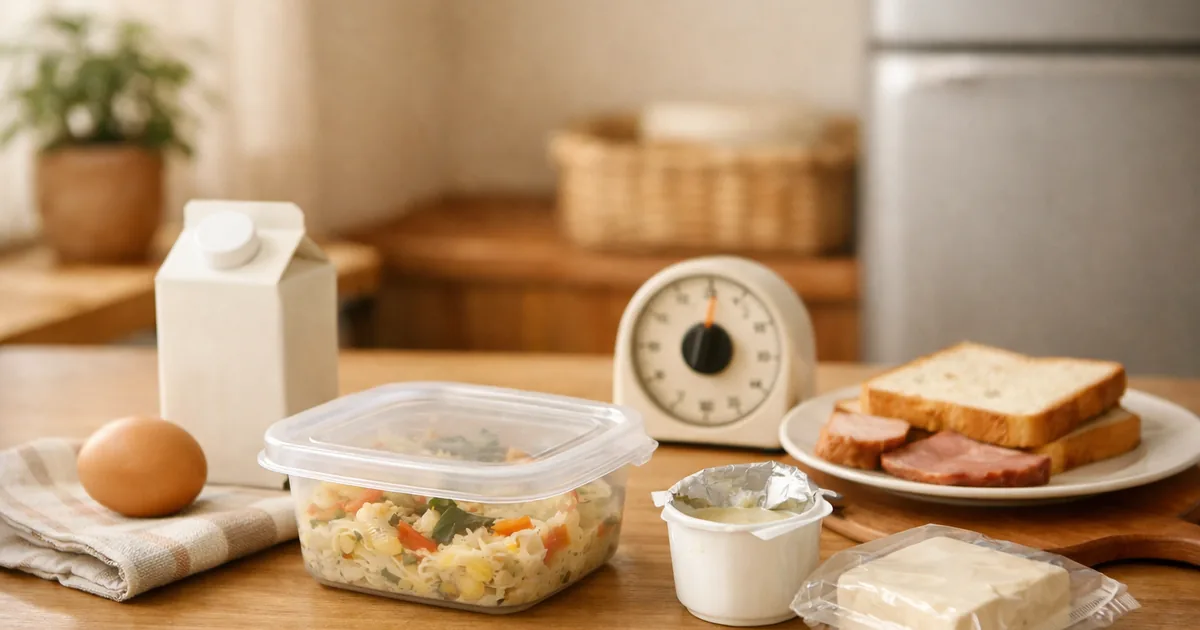
How long does food last in a fridge during a power cut? The US Centers for Disease Control and Prevention (CDC) says that with the doors closed, food stays safe for about 4 hours in a refrigerator, 48 hours in a full freezer and 24 hours in a half-full one. Perishables such as meat, fish, cut produce, eggs, milk and leftovers should be thrown out after 4 hours without power or another cold source, and you should never taste food to check. FoodSafety.gov’s note that keeping food in snow outside isn’t recommended is set out too.
1. Doors closed: fridge about 4 hours, full freezer 48 hours, half-full freezer 24 hours.
2. Perishables without cold for over 4 hours go in the bin — don’t taste-test.
3. Thawed food with ice crystals, or at 4°C or below, can be refrozen or cooked.
Before, during and after — CDC
| Type | What the source says | Worth noting (ours) |
|---|---|---|
| Before | Appliance thermometers: fridge 40°F (4°C) or below, freezer 0°F (-18°C) or below | -18°C is our conversion (-17.8) |
| Before | Freeze water containers and gel packs; have a cooler; dry or block ice for long outages | — |
| During | Keep the doors closed | — |
| During | After 4 hours, move fridge perishables to a cooler with ice to stay at 40°F or below | — |
| After | Discard meat, fish, cut produce, eggs, milk and leftovers after 4 hours without power or cold | — |
| After | Discard food with odd smell, colour or texture; never taste | — |
| After | Thawed food with ice crystals or at 40°F or below can be refrozen or cooked | — |
FoodSafety.gov’s winter note says to discard meat, seafood, eggs and leftovers above 40°F (4°C) for 2 hours or more. That starts from a different point than the CDC’s 4 hours without power; if a thermometer tells you when 4°C was passed, the 2-hour rule is the stricter one (our reading). Storing leftovers is in leftovers.
Can I use the snow? — FoodSafety.gov
| Type | What the source says | Worth noting (ours) |
|---|---|---|
| Not recommended | Outdoor temperatures fluctuate even with snow, so chilled food can warm and frozen food thaw | — |
| Not recommended | Food outside is exposed to animals and unsanitary conditions | — |
| Instead | Put ice in the fridge, freezer or coolers — an unpowered fridge can work like an icebox | — |
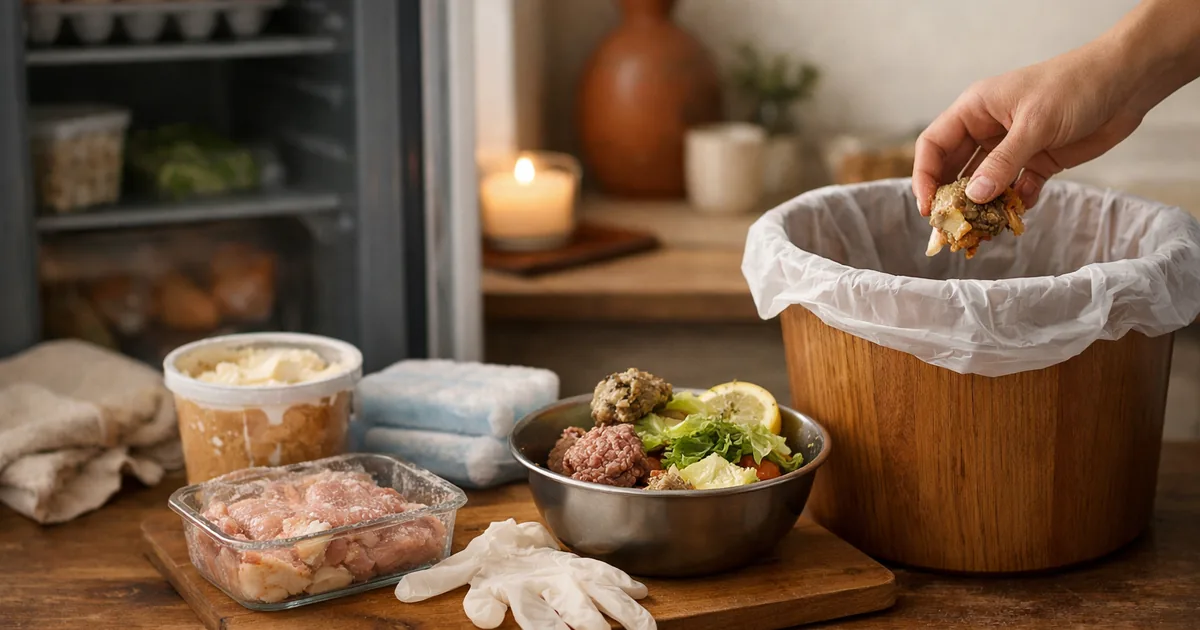
| Instead | Keep raw meat and poultry on one side or on a tray so juices don’t drip on other food | — |
| Danger zone | Above 40°F (4°C) and below 140°F (60°C) | — |
After a flood — CDC
Discard food that touched floodwater, food in non-waterproof packaging, cardboard cartons (juice, milk, formula), containers with screw, snap or flip tops, home-canned food and bulging or damaged cans. Wooden chopping boards, baby bottle teats and dummies that touched floodwater go too, since sanitising can’t clean them. The CDC sums it up: “When in doubt, throw it out.”
Checklist
- ☐ Thermometers in fridge and freezer — 4°C and -18°C or below
- ☐ Keep doors shut during the outage
- ☐ After 4 hours, perishables into a cooler
- ☐ Meat, eggs, milk and leftovers without cold for 4+ hours: bin them
- ☐ Don’t taste; when in doubt, throw it out
Generator, charcoal and heater CO rules are in generator safety in a power cut.
Questions that remain
Frozen meat half-thawed — can I refreeze it?
Both the CDC and FoodSafety.gov say yes if it still has ice crystals or is at 40°F (4°C) or below.
What about kimchi and fermented sauces?
Both pages list US perishables only and don’t address fermented foods.
Sources
- CDC — Keep Food Safe After a Disaster or Emergency — source (reviewed and updated 24 November 2025; checked 19 October 2026). Before, during and after steps; 4, 48 and 24 hours; what to discard; refreezing; flood disposal and sanitising.
- FoodSafety.gov — Winter Weather Food Safety — source (modified 21 September 2023). Danger zone, the 2-hour rule, risks of storing food in snow.
- Not read. FoodSafety.gov’s food-by-food chart; Korean food safety guidance.
- What we added. The “worth noting” column and the Korean everyday gloss.
Where to check further
- Ministry of Food and Drug Safety — Korean storage guidance.
Written on 19 October 2026. The content is from the source; the glosses are ours.