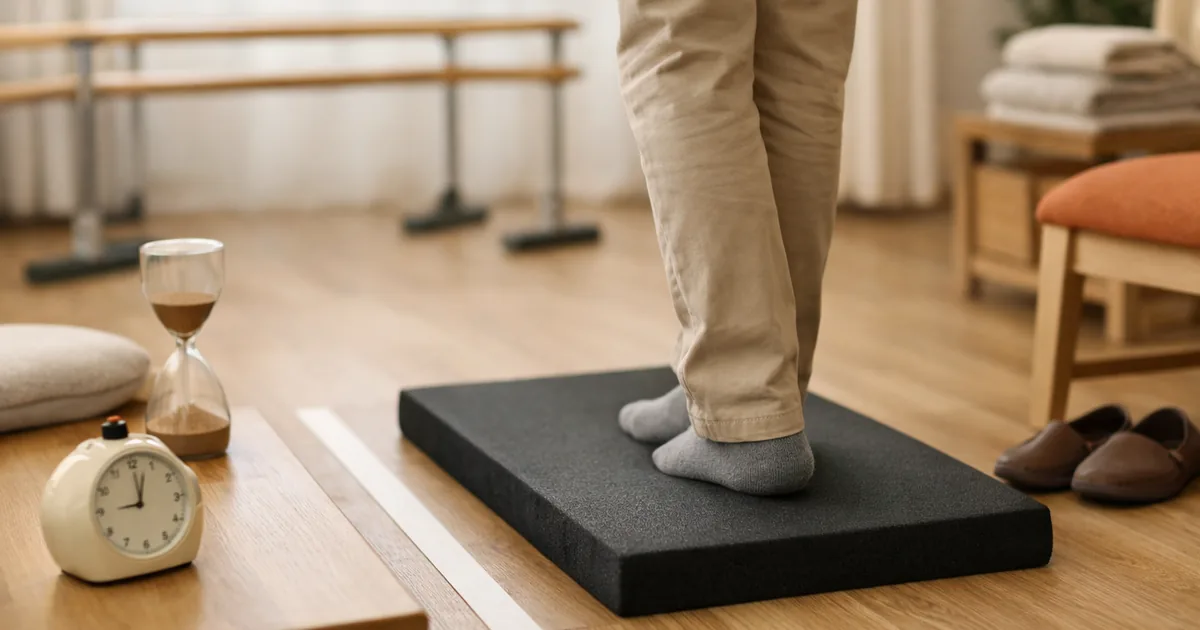
Past 65, what actually counts as exercise, and how much is enough? The US Centers for Disease Control and Prevention (CDC) says adults aged 65 and older need a weekly mix of aerobic, muscle-strengthening and balance activity. Aerobic activity means 150 minutes a week at moderate intensity (for example brisk walking, 30 minutes on 5 days), or 75 minutes at vigorous intensity, or a mix of the two. Muscle-strengthening means at least 2 days a week, with 8 to 12 repetitions making a set. On top of that come balance activities such as walking backward or standing on one leg, to help prevent falls. This page sets out the CDC page “What Counts as Physical Activity for Older Adults”, with a checker that counts the minutes and days still short in a week.
1. Aerobic: 150 minutes moderate or 75 minutes vigorous a week — for brisk walking, 30 minutes on 5 days. One vigorous minute counts as about two moderate minutes (CDC adults page).
2. Muscle-strengthening on at least 2 days a week — to the point where another repetition is hard without help; 8 to 12 repetitions make a set, at least one set (two or three for more benefit).
3. Balance — walking backward, standing on one leg, a wobble board. 90 moderate minutes and 20 vigorous minutes come to 130 moderate-equivalent minutes, 20 short (our sum).
Checker
Minutes still to reach 150: - · more strength days: - · types the chosen activity covers (aerobic, strength, balance): -
Results update as you type. The moderate-equivalent total is “moderate minutes + vigorous minutes × 2”, the minutes to go are “150 − that total”, and strength days to go are “2 − days done” (never below 0) — our sums. Counting one vigorous minute as two moderate minutes follows the CDC adults page; the page for adults 65 and older says only that a mix is fine. The types for each activity follow the CDC examples below.
Take a week with 90 moderate minutes and 20 vigorous minutes: that is 130 moderate-equivalent minutes, 20 short of 150 (our sum). With strength work on 1 day, one more strength day is still to go. Brisk walking for 30 minutes on 5 days reaches 150 minutes on its own. Raising the vigorous time from 20 to 40 minutes brings the total to 170 minutes, past the aerobic amount. Pick tai chi in the activity box and it covers 3 types — aerobic, strength and balance — because the CDC lists yoga, tai chi and gardening as “multicomponent” activities that combine all three.
How much, in the CDC’s words
| Type | What the CDC says | Worth noting (our gloss) |
|---|---|---|
| Aerobic | 150 minutes a week of moderate intensity (such as brisk walking, 30 minutes on 5 days), or 75 minutes of vigorous intensity (such as running or jogging), or a mix | It need not be done in one go — the adults page says it can be spread out |
| Muscle-strengthening | At least 2 days a week, to the point where another repetition is hard without help. A set is 8 to 12 repetitions; at least one set, two or three for more benefit | These days come on top of the 150 aerobic minutes |
| Balance | Activities that help prevent falls, such as walking backward, standing on one leg or a wobble board. Strengthening the back, abdomen and legs also helps balance | No number of days is given on this page |
| Multicomponent | Yoga, tai chi, gardening and many sports combine aerobic, strengthening and balance elements | One activity fills all three boxes |
The CDC adults page (“What Counts as Physical Activity for Adults”) spells the same rules out a little further. It says one minute of vigorous activity is about the same as two minutes of moderate activity; moderate effort raises your breathing and heart rate enough to break a sweat while you can still talk comfortably, and vigorous effort makes it hard to say more than a few words. Fitness levels differ, so the same activity can be moderate for one person and vigorous for another.
What goes where — the CDC examples
| Type | CDC examples | Our note |
|---|---|---|
| Aerobic | Brisk walking · running or jogging · yard work · dancing · walking to the store · hiking · active yoga · bicycling · water aerobics | Walking to the store counts |
| Muscle-strengthening | Lifting weights · resistance bands · body-weight exercises · gardening · some yoga poses | The adults page gives push-ups and sit-ups as body-weight examples |
| Balance | Walking backward · standing on one leg · wobble board | How to start next to a wall or chair is in our balance guide |
| Multicomponent | Yoga · tai chi · gardening · many sports | Counted as 3 types in the checker |
For muscle-strengthening, the adults page says to work all the major muscle groups: legs, hips, back, chest, abdomen, shoulders and arms. The page for adults 65 and older keeps the same “8 to 12 repetitions, at least one set” and adds balance, so read together a week at 65 and over is “150 aerobic minutes + 2 strength days + balance” (our reading).
Laid out as a week (our example)
Taking the CDC’s “30 minutes on 5 days” as the frame: brisk walking for 30 minutes on Monday, Tuesday, Thursday, Friday and Saturday; a set of 8 to 12 band or body-weight moves on Tuesday and Friday; and a one-leg stand at the end of each walk. A tai chi or yoga class once or twice a week fills all three boxes at once. This timetable is our example, not CDC text.
The NHS amounts for 65 and over (something every day, strength, balance and flexibility on 2 days) are in how active should you be at 65 and over, so the two countries’ rules can be read side by side. The moves themselves are in strength exercises for older adults and balance exercises for older adults; the CDC’s tips for getting started and the benefits are in physical activity benefits for older adults (CDC).
Checklist
- ☐ Aerobic — 150 minutes moderate or 75 vigorous (1 vigorous minute = 2 moderate)
- ☐ Strength — at least 2 days, at least one set of 8 to 12 repetitions
- ☐ Balance — walking backward, standing on one leg (next to support at first)
- ☐ Yoga, tai chi and gardening fill all three boxes
- ☐ If you can talk but not sing, it is moderate
- ☐ With a long-term condition, talk to your doctor before stepping up
Questions that remain
Do shopping and housework count towards 150 minutes?
Another CDC page (adding activity for older adults) says everyday tasks such as mowing or carrying groceries count towards your total. Only time that gets your breathing and heart rate up is moderate, though, so it is that time that belongs in the checker (our gloss).
How many days a week of balance work?
The CDC page set out here gives no number of days for balance work. The checker only asks done or not done.
Do strength days count as aerobic minutes?
The CDC says to do muscle-strengthening in addition to aerobic activity. Time lifting weights counts as a strength day, not as aerobic minutes (our gloss).
Sources
- CDC — What Counts as Physical Activity for Older Adults — source (page shows: reviewed 4 December 2025; checked 19 November 2026). 150 or 75 minutes or a mix, 30 minutes on 5 days, strength on 2 days with 8 to 12 repetitions and at least one set, balance examples, multicomponent activities, examples by type.
- CDC — What Counts as Physical Activity for Adults — source (page shows: reviewed 6 December 2023). One vigorous minute about two moderate minutes, the talking rule for moderate and vigorous, the major muscle groups (legs, hips, back, chest, abdomen, shoulders, arms), push-ups and sit-ups.
- CDC — Older Adults: Adding Activity — source (page shows: reviewed 4 December 2025). Everyday tasks count towards the total.
- Not read. The full Physical Activity Guidelines for Americans, 2nd edition; the CDC Move Your Way tool; the research behind each activity’s intensity; other bodies’ numbers of days for balance work; Korean physical activity guidelines for older adults.
- What we added. The “worth noting” and “our note” columns, the checker’s equivalent total, minutes to go and days to go, the timetable example, and the reading across the two pages.
Where to check further
- Your doctor — with arthritis, diabetes or heart disease, or before starting vigorous activity after a long inactive spell.
- Local exercise classes for older people — whether there is tai chi or yoga that fills all three boxes (our addition).
Written on 19 November 2026. The content is from the CDC; the glosses and sums are ours.