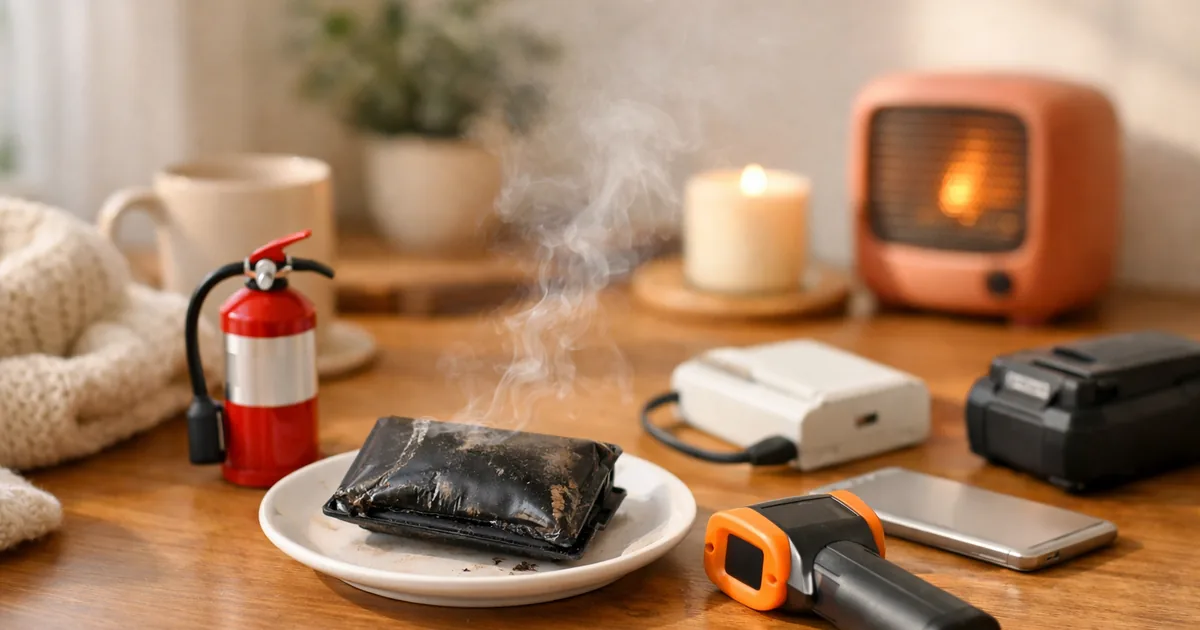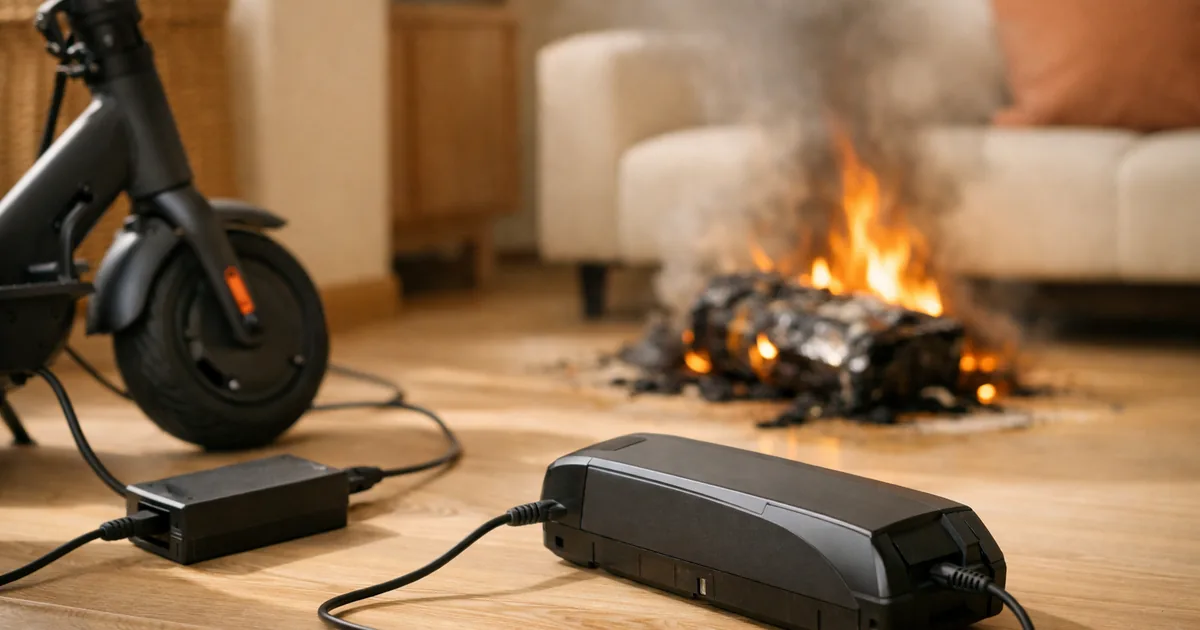
The US Consumer Product Safety Commission (CPSC) groups e-scooters, e-bikes and hoverboards as “micromobility”. A CPSC staff report (April 2026) counts 533 deaths from 2017 through 2024, 45 of them in lithium-ion battery fires. Deaths rose steadily from 5 in 2017 to 135 in 2024. The CPSC’s guidance says to always be present when charging, and never charge while sleeping or away from home — it has seen many home fires and deaths at night while batteries charged and families slept. Here are the report’s numbers and the CPSC’s before, during and after-the-ride rules.
1. Charge only when you’re there — never while asleep or out.
2. The charger supplied or recommended by the maker; batteries the maker confirms.
3. 45 of 533 deaths in 2017–2024 were battery fires (CPSC staff report).
Numbers — CPSC staff report (April 2026)
| Type | What the source says | Worth noting (ours) |
|---|---|---|
| All deaths | 533 from 2017 through 2024, rising from 5 in 2017 to 135 in 2024 | The report says 2023–2024 reporting is ongoing |
| By product | E-bikes 310, e-scooters 206, self-balancing scooters 17 | 206+17+310=533 (ours) |
| Battery fire deaths | E-scooters 15 (11 fires), self-balancing 11 (5), e-bikes 19 (13) | 45 deaths, 29 fires (ours) |
| ED visits | An estimated 698,500 in 2017–2024: e-scooters 380,000, self-balancing 163,300, e-bikes 155,200 | Sums to 698,500 (ours) |
| Trend | ED estimates rose from 37,300 in 2017 to 149,100 in 2024 | About 4.0 times (ours) |
| Share with fire | Fire hazard in 173 of 197 self-balancing reports, 106 of 145 e-bike incidents, 88 of 189 e-scooter incidents | About 88%, 73%, 47% (ours) |
After the ride — charging and batteries (CPSC)
| Type | What the source says | Worth noting (ours) |
|---|---|---|
| How | Charge as the manufacturer says and unplug when done | — |
| Be present | Always be present; never charge while sleeping or not at home — CPSC has seen many fires and deaths at night while families slept | Firmer than USFA’s “avoid unattended when possible” |
| Charger | Only the one supplied with or recommended by the maker | CPSC also warned about “universal” chargers on 5 September 2024 |
| Replacements | Only replacement or secondary packs tested and confirmed suitable by the maker | — |
| Modified packs | Never ride a device whose pack was modified or reworked by unqualified people or built from repurposed or used cells | — |
| Disposal | Never in the trash or general recycling — to a battery recycler or hazardous waste centre; for recalls, follow the CPSC release | — |
Before and during the ride — CPSC
| Type | What the source says | Worth noting (ours) |
|---|---|---|
| Law | Follow local traffic laws on helmets, where to ride and roads | Korean rules linked below (ours) |
| Helmet | Always a bicycle helmet | — |
| Check | Handlebars, brakes, throttle, lights, tyres, cables, frame | — |
| Manual | Note the weight and age limits | — |
| Be seen | Most deaths involve motor vehicles, and these devices are quiet — reflectors, lights, bell or horn | — |
| Speed, surface | Slow down and assume you’re unseen; small wheels can stop dead on bumps — slow and lean back | — |
| Hands, load | Both hands on the bars, nothing hung on them; no sudden moves | — |
| Other | No alcohol or drugs; one rider per scooter | — |
Reading the numbers — our arithmetic
The 45 battery fire deaths are about 8.4% of all 533 (our arithmetic). The CPSC says most deaths involve motor vehicles, so riding risk and charging risk need different rules. Fires are fewer but happen at home, at night — which is why the charging rule names sleep and being away. The report is a staff report not reviewed or approved by the Commission, and says 2023–2024 counts may change. These are US figures; we did not check Korean statistics.
Where it meets Korea — our note
The CPSC just says to follow local law. Korea’s licence, helmet and one-rider rules are in e-scooter rules in Korea, from the Road Traffic Act. On charging and storage, the US Fire Administration points the same way: no charging below 0°C or above 40°C, and big devices kept in dry, ventilated spaces away from building exits (lithium-ion battery fire safety). Charging a scooter in the hallway overnight in winter breaks both agencies’ rules at once (ours). Escape routes are in home fire escape plan.
Checklist
- ☐ Charge only while awake and home; unplug when full
- ☐ Maker’s charger and maker-approved batteries — no “universal” chargers or modified packs
- ☐ Big devices stored away from hallway exits
- ☐ Helmet, lights, reflectors, bell; one rider
- ☐ Spent batteries to a collection point, not the bin
Questions that remain
Does this apply to shared scooters?
The riding rules apply to anyone riding; the charging rules apply to devices you charge at home (our reading).
What period does 45 cover?
Eight years, 2017–2024: e-scooters 15, self-balancing 11, e-bikes 19. The report says 2023–2024 reporting isn’t finished.
What if the battery has swollen?
USFA says to stop using a battery that is smoking, hissing, punctured or swollen. Disposal is in lithium-ion battery disposal.
Sources
- US Consumer Product Safety Commission (CPSC) — Micromobility: E-Bikes, E-Scooters and Hoverboards — source (no update date shown; checked 4 November 2026). Four before-ride checks; riding rules (vehicles, visibility, speed, surfaces, hands, alcohol, one rider); after-ride rules (charge while present, never asleep or away, maker’s charger and battery, no modified or used cells, disposal, reporting).
- CPSC staff report — Micromobility Products-Related Deaths, Injuries, and Hazard Patterns: 2017–2024 — source (April 2026; checked 4 November 2026). 533 deaths (5 to 135), 310, 206 and 17 by product, battery fire deaths 15, 11 and 19 (11, 5 and 13 fires), 698,500 ED visits (37,300 to 149,100), fire in 173/197, 106/145 and 88/189. A staff report not reviewed by the Commission; 2023–2024 reporting ongoing.
- Not read. The full report appendices (a small part past 100,000 characters), the 5 September 2024 universal charger warning itself, individual recalls, Korean statistics and certification.
- What we added. The “worth noting” column and the Korean everyday gloss.
Where to check further
- Your device manual — charger spec, weight and age limits.
- The Road Traffic Act — Korean licence, helmet and riding rules.
Written on 4 November 2026. The content is from the source; the glosses are ours.