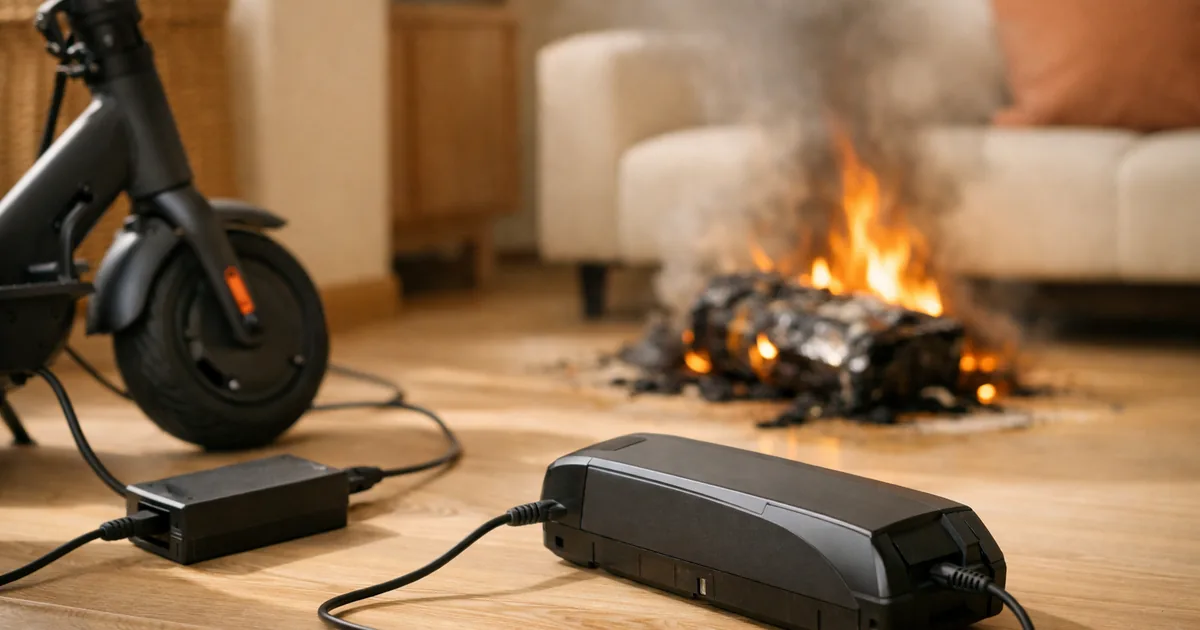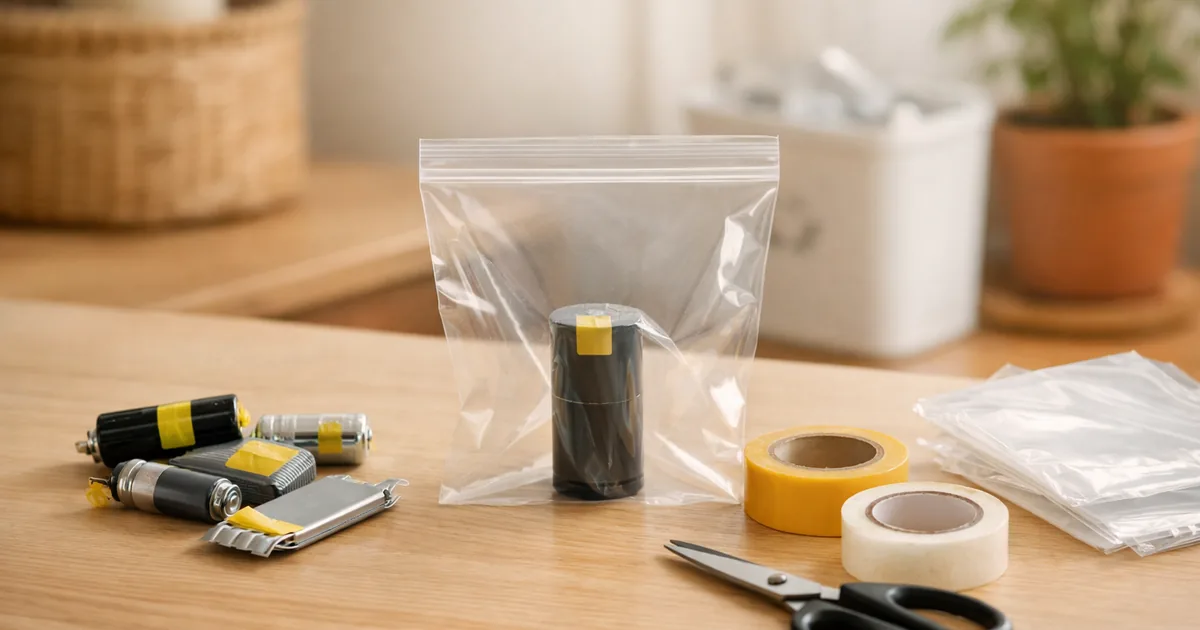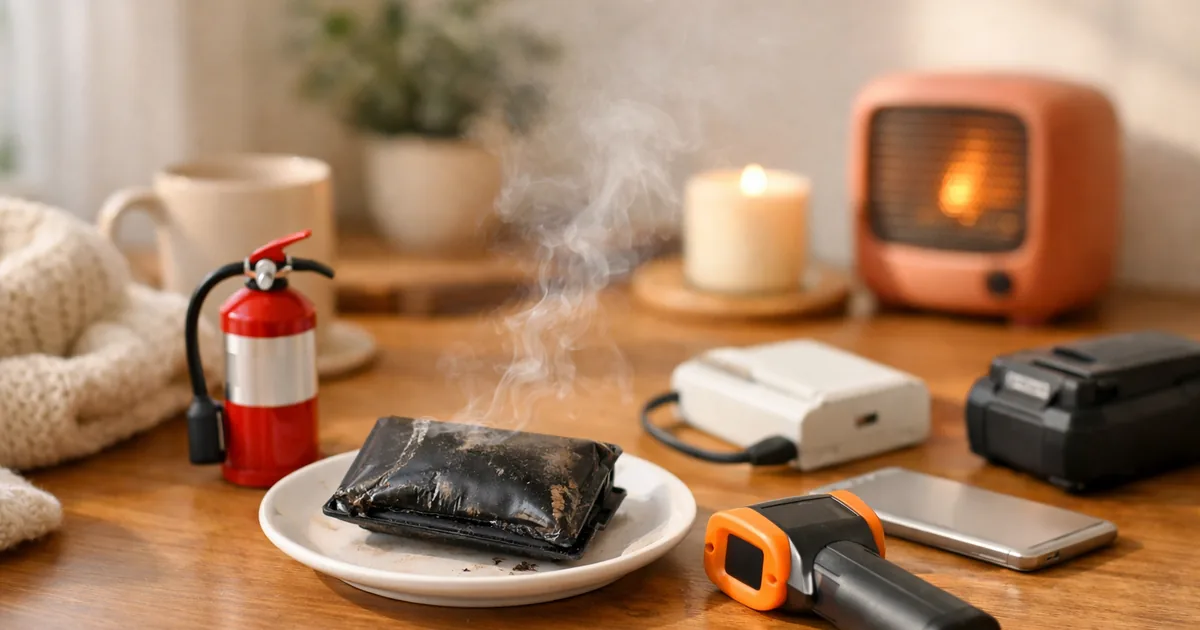
Phones, power banks, wireless earbuds, e-scooters, power tools and laptops mostly run on lithium-ion batteries. The US Fire Administration (USFA) says to store them at room temperature when possible and not to charge them below 32°F (0°C) or above 105°F (40°C). Stop using one if you notice an odour, a change in colour, too much heat, a change in shape, leaking or odd noises. Here are USFA’s battery fire safety page, its handout on batteries in electronic devices and its blog post of 13 October 2026, side by side. In winter, devices brought in from a balcony or a car and plugged straight in make the 0°C line easy to cross.
1. No charging below 0°C (32°F) or above 40°C (105°F); store at room temperature when possible.
2. Odour, colour change, heat, swelling, leaking, odd noises — stop using it.
3. The maker’s charger, plugged straight into a wall outlet, not a power strip or extension cord.
Signs to stop — USFA
| Type | What the source says | Worth noting (ours) |
|---|---|---|
| Battery page: 6 signs | Stop using a lithium-ion battery if you notice an odour, change in colour, too much heat, change in shape, leaking or odd noises | Change in shape — what people call swelling (ours) |
| Blog: 4 signs | If a battery is smoking, hissing, punctured or swollen, stop using it immediately | Overlaps the page’s list |
| Why it fails | If internal safety features fail or design flaws exist, batteries can bulge, leak or ignite (overheating and thermal runaway) | — |
| If it burns | Burning batteries release harmful chemicals that threaten people nearby, first responders and the environment | — |
| If it gets wet | Flooding or spills can trigger reactions leading to failure even days later | Don’t assume a dried-out device is fine (ours) |
Charging — USFA
| Type | What the source says | Worth noting (ours) |
|---|---|---|
| Temperature | Don’t charge below 32°F (0°C) or above 105°F (40°C) | The USFA page cites an NFPA document as the source |
| Charger | Use the charger the manufacturer provides; the blog says original or certified replacement chargers and cables only, not cheap knockoffs | — |
| Outlets | Don’t overload outlets; multiplug adapters or power strips can overheat and cause a fire | — |
| Plug-in | Plug chargers directly into an outlet, not an extension cord or multiplug adapter | — |
| Surface | Solid, flat surfaces, out of direct sunlight | Not on a duvet or sofa (ours) |
| Attention | Avoid leaving devices charging unattended when possible | For e-bikes and e-scooters the CPSC goes further — never while asleep or away |
| Doubtful wiring | Have a licensed electrician test your circuits | — |
Storage and travel — USFA
| Type | What the source says | Worth noting (ours) |
|---|---|---|
| Temperature | Store lithium-ion batteries at room temperature when possible | — |
| Spares | Keep spare batteries away from anything that can burn | — |
| Sun, cars | Not in direct sunlight or hot cars — a fire risk | — |
| Bigger devices | E-bikes, scooters and power tools in dry, ventilated spaces, away from flammables and building exits | Keep the hallway and front door clear (ours) |
| Flying | Take batteries out of checked smart luggage, and loose spares out of checked bags, and keep them with you | Wh limits are the FAA’s — link below |
Before buying and when disposing — USFA handout
| Type | What the source says | Worth noting (ours) |
|---|---|---|
| Recalls | Check the US product safety reporting site for recalls on what you plan to buy | For Korean products, check Korean recall information (ours) |
| Certification | Look for a Nationally Recognized Testing Laboratory (NRTL) stamp on the package and product | A US scheme — Korea uses its own (ours) |
| Repairs | Battery pack repairs only at a certified repair facility | — |
| Terminals | Put tape over battery ends and terminals to prevent accidental discharge and fire | — |
| Trash, recycling | Don’t put lithium-ion batteries in the trash or recycling — they can ignite; find a local collection site | Disposal has its own guide — link below |
C.H.A.R.G.E. — USFA’s six letters
- Choose certified products
- Handle with care
- Always stay alert
- Recycle properly
- Get out quickly
- Educate others
Numbers in the USFA blog
The USFA blog says lithium-ion batteries entered the consumer market in 1991, in Sony camcorders (35 years ago this year, our arithmetic). In 2022, a Pennsylvania house fire caused by a hoverboard battery killed 2 children and led to the recall of more than 53,000 units. The post also notes that lithium-ion cells are common not just in phones, laptops and tools but in safety devices such as 10-year smoke alarms.
E-bike and e-scooter battery fire figures and charging rules are in e-bike and e-scooter battery fires; disposal in lithium-ion battery disposal; testing and replacing alarms in smoke alarms.
Where it meets winter — our reading
The temperature line is short but the one most easily broken in winter. Bringing an e-scooter, power bank or power tool in from a freezing balcony, car park or car and plugging it in straight away can mean charging below 0°C. USFA says only “don’t charge below 0°C” and “store at room temperature when possible”; waiting until it is back at room temperature is our reading of the two together, and the source gives no waiting time. 32°F is exactly 0°C; 105°F is about 40.6°C, which USFA writes as 40°C (our conversion).
The other overlap is the power strip. The handout says to plug chargers straight into an outlet, and the same agency’s electrical fire material says heat-producing appliances go one to a wall outlet. Winter is when heaters, electric blankets and chargers crowd onto one strip.
Checklist
- ☐ Devices from the cold charged only once at room temperature (no charging below 0°C)
- ☐ Maker’s or certified charger, straight into a wall outlet
- ☐ Solid, flat surface, out of the sun, attended where possible
- ☐ Odour, colour change, heat, swelling, leaking, odd noises — stop using it
- ☐ Spares away from flammables; big devices away from exits
- ☐ Taped terminals on disposal; never in the trash or recycling
Questions that remain
Can I leave it charging overnight?
The USFA blog says to avoid leaving devices charging unattended when possible. For large batteries like e-bikes and e-scooters, the US Consumer Product Safety Commission (CPSC) is firmer: never while sleeping or away from home. Phone battery lifespan is covered in making your phone battery last.
Whose figures are 0°C and 40°C?
The USFA page cites an NFPA document right under that line. We carried the USFA wording and did not read the NFPA source.
How many Wh can I fly with?
USFA only says to keep batteries with you rather than in checked bags. The 100 Wh and 160 Wh limits are the FAA’s, in packing for a trip.
Sources
- US Fire Administration (USFA) — Battery Fire Safety — source (page last reviewed 7 November 2024; checked 4 November 2026). No charging below 32°F (0°C) or above 105°F (40°C) and room-temperature storage (NFPA cited), C.H.A.R.G.E., six stop signs, spares, sunlight and hot cars, checked luggage.
- USFA — Lithium-Ion Battery Safety for Electronic Devices (handout PDF) — source (no date shown; checked 4 November 2026). Recalls, NRTL stamp, maker’s charger, no overloading or multiplugs, direct to outlet, electrician, taped terminals, certified repairs, no trash or recycling.
- USFA — Lithium-Ion Batteries: Everyday Convenience, Hidden Fire Risks (blog) — source (posted 13 October 2026; checked 4 November 2026). 1991 and Sony; 2022 Pennsylvania hoverboard fire, 2 children, more than 53,000 units recalled; 10-year smoke alarms; thermal runaway, harmful chemicals, water; solid flat surfaces; storage away from exits; smoking, hissing, punctured or swollen.
- Not read. The NFPA source; USFA’s firefighter-facing lithium-ion pages; Korean certification, recall and disposal rules.
- What we added. The “worth noting” column and the Korean everyday gloss.
Where to check further
- Your device manual — charging temperature range and charger spec.
- Your local council — battery collection points.
Written on 4 November 2026. The content is from the source; the glosses are ours.