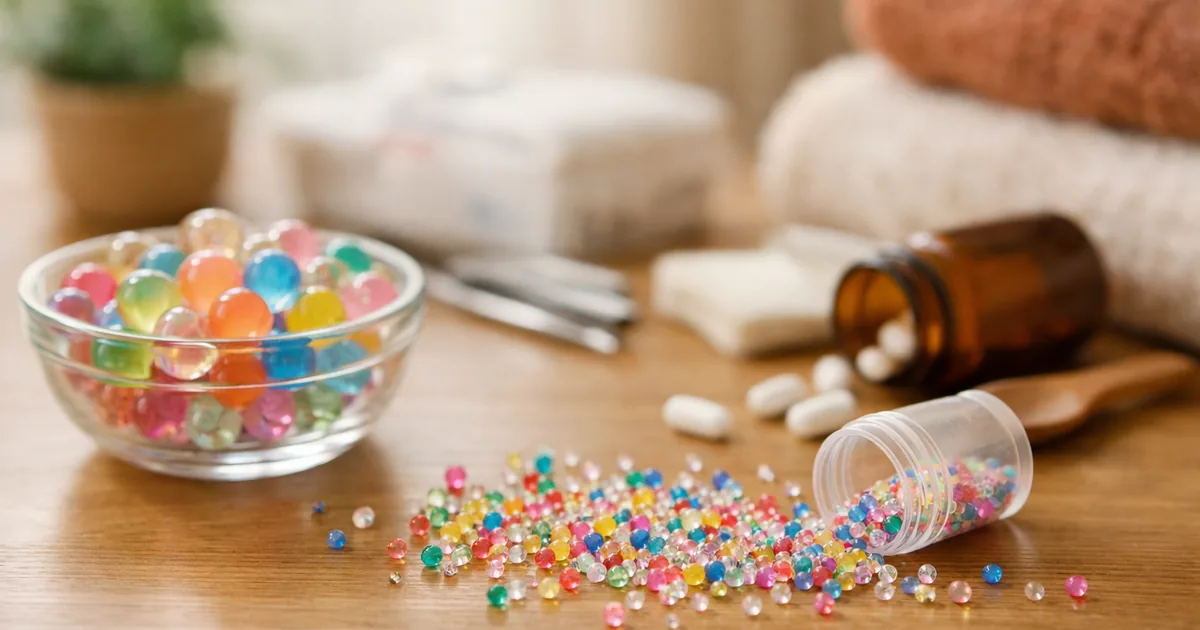
Water beads — small, colourful balls that swell in water — can keep growing inside a child who swallows them. The US Consumer Product Safety Commission (CPSC) says water beads can grow up to 100 times their original size when wet, and that dry beads can be as small as a pinhead, so a dropped one is hard to find. The CPSC safety alert (Publication 5101) estimates about 7,800 US emergency room visits from 2016 to 2022 and reports at least one death. CPSC therefore urges removing water beads from any place where children aged 3 and younger live or visit, and from 12 March 2026 water bead toys must meet a federal safety standard (16 CFR 1250.4). Enter a bead size and an acrylamide test result below to see where they fall under that standard.
1. Remove them from homes and childcare with children 3 and under — CPSC’s advice. Wet beads grow up to 100 times.
2. Swallowed, or pushed into an ear or nose? Get medical care right away — blockage, vomiting, dehydration; ear damage and surgery.
3. A federal standard since 12 March 2026 — no more than 325 µg acrylamide from 100 small beads or 1 large bead, a 5.0 mm gauge test after expansion, warning labels.
Checker
Updates as you type. For acrylamide, enter the result from 100 beads for small beads or from 1 bead for large beads. A small bead is under 4.0 mm in all dimensions when dry; a large bead is 4.0 mm or more in any dimension (CPSC business guidance). Classing by the longest side alone and the percentage are our sums. The 5.0 mm gauge test means actually soaking the beads, so the checker does not judge it from a number.
Why water beads are dangerous — CPSC
The CPSC safety alert (Publication 5101, August 2024 edition) describes water beads as small, colourful balls made of super absorbent polymer, sold as toys, craft materials, sensory tools and for gardening. It lists four hazards.
| Hazard | What the source says | Worth noting (our gloss) |
|---|---|---|
| Look like candy | Colourful, so babies and young children swallow them | The same “into the mouth” pattern as laundry packets and button batteries |
| Grow inside the body | Swallowed beads keep growing: vomiting, dehydration, intestinal blockage, life-threatening injuries, possibly surgery | The child can look fine while the bead swells in the gut |
| Ears and nose | Beads in the ear can damage its structures, causing hearing loss and needing surgery | Swallowing is not the only risk |
| Hard to see | Dry beads can be as small as a pinhead, so dropped or spilled ones are missed | Checking the floor after play is no guarantee |
The CPSC Water Beads Information Center adds that acrylamide is a known carcinogen, and that some large water beads in CPSC warnings contained acrylamide at levels that violate the Federal Hazardous Substances Act.
The numbers — three estimates over different periods
| Period | Figure in the source | Source |
|---|---|---|
| 2016–2022 | About 7,800 emergency room visits (estimate), at least one death | CPSC safety alert, Publication 5101 (August 2024) |
| 2018–2022 | Nearly 7,000 ingestion injuries treated in emergency departments | CPSC Water Beads Information Center |
| 2017–2022 | About 6,300 injuries treated in emergency departments (estimate; none of the 250 sample cases fatal) | Final rule preamble (Federal Register, 12 December 2025) |
| 2017–2023 | 64 incidents reported to CPSC — swallowing, ear or nose insertion, aspiration, choking | Final rule preamble |
The figures differ because they cover different periods and scopes (our reading). The information center also records the death of a 10-month-old girl in 2023, and the final rule preamble describes a 13-month-old whose intestine was blocked by a 13.0 mm water bead.
If a child swallows or inserts one — CPSC
The instruction is simple: get medical treatment right away. The US source also gives a 24-hour poison help line, which we have not copied here; in Korea, call 119 or go to the nearest emergency department (our addition). The source says US injuries and experiences can be reported at SaferProducts.gov.
From 12 March 2026 — the federal water bead toy standard
CPSC approved a federal standard for water bead toys on 21 August 2025. The final rule was published in the Federal Register on 12 December 2025 (90 Fed. Reg. 57,820) and took effect on 12 March 2026, at 16 CFR 1250.4. Here is what CPSC’s Water Bead Toys Business Guidance says.
| Item | What the source says | Worth noting (our gloss) |
|---|---|---|
| Water bead | A liquid absorbent polymer of various shapes — polyacrylamide, polyacrylate and similar — that expands when soaked | Not only round beads |
| Small and large beads | Small: under 4.0 mm in all dimensions when dry. Large: 4.0 mm or more in any dimension | The checker classes by the longest side |
| Size limit (c)(1) | Beads that fit entirely in the small parts cylinder when dry must pass a 5.0 mm test gauge (funnel or sieve) once fully expanded | Final rule preamble: cut from the proposed 9.0 mm to 5.0 mm, and the 50% expansion limit dropped |
| Acrylamide (c)(2) | No more than 325 µg extractable acrylamide from 100 small beads or 1 large bead | The checker’s acrylamide box |
| Warning label (d) | On water bead toys, packaging and containers, and on toys containing beads such as filled balls; hangtag or sticker if unpackaged; each item in a multi-pack | The full label text appears only as images on the guidance page |
| Certification | Manufacturers and importers must issue a Children’s Product Certificate (CPC) listing the rule | A US sales requirement |
Warning wording quoted in the final rule preamble includes “Contains water beads that can grow larger when swallowed or inserted in the ear or nose”, “Children have DIED when the beads blocked their intestines”, “Inserted beads have resulted in surgeries” and “Get medical help right away if you think your child swallowed or inserted beads”.
Trying the checker — our example
Say the longest side of a dry bead is 2.5 mm and 100 beads release 400 µg of acrylamide. Under 4.0 mm, it is a small bead, so the limit is 325 µg per 100 beads. 400 µg is 75 µg over the limit, or 123.1% of it (our sum). If instead one large bead, 6 mm when dry, released 300 µg, it would be within the limit at 92.3% (our sum). All figures are examples, not test results for any real product.
Other things children readily put in their mouths are covered in button batteries and liquid laundry packets; the risks of squishy toys that contain water beads are in squishy toys (CPSC).
Checklist
- ☐ Remove water beads from homes where children 3 and under live or often visit
- ☐ Supervise older children who play with them — never leave them alone
- ☐ Store them in a secure container out of young children’s reach
- ☐ Do not use them at all in childcare, camps or schools
- ☐ Check squishy toys and balls that contain water beads for tears
- ☐ Swallowed or inserted? Get medical care right away
Questions that remain
Does “100 times” mean 100 times the diameter?
The source says only “up to 100 times their original size” and does not say whether that is diameter or volume, so we have not calculated a grown size.
Does Korea have a water bead standard?
This article covers only US CPSC material. We have not read Korean children’s product safety standards or Korean water bead recalls and statistics.
What does “must pass” the 5.0 mm gauge mean in practice?
The business guidance says beads that fit in the small parts cylinder when dry must pass the 5.0 mm gauge once fully expanded. The soaking liquid, time and other steps are in the rule text and the test method document, which we have not read.
Sources
- US Consumer Product Safety Commission (CPSC) — Water Beads: A Danger to Young Children — source (safety alert Publication 5101, August 2024; checked 16 November 2026). 100 times, look like candy, growing inside the body, ears, pinhead size, removing them where children 3 and under are, supervision and storage, childcare, camps and schools, about 7,800 visits in 2016–2022, getting care right away.
- CPSC — Water Beads Information Center — source (no page date shown; checked 16 November 2026). Nearly 7,000 in 2018–2022, the 2023 death of a 10-month-old, acrylamide and the Federal Hazardous Substances Act, approval on 21 August 2025 and effect on 12 March 2026.
- CPSC — Water Bead Toys Business Guidance — source (checked 16 November 2026). 16 CFR 1250.4, 90 Fed. Reg. 57,820, definitions, 4.0 mm, the 5.0 mm gauge, 325 µg, labels, CPC.
- Federal Register — Safety Standard for Toys: Requirements for Water Beads (final rule) — source (12 December 2025). The preamble’s 6,300 and 64 incidents, the 13-month-old case, 9.0 to 5.0 mm, the dropped 50% limit, warning wording.
- Not read. The full text and figures of 16 CFR 1250.4 (label samples), the test method document for extractable acrylamide, ASTM F963, US statistics after 2023, the full recall list, Korean children’s product standards and Korean recalls and statistics.
- What we added. The “worth noting” column, the checker that classes by the longest side, the percentages and example figures, and the Korean 119 note.
Where to check further
- Emergency services or the nearest emergency department — if a bead is swallowed or inserted.
- The warning and age labels on the packaging — before buying.
Written on 16 November 2026. The content is from the source; the glosses are ours.