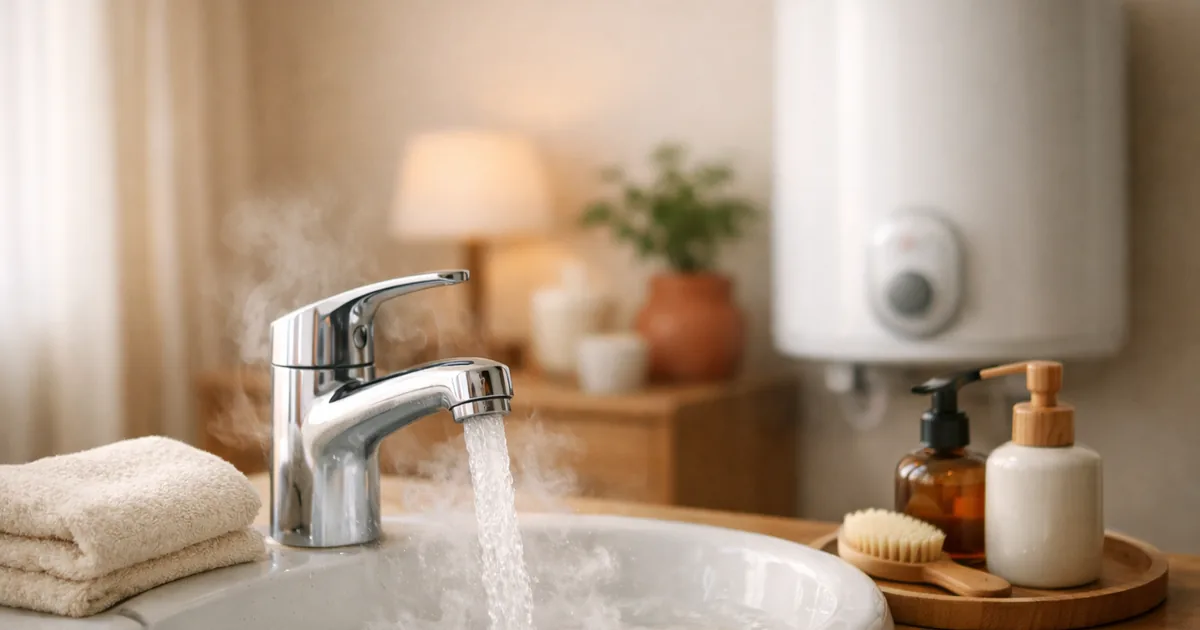
Hot water straight from the tap can cause third-degree burns. The US Consumer Product Safety Commission (CPSC) leaflet “Avoiding Tap Water Scalds” (Publication 5098) says most adults suffer third-degree burns after 2 seconds in 150°F water, 6 seconds at 140°F and 30 seconds at 130°F, and that even 120°F water can cause third-degree burns in 5 minutes. That is why CPSC urges setting the water heater to 120°F. Most people injured or killed by tap water scalds are older people and children under five. Enter your boiler or water heater setting below to see which row of the CPSC table it falls in (the Celsius conversions are ours).
1. Set the water heater to 120°F (about 48.9°C) — CPSC’s advice. Even 120°F water burns in 5 minutes.
2. 140°F (60°C) water burns in 6 seconds, 150°F (about 65.6°C) in 2 — third-degree burns in most adults.
3. Test the water by hand before bathing a child, and never leave a child alone in the bathroom — most victims are older people and under-fives.
Calculator
Updates as you type. The CPSC table has only four rows: 150°F 2 seconds, 140°F 6 seconds, 130°F 30 seconds, 120°F 5 minutes. The calculator picks the highest row your temperature is at or above (our reading — it does not estimate times between rows). °F = °C × 9 ÷ 5 + 32 (our conversion).
The CPSC table — temperature and time to a third-degree burn
| Water (source) | What the source says | Celsius (our conversion) |
|---|---|---|
| 150°F | Most adults suffer third-degree burns in 2 seconds | about 65.6°C |
| 140°F | 6 seconds | 60°C |
| 130°F | 30 seconds | about 54.4°C |
| 120°F | Even here, 5 minutes of exposure can cause a third-degree burn — the setting CPSC recommends | about 48.9°C |
The source gives these times for “most adults”. It does not say children and older people with thinner skin last as long, and it separately notes that most victims are older people and children under five. Each 10°F (about 5.6°C) drop stretches the time from 2 seconds to 6, then 30, then 5 minutes (our reading).
Trying Korean hot water settings — our examples
| Setting (our example) | Fahrenheit (our conversion) | CPSC row (our reading) |
|---|---|---|
| 70°C | 158°F | 150°F or above — 2 seconds |
| 65°C | 149°F | 140°F or above — 6 seconds |
| 60°C | 140°F | 140°F — 6 seconds |
| 55°C | 131°F | 130°F or above — 30 seconds |
| 50°C | 122°F | 120°F or above — 5 minutes |
| 45°C | 113°F | Below the table (it starts at 120°F) |
Korean boilers and electric water heaters usually show Celsius, so we converted. Hot water at 60°C is 140°F — exactly the 6-second row. 65°C (149°F) falls 1°F short of 150°F, so we read it as the 6-second row, but it sits right next to the 2-second row. The source does not say whether the display matches the water at the tap, so measuring with a thermometer, as below, is the source’s own method.
Turning the water heater down — CPSC
| Heater type | What the source says | Worth noting (our gloss) |
|---|---|---|
| Electric | Call the local electric company (some adjust it at no charge). To do it yourself, use no hot water for at least 2 hours first, turn off power at the breaker or fuse, remove the upper and lower access panels and set both thermostats to the same temperature. Check with a candy or meat thermometer under the faucet | Power off comes first. For Korean models, follow the maker’s manual |
| Gas | Thermostat designs differ, so call the local gas company. Measure with a thermometer first thing in the morning or at least 2 hours after water use; if too hot, adjust per the manufacturer and measure again | We read the 2 hours as letting the tank settle before measuring (our reading) |
| Furnace (on-line) systems | Ask the fuel supplier to lower it. Lowering the water temperature does not affect the heating capacity | Close to the hot-water setting on a Korean combi gas boiler (our gloss) |
| Apartments | Contact the building manager | In centrally heated complexes, the management office (our gloss) |
Another CPSC guide, “Childproofing Your Home”, says the water heater can be set to 120°F or lower, and that anti-scald devices for faucets and shower heads can also be used to prevent scalds. Publication 5098 adds that turning it down to 120°F also saves energy and money.
The numbers CPSC saw in 1979
The CPSC release “Commission Acts On Hot Tap Water Scald Hazard” (21 March 1979) estimated about 2,600 scald injuries a year from excessively hot tap water in the US. Of 159 death certificates from July 1973 to October 1977, 116 involved children under 5 and adults over 65, which the release called 75% (dividing 116 by 159 ourselves gives about 73.0%). A petition asked for a 130°F maximum setting on new residential water heaters; the Commission deferred it, opened a comment period, and urged industry to develop voluntary standards for warning labels and lower factory pre-set temperatures.
What came next is in the Record of Commission Action that CPSC has posted (meetings of 8 and 15 March 1979) and the Federal Register notice attached to it (Vol. 44, No. 106, 31 May 1979, p. 31276). On 8 March the Commission told staff to prepare information and education materials for consumers; on 15 March it deferred the petition and opened an investigation under section 10(c) of the Consumer Product Safety Act into appropriate operating temperatures for water heaters. It also had letters drafted to Underwriters Laboratories and ANSI encouraging voluntary work on labelling and lower factory pre-set temperatures. The notice proposed no mandatory rule and took comments until 30 July 1979. The notice’s figures — 2,816 ER-treated injuries a year, and 73% of 148 tap water scald deaths involving children under 5 or adults over 65 — differ from the release’s 2,600 and 159 (the two seem to rest on different counts; our reading). The scan is hard to read; the staff’s recommended range reads as 120–125°F (about 49–52°C, our conversion).
First aid at home after a burn (cool running water for 20 minutes and more) is in burns and scalds first aid.
Checklist
- ☐ Check the water heater or boiler hot-water setting — is it above 120°F (about 48.9°C)?
- ☐ Measure the tap water with a thermometer (first thing in the morning, or 2 hours after use)
- ☐ Test the water by hand before bathing a child
- ☐ Never leave a young child alone in the bathroom, even briefly
- ☐ Consider anti-scald devices on faucets and shower heads
Questions that remain
Does Korea have a hot water temperature standard?
This article covers only CPSC’s US guidance. We have not read Korean factory settings for water heaters or boilers, or apartment hot-water rules.
Is lower than 120°F safer?
“Childproofing Your Home” says “120°F or lower”. How much lower, and how to balance it against other risks such as bacteria, is not in the source.
What about temperatures between rows, say 135°F?
The table has only four rows, so we do not estimate in-between times. The calculator shows the nearest row at or below your temperature (130°F, 30 seconds, for 135°F); the real time may be shorter (our reading).
Sources
- US Consumer Product Safety Commission (CPSC) — Avoiding Tap Water Scalds — source (Publication 5098, code 032012 at the foot; checked 12 November 2026). 150°F 2 s, 140°F 6 s, 130°F 30 s, 120°F 5 min, the 120°F setting, older people and under-fives, electric, gas, furnace and apartment steps, 2 hours, thermometer, hand-testing and supervision. Another edition under the same number gives the same table.
- CPSC — Childproofing Your Home — source (checked 12 November 2026). 120°F or lower; anti-scald devices for faucets and shower heads.
- CPSC — Record of Commission Action, Petition CP 78-15 (Seattle City Light) · Federal Register Vol. 44, No. 106, p. 31276 — PDF (scan) (decisions of 8 and 15 March 1979, notice of 31 May; checked 12 November 2026). Petition deferred and a section 10(c) investigation opened, letters to UL and ANSI, comments until 30 July, 2,816 ER injuries, 73% of 148 deaths.
- CPSC — Commission Acts On Hot Tap Water Scald Hazard — source (21 March 1979). About 2,600 a year; 116 of 159 deaths (75% in the source); the 130°F petition.
- Not read. what came of the comments after the May 1979 notice and any final decision; a clean copy of the notice text; ANSI and UL water heater standards; the research behind the burn-time table; recent US tap water scald statistics; performance standards for anti-scald devices; Korean factory settings and apartment hot-water rules; Korean burn statistics.
- What we added. Celsius conversions, the Korean settings table, the “worth noting” column, and how the calculator picks a row between temperatures.
Where to check further
- The maker’s manual — for your water heater or boiler setting.
- Emergency services — for large or deep burns.
Written on 12 November 2026. The content is from the source; the glosses are ours.