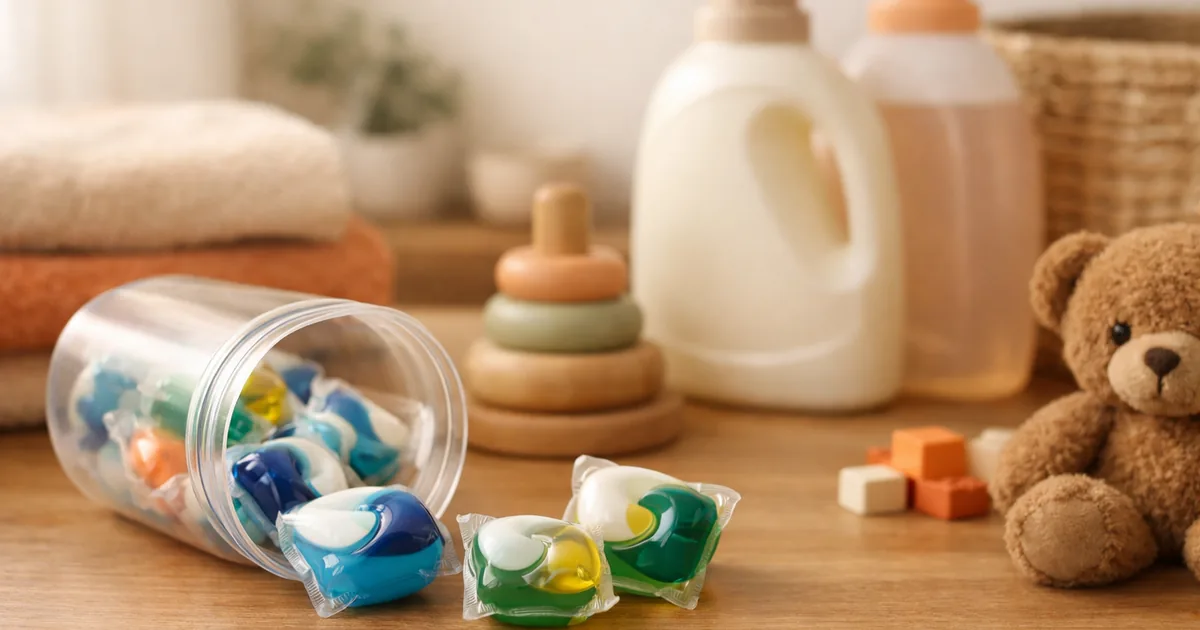
Single-load liquid laundry packets (laundry pods) look like candy, toys or teething products, so children put them in their mouths. The US Consumer Product Safety Commission (CPSC) warns that the packets dissolve quickly on contact with water, wet hands or saliva and release highly concentrated chemicals. Swallowing one can mean hospitalisation for loss of consciousness, excessive vomiting, drowsiness, throat swelling and breathing difficulty severe enough to need intubation; detergent in the eye can cause severe irritation and temporary vision loss from chemical burns. A CPSC report estimates that about 3,600 children under 5 were treated in US emergency departments for packet injuries in 2019, and that the rate fell from 72 to 25 per million units sold between 2012–2013 and 2019. Adjusted for population, though, the change was not statistically significant.
1. Do not let children handle packets — keep them sealed in the original packaging, locked up, out of sight and reach.
2. Handle packets with dry hands — water, wet hands and saliva dissolve them fast.
3. About 3,600 ER visits under age 5 in 2019 (US); 72 → 25 per million units sold — no significant change per head of population.
Calculator
Updates as you choose. Figures are copied from the tables of the CPSC Directorate for Epidemiology report (NEISS national estimates); the “vs baseline” changes are our division of the rounded table values. The report says differences per unit sold were statistically significant for every age group, and differences per head of population were not.
What the CPSC safety alert says
| Topic | What the source says | Worth noting (our gloss) |
|---|---|---|
| Why children grab them | Packets look like candy, toys or teething products | The soft, colourful shape is itself the hazard |
| Why they are dangerous | They dissolve quickly on contact with water, wet hands or saliva and release highly concentrated chemicals; some are toxic | We read this as: mouthing alone can burst one (our reading) |
| If swallowed | Loss of consciousness, excessive vomiting, drowsiness, throat swelling, breathing difficulty needing intubation — may require hospitalisation | — |
| If in the eye | Detergent from a ruptured packet can cause severe irritation and temporary vision loss from ocular burns | Happens when a child squeezes one until it bursts (our gloss) |
| Three steps | (1) Do not let children handle packets (2) keep them sealed in the original packaging, locked up, out of sight and reach (3) if swallowed or in the eye, contact Poison Help immediately | Korean contacts are not in the source — in an emergency, 119 (our addition) |
| Adults using them | Handle packets carefully, with dry hands | — |
A joint warning from CPSC and the Australian Competition and Consumer Commission (ACCC) on 21 March 2013 added: wash and dry your hands after each use; if swallowed, rinse as much detergent from the mouth as possible; if in the eye, flush with water for at least 15 minutes. At that point CPSC had received more than 500 incident reports involving children aged five or younger.
The report’s numbers — estimated ER-treated injuries (US)
| Period | Under 5 (source) | All ages (source) |
|---|---|---|
| Jul 2012–Jun 2013 (baseline) | 4,200 · 72 per million units | 4,500 · 78 per million units |
| 2017 | 3,900 · 30 per million units | 5,300 · 40 per million units |
| 2018 | 3,300 · 24 per million units | 4,400 · 32 per million units |
| 2019 | 3,600 · 25 per million units | 4,700 · 33 per million units |
The report treats July 2012–June 2013 as the baseline, July 2013–December 2016 as the transition, and 2017–2019 as the period after the ASTM F3159 standard took effect. Units sold rose from 58.075 million to 143.680 million, and packets from 2,051 million to 5,200 million — about 36 packets per unit (5,200 ÷ 143.68, our sum). So the rate per million units sold fell sharply from 72 to 25 (about −65.3%, our sum), while the rate per million children under 5 fell only from 210.7 to 183.8 (about −12.8%, our sum), a difference the report calls not statistically significant. Across all ages the rate per million people was 14.4 in both periods.
The report stops at 2019, so we also opened the CPSC Directorate for Epidemiology’s “Annual Report on Pediatric Poisoning Fatalities and Injuries” (March 2025). For 2022 it estimates about 2,900 ER-treated injuries from laundry packets among children under 5 (95% confidence interval 1,700 to 4,100), fifth among the top 10 poisoning products; for 2023 the coefficient of variation was above 33%, so no estimate is given (“N/A”). It notes that laundry packets came out in 2012 and have been in the top 10 every year since 2013, and says the report has not been reviewed or approved by the Commission. Because the periods and age groups differ from the report through 2019, we do not set the two sets of numbers side by side (our reading).
Ingestions, admissions and deaths
| Item | What the source says | Worth noting (our gloss) |
|---|---|---|
| Ingestions under 5 | 3,300 (baseline) → 2,900 (2017) → 1,900 (2018) → 2,000 (2019) | Most injuries under 5 were ingestions |
| Eye injuries under 5 | 1,300 (2018) · 1,500 (2019); no estimate could be published for the baseline or 2017 | Ingestions down, eye injuries remain (our reading) |
| Admitted or transferred (all ages) | 11% (baseline) → 2% (2017) → 4% (2018) → 4% (2019); treated and released 84% → 95% | The report states it ran no statistical tests on these shares |
| Deaths | 1 in the baseline; 7 in the transition (including two children under 2, both in 2013); 3 in 2017–2019 (two elderly men in 2017, a 43-year-old man in 2018). CPSC is not aware of any deaths in 2019 | Adults died too — the report gives no circumstances |
The report notes it was prepared by CPSC staff and has not been reviewed or approved by the Commission. ASTM F3159-15e1 is a voluntary standard published in October 2015; the report says only that it covers the packaging, labelling and taste/dissolution properties of the packets. We have not read the standard itself (it is paid).
Care-label symbols and fabric-by-fabric washing rules are in reading Korean care labels; another small object that is dangerous to swallow is covered in button batteries.
Checklist
- ☐ Packets in their original packaging, lid or zip closed
- ☐ In a locked cupboard or high out of a child’s sight
- ☐ Take them out with dry hands; wash and dry hands after use
- ☐ Close the pack straight away if a child is nearby while you do the laundry (our addition)
- ☐ If swallowed or in the eye, call emergency services at once — flush eyes for at least 15 minutes
Questions that remain
Does the same happen in Korea?
This article covers only CPSC’s US material. We have not read Korean injury statistics or Korean labelling rules for laundry packets.
Are packets more dangerous than powder or liquid detergent?
The report counts packets only and makes no comparison with other detergents.
If the rate per unit sold fell, are they safe now?
The report states both: the drop per unit sold was significant, the change per head of population was not. As more homes used packets, the risk per pack fell, but the number of children hurt did not clearly fall (our reading).
Sources
- US Consumer Product Safety Commission (CPSC) — Single-Load Liquid Laundry Packets: Harmful to Children — source (safety alert Publication 390, code 112021; checked 12 November 2026). Candy look-alike, concentrated chemicals, ingestion and eye symptoms, three steps, dry hands.
- CPSC Directorate for Epidemiology — Liquid Laundry Packets Post-Implementation Period Report Through 2019 — source (December 2020; checked 12 November 2026). Periods, ER estimates and sample sizes, ingestions and eye injuries, units and packets sold, per-unit and per-person rates and significance, dispositions, deaths, ASTM F3159-15e1 (October 2015).
- CPSC Directorate for Epidemiology — Annual Report on Pediatric Poisoning Fatalities and Injuries (March 2025) — PDF (checked 12 November 2026). About 2,900 ER-treated injuries in children under 5 in 2022 (95% CI 1,700–4,100, fifth), 2023 estimate unstable (N/A), in the top 10 every year since 2013.
- CPSC — CPSC and ACCC Warn of Poison Dangers with Liquid Laundry Packets — source (21 March 2013, release 13-147). More than 500 reports, wash and dry hands, rinse the mouth, 15 minutes for eyes.
- Not read. The ASTM F3159 text (paid) and later revisions; the 2020 and 2021 figures and the yearly values in Figure A.2 of the 2025 report; year-by-year transition-period figures; per-unit rates for the under-6 group; why no eye-injury estimate could be published for the baseline and 2017; the circumstances of the deaths; poison centres’ own statistics; Korean laundry packet injury data and Korean labelling and packaging rules.
- What we added. Changes against the baseline, packets per unit, the “worth noting” column, the fourth checklist line, and 119 for Korea.
Where to check further
- Emergency services — if swallowed or in the eye.
- Korea’s product safety information centre — recalls and standards.
Written on 12 November 2026. The content is from the source; the glosses are ours.