If a certain food brings on diarrhoea, bloating or tummy pain a few hours later, again and again, but allergy tests show nothing, it may be a food intolerance. The UK National Health Service (NHS) says a food intolerance is caused by your body not being able to digest a certain food or an ingredient in food. Unlike a food allergy, it is not caused by the immune system overreacting, so you cannot have a serious allergic reaction. Lactose intolerance is the most common; gluten, histamine, caffeine, alcohol and sulphites are among other triggers. Here are the NHS symptoms, 8 trigger ingredients, tests, treatment, and why it does not recommend home tests.
1. Symptoms usually a few hours after eating — diarrhoea, bloating, farting, tummy pain; lasting hours or days.
2. Not an allergy — no immune reaction, so no serious allergic reaction. Swollen lips or throat or breathing trouble: call 999.
3. Tests: elimination diet, blood tests, breath test, a food diary — home tests are not recommended.
Symptoms — NHS
| Type | What the NHS says | Worth noting (ours) |
|---|---|---|
| When | Usually a few hours after the food or ingredient | Lactose intolerance can start within minutes |
| Common | Diarrhoea, bloating, farting, tummy pain | — |
| Other | Headache, feeling tired or exhausted, feeling sick, constipation, joint pain, rashes | — |
| How long | A few hours or days | — |
| Not an allergy | A food allergy causes itchy skin, wheezing, swelling of the lips, face and eyes | No immune reaction, so no serious allergic reaction |
Trigger foods and ingredients — NHS
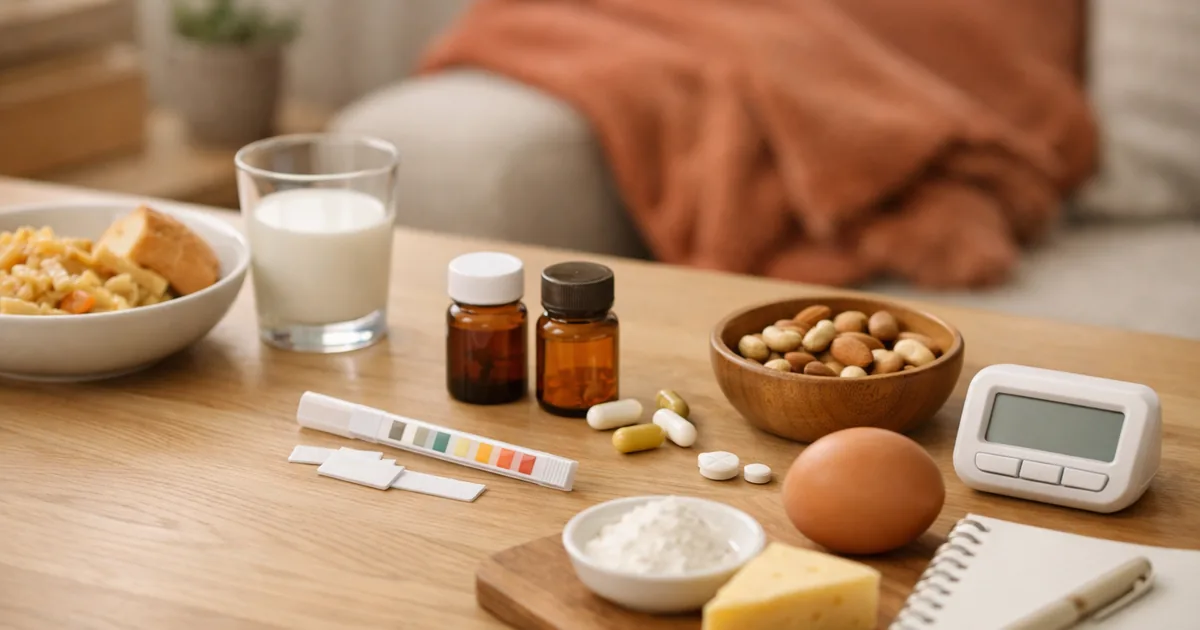
The most common is lactose intolerance — lactose is a sugar mainly in milk and dairy such as cheese and yoghurt. But you can be intolerant to any food or ingredient, the NHS says, such as:
| Ingredient | NHS examples | Worth noting (ours) |
|---|---|---|
| Gluten | Wheat, rye, barley — bread, pasta | Coeliac disease is autoimmune, not an intolerance (link below) |
| Histamine | Foods and drinks like wine and cheese | — |
| Caffeine | Coffee, tea, some fizzy drinks | — |
| Alcohol | Alcoholic drinks | — |
| Sulphites | Cider, beer, wine | — |
| Salicylates | Some fruits, vegetables, herbs and spices | — |
| MSG | Ripened fruits, cured meats, savoury foods | — |
| Benzoates | Preservative in soft drinks, fruit juices, salad dressing, jams, jellies, pickles | Listed as sodium benzoate on Korean labels (ours) |
See lactose intolerance, and coeliac disease for the immune reaction to gluten.
When to get help — NHS
See a GP if you or your child have food intolerance symptoms that keep coming back. In Korea, a local clinic, gastroenterology or paediatrics (ours). The following are signs of a serious allergic reaction, not intolerance; the NHS says call 999. They may need immediate hospital treatment.
| If | NHS advice | Worth noting (ours) |
|---|---|---|
| Lips, mouth, throat or tongue suddenly swollen | Call 999 | In Korea, 119 (ours) |
| Breathing very fast or struggling to breathe (wheezy, choking, gasping) | 999 | — |
| Throat feels tight or struggling to swallow | 999 | — |
| Skin, tongue or lips blue, grey or pale | 999 | On black or brown skin, easier to see on palms or soles |
| Suddenly very confused, drowsy or dizzy; someone faints and cannot be woken | 999 | — |
| A child is limp, floppy or not responding normally | 999 | A swollen, raised or itchy rash may also appear — signs of anaphylaxis |
Tests — NHS
| Type | What the NHS says | Worth noting (ours) |
|---|---|---|
| Dietitian | A GP may refer you to a dietitian | — |
| Elimination diet | Avoid the suspect food to see if symptoms improve; after a few weeks eat it again to see if they return | Better with a dietitian than alone (ours) |
| Blood tests | May be done | — |
| Breath test | If you might be lactose intolerant | — |
| Food and symptoms diary | To help work out triggers | Note times of eating and of symptoms to spot the few-hours gap (ours) |
Home tests not recommended — NHS
Some tests you can buy that claim to diagnose food intolerances are not recommended, the NHS says plainly. There is limited evidence they give accurate results, and they may suggest avoiding multiple foods, which can be harmful. Kits sold in Korea are worth viewing the same way (ours).
Treatment — NHS
| Type | What the NHS says | Worth noting (ours) |
|---|---|---|
| Avoid or reduce | The food, and foods containing the ingredient | Labels matter (ours) |
| Ask first | Don’t cut foods out of your or your child’s diet without a GP or dietitian | — |
| Why | You could miss vitamins and minerals, especially important for a child’s growth and development | — |
Checklist
- ☐ Use a food and symptoms diary to see if symptoms come hours later
- ☐ Look for suspect ingredients (lactose, gluten, caffeine, alcohol, sulphites) on labels
- ☐ Keeps coming back: see a GP, an elimination diet with a dietitian
- ☐ Swollen lips or throat, breathing trouble, pale skin: emergency
- ☐ Don’t cut foods on a home test result alone
Questions that remain
Does a food intolerance go away?
This page only says to avoid or reduce the trigger; it doesn’t say whether it improves. The lactose page notes premature babies usually improve as they grow.
How many weeks for an elimination diet?
The NHS only says to reintroduce the food “after a few weeks”. Agree the length with a dietitian (ours).
How do I know bloating is from food?
The NHS suggests a food and symptoms diary. Other causes such as IBS exist, so see a doctor if it keeps coming back.
Sources
- NHS — Food intolerance — source (page shows: reviewed 18 June 2026, next review due 18 June 2029; checked 5 November 2026). Symptoms, timing and length, allergy difference, GP criterion, 7 999 criteria, causes (lactose and 8 ingredients), 4 tests and a diary, home tests not recommended, treatment.
- Not read. The food allergy page; histamine and salicylate detail; material on Korean home test kits.
- What we added. The “worth noting” column and the Korean care gloss.
Where to check further
- Gastroenterology or paediatrics — when symptoms keep returning.
- A dietitian — elimination and reintroduction.
Written on 5 November 2026. The content is from the NHS; the glosses are ours.