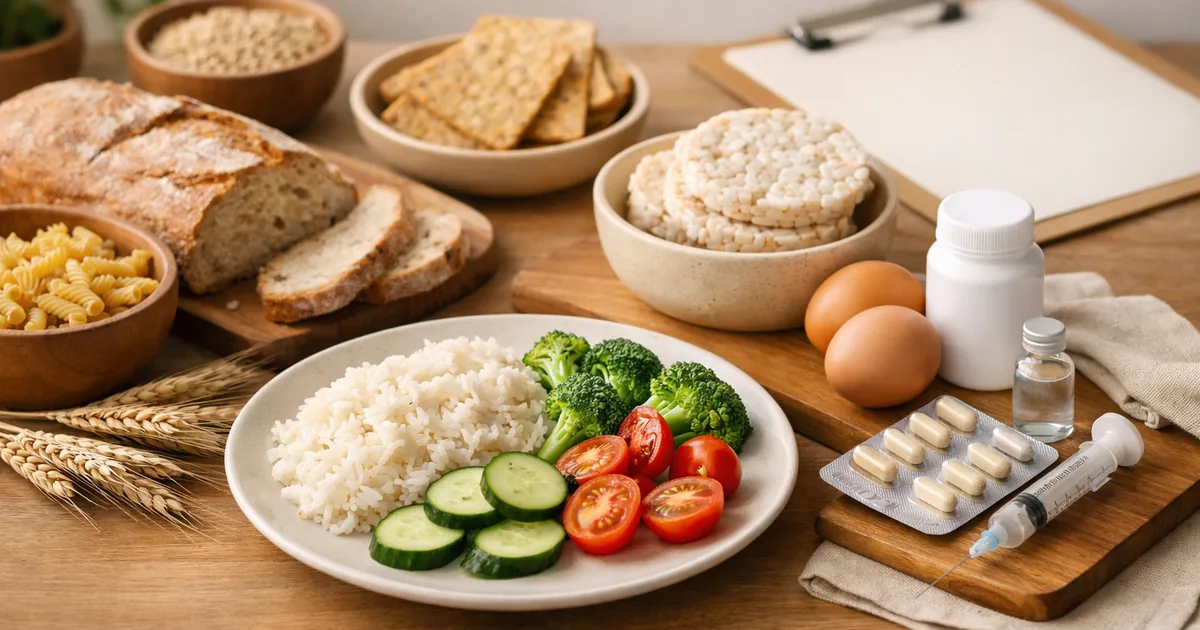
Repeated diarrhoea, stomach pain and bloating after bread or pasta, with tiredness or anaemia nobody can explain, can point to coeliac disease. The UK National Health Service (NHS) describes it as a condition where the immune system attacks your own tissues when you eat gluten, damaging the small intestine so the body cannot properly take in nutrients. Gluten is a protein in wheat, barley and rye. It affects at least 1 in every 100 people in the UK. Here is the NHS guidance on symptoms, who should be tested, what to do during testing, the gluten-free diet and complications.
1. Caused by gluten in wheat, barley and rye — oats have no gluten but can be contaminated.
2. A blood test first, a small-bowel biopsy to confirm — keep eating gluten during testing so the results are accurate.
3. Treatment is no gluten, for life — symptoms improve within weeks, but the gut may take up to a few years to heal.
Symptoms — NHS
| Type | What the NHS says | Worth noting (ours) |
|---|---|---|
| Gut | Diarrhoea (may smell particularly unpleasant), stomach aches, bloating and farting, indigestion, constipation | Easily confused with IBS |
| General | Tiredness from malnutrition, unintentional weight loss, an itchy rash (dermatitis herpetiformis) | — |
| Other | Problems getting pregnant, nerve damage (peripheral neuropathy), problems with co-ordination, balance and speech (ataxia) | — |
| Children | May not grow at the expected rate and have delayed puberty | — |
Some experts think the 1 in 100 figure is an underestimate, the NHS notes, because milder cases go undiagnosed or are misdiagnosed as other digestive conditions such as IBS. More cases are reported in women, and it can develop at any age.
Where gluten is found — NHS
| Type | What the NHS says | Worth noting (ours) |
|---|---|---|
| Cereals | Wheat, barley, rye, including farina, semolina, durum, bulgar, cous cous and spelt | In Korea this includes noodles and batter mixes made with wheat flour (ours) |
| Common foods | Pasta, cakes, breakfast cereals, most bread, certain sauces, some ready meals | Check soy sauce and gochujang labels for wheat (ours) |
| Drink | Most beers are made with barley | — |
| Hidden gluten | Additives such as malt flavouring and modified food starch; some medicines | Labels matter most for processed foods |
| Cross-contamination | When gluten-free and gluten foods are prepared together or served with the same utensils | — |
| Oats | No gluten, but can be contaminated; a very small number react to pure oats (avenin) | Avoid oats not labelled gluten-free, says the NHS |
Who should be tested — NHS
There is no routine testing in England. The NHS says you should be tested if you have any 1 of these:
- Persistent unexplained gut symptoms such as diarrhoea, stomach ache and bloating
- Faltering growth, prolonged tiredness, unintentional weight loss
- Severe or persistent mouth ulcers
- Unexplained iron deficiency anaemia, or vitamin B12 or folate deficiency anaemia
- Type 1 diabetes; autoimmune thyroid disease, including an underactive or overactive thyroid
- IBS (in adults)
- A parent, sibling or child with coeliac disease
See iron deficiency anaemia and vitamin B12 or folate deficiency anaemia. Down’s syndrome and Turner syndrome also raise the risk, says the NHS.
Tests — NHS
| Type | What the NHS says | Worth noting (ours) |
|---|---|---|
| Diet during tests | Keep eating foods containing gluten so the tests are accurate | Stopping early can give a wrong result |
| Blood test | A GP checks for antibodies usually present in coeliac disease | You can have it without these antibodies |
| If positive | Referral to a gastroenterologist; more blood tests or a biopsy | Don’t go gluten-free until a specialist confirms, even after a positive blood test |
| Negative but symptoms | A GP may still refer you | — |
| Biopsy | In hospital, an endoscope passed through the mouth takes samples of the small-intestine lining; throat numbed, maybe a sedative | Similar to an upper endoscopy with biopsy in Korea (ours) |
| After diagnosis | Blood tests for iron, vitamins and minerals; skin biopsy for a rash; a DEXA scan if bones may be affected | — |
Treatment — gluten-free for life (NHS)
There is no cure; treatment is cutting gluten out. The NHS says you must stop eating all sources of gluten for life: symptoms return and long-term damage follows if you eat it. A diet change is recommended even with mild symptoms, or with no noticeable symptoms when tests show some degree of coeliac disease. Even a small amount, such as a spoonful of pasta, can bring very unpleasant gut symptoms.
| Type | What the NHS says | Worth noting (ours) |
|---|---|---|
| Recovery | Symptoms improve considerably within weeks; the gut may take up to a few years to heal | — |
| Follow-up | Referral to a dietitian at diagnosis; an annual review with a GP (height, weight, symptoms, diet) | — |
| Safe foods | Most dairy (cheese, butter, milk), fruit and vegetables, meat and fish (not breaded or battered), potatoes, rice and rice noodles, rice, corn, soy and potato flour | Rice, vegetable side dishes and grilled fish usually fit (ours) |
| “Gluten-free” label | By law no more than 20 ppm of gluten; trace amounts don’t trouble most people | 20 ppm = 20 mg per kg (our conversion). UK rule; Korean labelling not read |
| Babies | No gluten before 6 months; breast milk and infant formula are gluten-free | — |
| Vaccines | If the spleen works less well, flu and pneumococcal vaccines may be needed | Not usually needed if the spleen is unaffected |
| Supplements | Vitamins and minerals if needed, e.g. for iron deficiency anaemia | — |
| Dermatitis herpetiformis | Gluten-free helps but can take longer; often dapsone twice a day for up to 2 years | Lowest effective dose because of anaemia, headaches and depression; regular blood tests |
| Refractory coeliac disease | A rarer type where symptoms continue on a gluten-free diet — tests for other causes, a specialist, steroids (prednisolone) or immunosuppressants | — |
See the pneumococcal vaccine page. In the first few months many people eat gluten by accident and symptoms return, the NHS notes.
Complications — NHS
Complications mostly affect people who keep eating gluten or are not yet diagnosed. Long-term they include osteoporosis, iron deficiency anaemia and vitamin B12 or folate deficiency anaemia; less common and more serious are some cancers, such as bowel cancer, and pregnancy problems such as low birth weight. The cause seems to be a mix of genetics and environment, but it is not entirely clear, says the NHS.
Checklist
- ☐ Unexplained diarrhoea, bloating, tiredness or anaemia that keeps going
- ☐ A first-degree relative with coeliac disease, type 1 diabetes or autoimmune thyroid disease
- ☐ Keep eating gluten until testing is finished
- ☐ If confirmed: a dietitian, gluten-free for life, labels and cross-contamination
- ☐ An annual review, anaemia and bone checks
Questions that remain
If I cut gluten and feel better, is it coeliac disease?
The NHS says to keep eating gluten during testing and not to go gluten-free before a specialist confirms the diagnosis, so trying the diet first is not the advised route (our reading).
How much gluten, for how long, before the test?
The pages we read give no amount or time. Ask the doctor arranging the test.
Can I eat oats?
Oats have no gluten but can be contaminated, and a few people react to pure oats. Discuss it with a professional first and choose only pure oats labelled gluten-free, says the NHS.
Sources
- NHS — Coeliac disease (overview, diagnosis, treatment) — source (page shows: reviewed 31 March 2023, next review due 31 March 2026 (past at the time we checked); checked 5 November 2026). Overview (cereals, symptoms, causes, complications, who’s affected), diagnosis (9 reasons to test, blood test, biopsy, tests after diagnosis), treatment (gluten-free for life, safe foods, 20 ppm, oats, babies, vaccines, supplements, dermatitis herpetiformis, refractory disease).
- Not read. The complications, symptoms and causes subpages; Korean gluten-free labelling and guidance.
- What we added. The “worth noting” column and the Korean care gloss.
Where to check further
- A gastroenterologist — blood tests and biopsy.
- A dietitian — planning a gluten-free diet.
Written on 5 November 2026. The content is from the NHS; the glosses are ours.