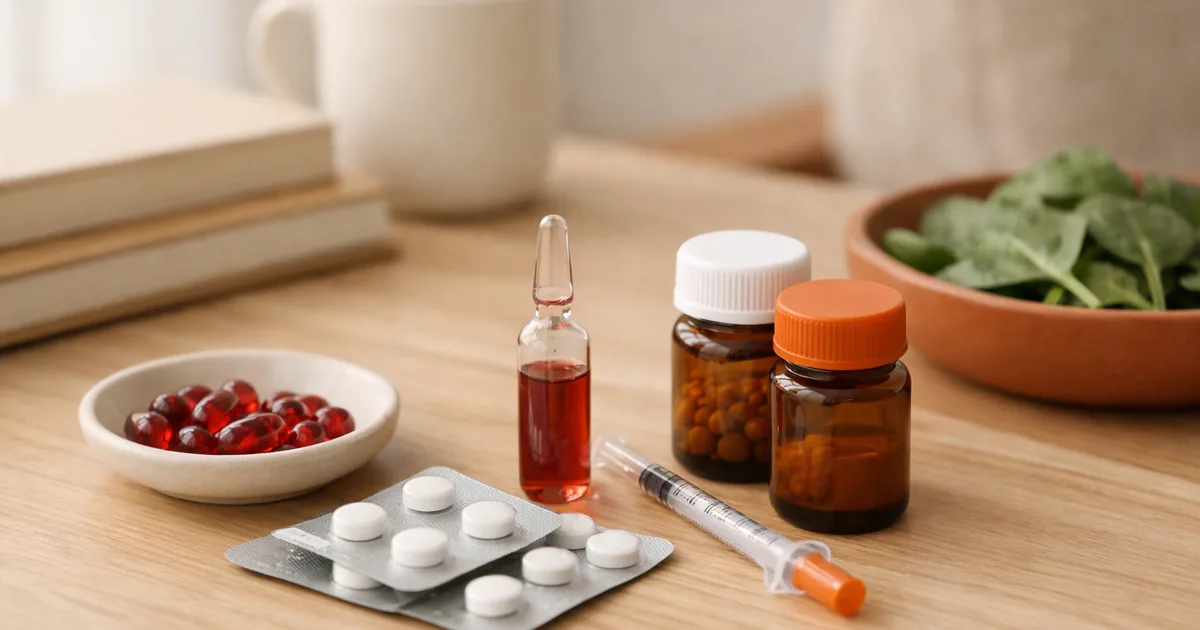
Exhausted all the time, pins and needles, a sore red tongue — these can point to vitamin B12 or folate deficiency anaemia. The UK National Health Service (NHS) explains that a lack of vitamin B12 or folate (vitamin B9) makes the body produce abnormally large red blood cells that cannot work properly. Most cases are easily treated with injections or tablets, but some problems can be irreversible, so it should be diagnosed and treated as soon as possible. B12 deficiency not caused by diet usually means an injection every 2 to 3 months for life; folic acid tablets usually run for about 4 months. It’s more common with age — around 1 in 10 people aged 75 or over and 1 in 20 aged 65 to 74. Here are the NHS overview and treatment pages.
1. Symptoms: extreme tiredness, pins and needles, a sore red tongue, mouth ulcers, muscle weakness, vision and memory problems. See a GP — some damage can be permanent if left.
2. B12: injections every other day at first; then tablets or 2 injections a year if diet-related, otherwise every 2 to 3 months for life.
3. Folate: daily folic acid tablets, usually about 4 months — B12 is checked first.
What kind of anaemia — NHS
Red blood cells carry oxygen using haemoglobin. Anaemia means fewer red blood cells than normal or too little haemoglobin in each. Vitamin B12 and folate also keep the nervous system healthy, so a lack of either can cause a wide range of problems, and some can happen without anaemia, says the NHS.
Symptoms — NHS
| Type | What the NHS says | Worth noting (ours) |
|---|---|---|
| Energy | Extreme tiredness, lack of energy | Overlaps with iron deficiency anaemia |
| Nerves | Pins and needles, muscle weakness | — |
| Mouth | A sore and red tongue, mouth ulcers | — |
| Eyes | Problems with vision | — |
| Mind | Psychological problems from mild depression or anxiety to confusion and dementia; problems with memory, understanding and judgement | — |
When to get help — NHS
| Situation | NHS advice | Worth noting (ours) |
|---|---|---|
| You think you may have a B12 or folate deficiency | See a GP | In Korea, a local clinic (internal or family medicine) |
| Diagnosis | Often from symptoms and a blood test | — |
| Why hurry | Many symptoms improve with treatment, but some problems can be irreversible | — |
Causes — NHS
| Type | What the NHS says | Worth noting (ours) |
|---|---|---|
| Pernicious anaemia | The immune system attacks healthy stomach cells so B12 from food can’t be absorbed; the most common cause of B12 deficiency in the UK | Not diet-related |
| Diet | Uncommon: a vegan diet without B12 supplements or fortified foods, a restrictive diet, or a poor diet for a long time | — |
| Medicines | Some, including anticonvulsants and proton pump inhibitors (PPIs), affect absorption | PPIs reduce stomach acid (ours) |
| Age | More common in older people — around 1 in 10 aged 75 or over and 1 in 20 aged 65 to 74 | 1 in 10 = 10%, 1 in 20 = 5% (our conversion) |
Treating B12 deficiency anaemia — NHS
| Type | What the NHS says | Worth noting (ours) |
|---|---|---|
| At first | B12 injections called hydroxocobalamin every other day, given by a GP or nurse | The page doesn’t say how long this first phase lasts |
| Diet-related | B12 tablets every day between meals, or an injection twice a year; people who struggle to get B12 from food, such as vegans, may need tablets for life | If a long poor diet was the cause, you may stop once levels and diet improve |
| Not diet-related (e.g. pernicious anaemia) | Usually an injection every 2 to 3 months for the rest of your life | 4 to 6 a year (our sum) |
| Neurological symptoms | With symptoms such as numbness or tingling in the hands and feet, referral to a haematologist and possibly injections every 2 months; they advise how long | — |
| Which injection | In the UK hydroxocobalamin is preferred to cyanocobalamin because it stays in the body longer | — |
Treating folate deficiency anaemia — NHS
| Type | What the NHS says | Worth noting (ours) |
|---|---|---|
| Medicine | Daily folic acid tablets, perhaps with dietary advice | — |
| How long | Most people about 4 months; longer, possibly for life, if the cause continues | 4 months ≈ 16 weeks or so (our sum) |
| Before starting | The GP checks your B12 is normal first — folic acid can improve symptoms so much it masks a B12 deficiency | An undetected B12 deficiency can affect the nervous system |
Food — NHS
| Type | What the NHS says | Worth noting (ours) |
|---|---|---|
| B12 | Meat, salmon and cod, milk and dairy, eggs; for vegetarians and vegans, fortified foods such as some yeast extracts, breakfast cereals and soy products | Check nutrition labels for B12 |
| Folate | Broccoli, brussels sprouts, asparagus, peas, chickpeas, brown rice | — |
Checking treatment works — NHS
A blood test is often done around 7 to 10 days after starting, checking haemoglobin and immature red blood cells (reticulocytes), and another after about 8 weeks to confirm success. Most people need no further monitoring unless symptoms return or treatment isn’t working, says the NHS.
Complications — NHS
Uncommon, but especially after a long deficiency, with or without anaemia: nervous system problems, temporary infertility, heart conditions, and pregnancy complications and birth defects. Adults with severe anaemia also risk heart failure. Some improve with treatment, but others, such as nervous system problems, can be permanent.
The most common type, iron deficiency anaemia, is in iron deficiency anaemia.
Checklist
- ☐ Tiredness, pins and needles, sore tongue, mouth ulcers: GP blood test
- ☐ Vegan or restrictive diet, PPIs or anticonvulsants: mention them
- ☐ B12 injections: every other day at first, then tablets, twice a year or every 2 to 3 months by cause
- ☐ Folic acid usually about 4 months, B12 checked first
- ☐ Blood tests at 7 to 10 days and about 8 weeks
Questions that remain
Can I just take folic acid?
The NHS says folic acid can improve symptoms enough to hide a B12 deficiency, so the GP checks B12 before you start. A missed B12 deficiency can affect the nervous system.
Are the injections really for life?
It depends on the cause. Not diet-related (such as pernicious anaemia) usually means every 2 to 3 months for life; diet-related means tablets or twice-yearly injections, which may stop once your diet improves, says the NHS.
Sources
- NHS — Vitamin B12 or folate deficiency anaemia — source (page shows: reviewed 20 February 2023, next review due 20 February 2026 (past at the time we checked); checked 4 November 2026). Overview (nine symptoms, GP, three causes, frequency by age, treatment outline, food, complications). Also the Treatment page in the same set (same review date): hydroxocobalamin every other day, twice a year, every 2 to 3 months, every 2 months; folic acid about 4 months; B12 checked first; tests at 7 to 10 days and about 8 weeks.
- Not read. The Symptoms, Causes, Diagnosis and Complications sub-pages; how long the first every-other-day phase lasts; Korean anaemia guidance.
- What we added. The “worth noting” column and the Korean care gloss.
Where to check further
- A local clinic — blood tests, injections and tablets.
- A pharmacist — acid medicines, anticonvulsants and absorption.
Written on 4 November 2026. The content is from the NHS; the glosses are ours.