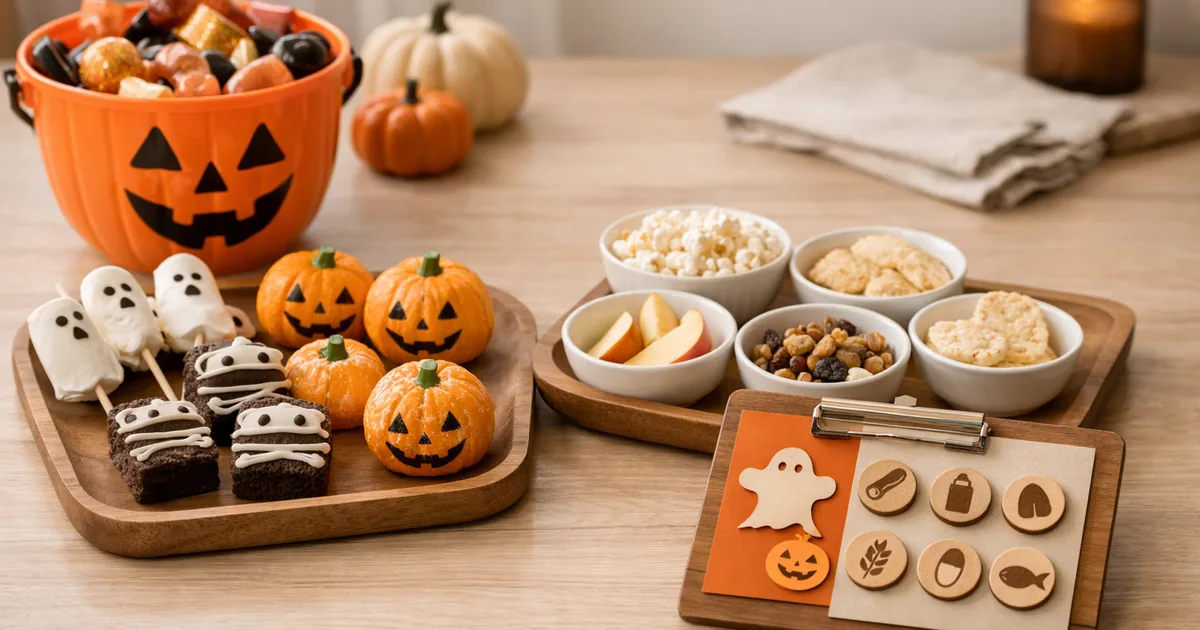
Most of the sweets a child brings home on Halloween arrive without their packet — scooped by the handful out of a big bag. And the allergen labelling only exists on that packet.
1. Labelling is required “regardless of quantity”. The annex says every allergen used as an ingredient must be declared “«regardless of» the amount contained in the product” — there is no “only a trace, so we left it off”.
2. The list runs to nineteen entries. It is often quoted as “22”; counted as the annex separates them by comma it is 19 (21 if you split the three shellfish named in brackets).
3. “May contain” means something different. Not it is in there but it shares a production line — the text treats the two separately.
Nineteen entries — straight from the annex
The basis is annex 2 to the Enforcement Rule of Korea's Act on Labelling and Advertising of Foods, headed “Labelling for consumer safety”. It sits in an annex rather than the body of the rule, which is why searching rarely surfaces it.
[Annex 2] I. General 1. Allergen labelling
(a) Allergenic substances
eggs (poultry only), milk, buckwheat, peanut, soybean, wheat, mackerel, crab, shrimp, pork, peach, tomato, sulphites (only where added such that the final product contains 10 mg or more of sulphur dioxide per kilogram), walnut, chicken, beef, squid, shellfish (including oyster, abalone and mussel), pine nut
| Group | As the annex lists them | Where it shows up in Halloween sweets |
|---|---|---|
| Grains and legumes | buckwheat, soybean, wheat, peanut, walnut, pine nut | nearly all chocolate, biscuits, wafers |
| Egg and dairy | eggs (poultry only), milk | milk chocolate, caramel, marshmallow |
| Meat | pork, chicken, beef | check the gelatine in jellies |
| Seafood | mackerel, crab, shrimp, squid, shellfish (oyster, abalone, mussel) | rare in confectionery; common in savoury snacks and seasoning |
| Fruit | peach, tomato | fruit-flavoured jellies and juices |
| Additive | sulphites — only at 10 mg SO₂/kg or more | anything with dried fruit |
📌 “Twenty-two” is not what the annex shows. Counting the comma-separated entries gives 19; splitting the oyster, abalone and mussel inside the shellfish bracket gives 21. The list is the same — the counting differs, which is why this article prints the list rather than a number. It is also the only way to notice that sulphites are the single entry carrying a «quantity threshold».

There is no “too small to mention”
(c) Method of labelling
An allergen box distinguishable from the background colour shall be placed near the ingredient list, and all allergens used as ingredients shall be declared regardless of the quantity contained in the product.
(Example) Contains egg, milk, shrimp, sulphur dioxide, shellfish (oyster)
Two requirements in one sentence. First, “all, regardless of quantity” — no threshold (sulphites being the one entry with a figure attached). Second, “distinguishable from the background colour” — a separate box, not allergens buried in the ingredient list. That is why looking for the box is faster than reading the ingredients.
The text also allows omission. For a food made from a single ingredient, or packaged or imported meat, where the product name is the same as the allergen, the declaration may be left off — milk called “milk” need not also say “contains milk”.
“May contain” is not “contains”
2. Labelling for possible cross-contact
Where products made with and without an allergen are produced through the same manufacturing process (including workers, equipment, production lines and ingredient storage) so that cross-contact is unavoidable, a warning such as “this product is manufactured in the same facility as products using buckwheat” or “may contain buckwheat” shall be shown.
| Wording on the pack | What the text means by it | How to read it |
|---|---|---|
| “Contains …” (allergen box) | used as an ingredient | it is in there, whatever the amount |
| “May contain …” | shares a production facility | not an ingredient, but cross-contact is possible |
| Neither | not applicable — or a labelling breach | on a loose sweet with no packet there is no way to know |
There is a proviso too — where the allergen is already an ingredient of the product, the cross-contact warning is not added, because “contains” already says it.
What happens if it is missing
Enforcement Rule article 15 (Recall and disposal criteria)
1. Foods for which a labelling-required allergen has not been declared
It is the first line of the list — ahead of misstated use-by dates (subparagraph 2). A missing allergen declaration puts the product in scope for recall, seizure and disposal.
Where Halloween actually goes wrong — a checklist
- Handing out loose sweets destroys the labelling. The rule attaches the declaration to the packaging — bin the bag and the information goes with it. If you are giving them out, choose individually wrapped products.
- Look for the «box», not the name. The allergen panel must be distinguishable from the background colour.
- Anything with dried fruit: check for sulphites — the one entry with a quantity threshold, so it may legitimately be absent.
- Do not ignore “may contain”. It is not an ingredient, but the text created that warning deliberately.
- Unpackaged homemade or bulk treats sit outside the labelling system — asking the person who made them is the only route.
- If symptoms appear, note the time. What was eaten and when is the first question at emergency care.
Questions that remain
How many allergens are on the list?
It depends how you count. 19 as the annex separates them by comma; 21 if the oyster, abalone and mussel inside the shellfish bracket are counted individually. This article prints the list rather than a number.
Does a tiny amount have to be declared?
Yes. Paragraph (c) says “all … regardless of quantity”. Sulphites are the only exception, and even there the figure is in the text — 10 mg SO₂ per kilogram or more.
If it only says “made in the same facility”, is it safe?
This article does not judge that. The text tells you “not used as an ingredient, but cross-contact is possible” and no more. There is no quantitative threshold in this annex — for a child with a diagnosed allergy, their doctor's view comes first.
Do imported snacks carry the same labelling?
The annex applies to “foods” and does not split by origin. How that plays out in import inspection and Korean-language labelling in practice is not settled by this provision alone, so it is listed below as unverified.
Is choking covered?
Not in this annex. “Labelling for consumer safety” covers allergens, cross-contact and gluten-free claims. Choking risk for small children is a matter of size, shape and how the food is eaten rather than labelling, so this article does not answer it from the text — what to do if an airway is blocked is in the CPR and first aid article.
Allergen labelling has no notion of “a little” — everything used has to be declared whatever the amount. So the risk is not in the label; it is in the moment the bag is thrown away and the sweets are handed over loose.
Sources
- Korea Ministry of Government Legislation, National Law Information Centre — annex text — Enforcement Rule of the Act on Labelling and Advertising of Foods, in force 1 January 2026, Prime Minister's Ordinance no. 2004, [Annex 2] “Labelling for consumer safety” (re art. 5(1)), amended 30 December 2024. Source for I.1(a) (the list), I.1(b) (what must be labelled), I.1(c) (all regardless of quantity; distinguishable box; example wording; the omission proviso), I.2 (cross-contact wording and its proviso) and I.3 (gluten-free). Read in the annex viewer on 17 September 2026. The Korean original is authoritative; the renderings are ours.
- Same Enforcement Rule, article 15 (Recall and disposal criteria) — source for subparagraph 1 being the first line of the recall list.
- Our own counting and grouping — “19 by comma, 21 splitting the shellfish”, the group table, and the “contains” versus “may contain” comparison are our reading of the annex.
Where to check further
- How labelling applies to imported foods in practice. The annex does not split by origin, but import inspection and Korean-label affixing were not examined here.
- A quantitative threshold for cross-contact. There is no figure in this annex. Drug-safety agency notices were not opened.
- Choking-risk criteria for children's foods. These appear to sit in other legislation or notices and are not covered here.
Written 17 September 2026. The annex and provisions quoted are the source text at the National Law Information Centre; the counting and the grouping are ours. The rest of the same night is in the coloured contact lens article and the crowd safety article. For a child running a temperature see infant fever; for what to keep at home see the home first aid kit. This is general information, not medical advice.