There are nights when the body is clearly tired but sleep won't come the moment you lie down. Usually the muscles that were held in one position all day never got the signal that the day was over. The point of a bedtime stretch isn't flexibility — it's telling the body the day has ended. Which is why speed and breathing matter far more than the moves themselves.
It helps to have a number to aim at. The US Centers for Disease Control and Prevention recommends 7 or more hours of sleep a night for adults aged 18–60, 7–9 hours for ages 61–64, and 7–8 hours for 65 and older. Cutting ten minutes off the time it takes you to fall asleep makes a bigger difference than it sounds.
1. What changes. A bedtime stretch is not about flexibility — it is about telling the body the day has ended. Which is why speed and breathing matter far more than the moves. The CDC recommends 7 or more hours of sleep for adults aged 18–60.
2. What is the risk. Do not push to the point of pain — comfort is the objective here, so intensity works against you. The NHS says to see a GP if changing your sleeping habits has not helped, if you have had trouble sleeping for months, or if it makes it hard to cope.
3. How to start. Add time, not moves. Run the 30-second check lying down to find what is keeping you awake tonight, then do only the moves that apply.
These are for winding down, so go slow and gentle. Don't push into pain — comfort is the whole point.
What is keeping you awake tonight?
Do this lying down. It isn't a flexibility test; it's a way of choosing which move you actually need tonight.
- Lying flat, does your hand slide easily under your lower back?
- With legs straight, do your calves feel heavy and tight?
- Do your shoulders lift off the mattress instead of resting flat?
- Even lying down, is there tension in your jaw and shoulders?
- Does it take more than 30 minutes to fall asleep on three or more nights a week?
| If this applies | What it means right now | What to do tonight |
|---|---|---|
| Item 1 | The lower back is stuck in an arched position | Hold ① for 30 seconds, then add ② |
| Item 2 | Blood is pooling in the legs after a day standing or sitting | Give ⑤, legs up the wall, a full 5 minutes |
| Item 3 | The front of the chest has shortened and rolled the shoulders in | Start with ④, child's pose, for the back and shoulders |
| Item 4 | You're lying down braced, not relaxed | Do fewer moves and focus only on lengthening the exhale |
| Item 5 | Could be habit, could be a sleep problem | If changing habits has not helped, or it has gone on for months, see a GP (NHS insomnia) |
How to use the four weeks
The usual way a bedtime routine fails is ambition. Try all five moves from week one and you'll quit by the third night. The table below builds hold time before move count.
| Week | Nights per week | One session | New this week | Goal for the week |
|---|---|---|---|---|
| Week 1 | 4 nights | ① ⑤ (about 4 min) | Dim the lights before starting | Hold ⑤ for a full 3 minutes |
| Week 2 | 5 nights | ① ② ⑤ (about 6 min) | ② supine spinal twist | Exhale twice as long as you inhale |
| Week 3 | 5 nights | ① ② ④ ⑤ (about 8 min) | ④ child's pose | Forehead reaches the floor in ④ |
| Week 4 | Daily | ① through ⑤ (about 10 min) | ③ butterfly stretch | Start at the same hour to fix your bedtime |
Worth noting: these ten minutes don't count as exercise. The WHO recommends adults get 150 minutes of moderate-intensity aerobic activity a week plus muscle-strengthening work on 2 or more days, and static stretching doesn't go in either column. If raising your heart rate late at night feels wrong, fill that quota earlier in the day with something like quiet home cardio instead.

The five moves — what each one releases
| Move | What it releases | Difficulty / load | Time | If it's too much |
|---|---|---|---|---|
| ① Hug both knees | Lower back, glutes | Beginner / almost no load | 20–30 sec | One leg at a time |
| ② Supine spinal twist | Side of the back, waist | Beginner / low back load | 20–30 sec each side | Pillow under the dropped knees |
| ③ Butterfly stretch | Inner hips, groin | Beginner / some knee load | 20–30 sec | Cushion under knees, sit up on a folded blanket |
| ④ Child's pose | Back, shoulders, hips | Beginner / knee and ankle load | 30 sec–1 min | Widen the knees and settle the belly between them |
| ⑤ Legs up the wall | Backs of legs, calves | Beginner / almost no load | 3–5 min | Slide the hips a hand's width off the wall |
① Hug both knees — undoing the day's curl
Lying down, wrap both arms around your knees and draw them slowly toward your chest. The lower back eases, and the curled shape itself feels grounding. Let the pull come from your breath rather than your arms — a centimetre closer on each exhale is plenty.
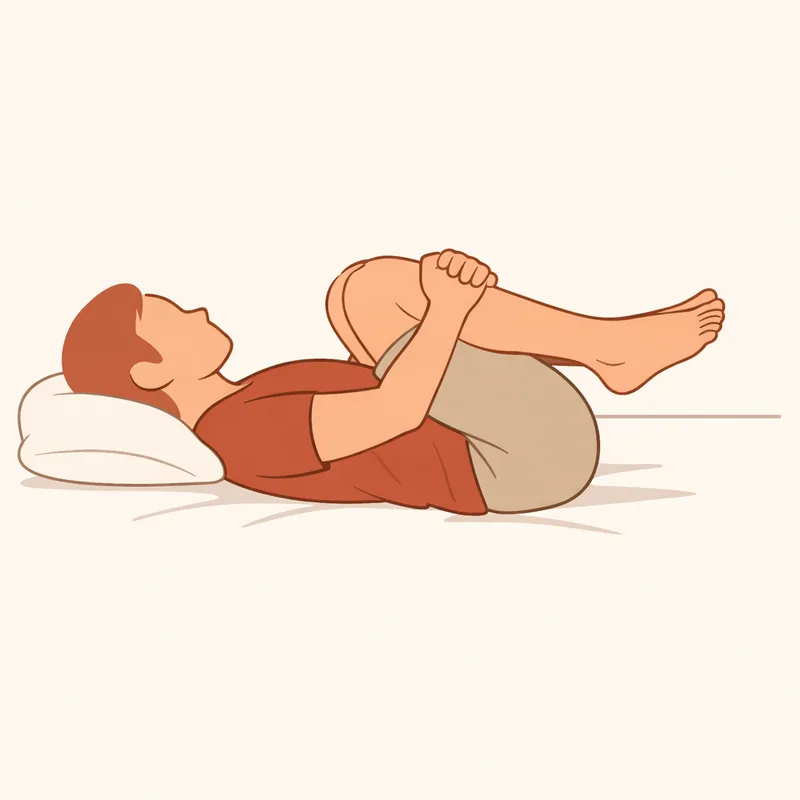
Common mistake: lifting the head and shoulders as you pull the knees in. Keep your head on the mattress the whole time. Easier version: one leg at a time with the other extended. If your lower back aches often, add a round of lower back stretches during the day.
② Supine spinal twist — keep the far shoulder down
Lie with your arms out to the sides and lower both bent knees slowly to one side, twisting gently. The measure isn't whether the knees touch the floor — it's whether the opposite shoulder stays down. The moment that shoulder lifts, the rotation stops happening in the spine and happens only at the pelvis.
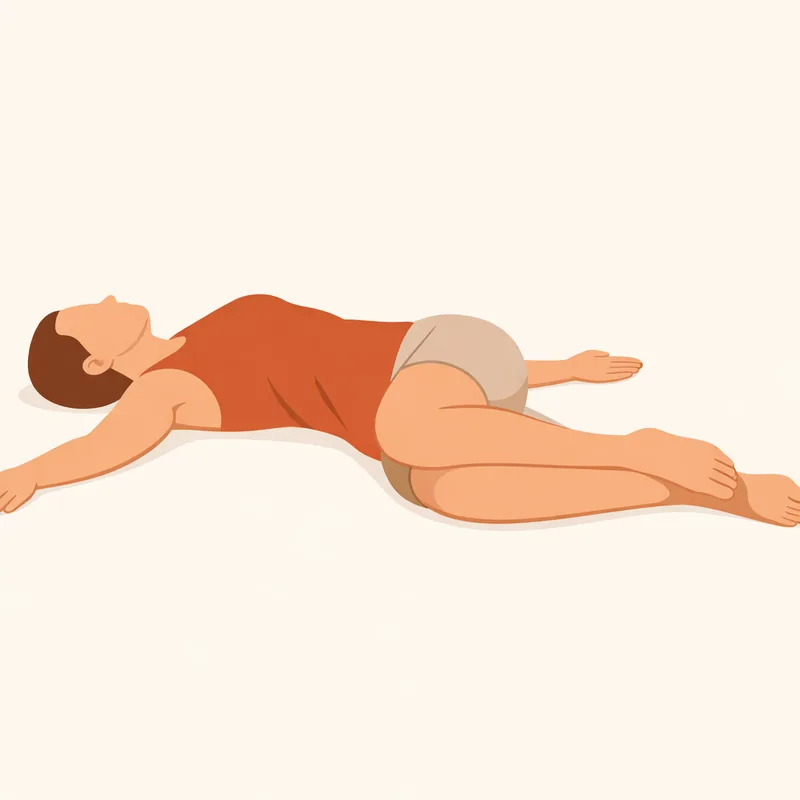
Common mistake: pressing the knees to the floor with your free hand. A range you forced isn't a release. Easier version: put a pillow under the dropped knees so they have somewhere to land.
③ Butterfly stretch — the one seated move, for the inner hips
Sitting, bring the soles of your feet together and let the knees fall outward, then fold forward slightly. The hips and groin open gently. Don't push the knees down with your hands — what lengthens here is the inner thigh, not the knee.
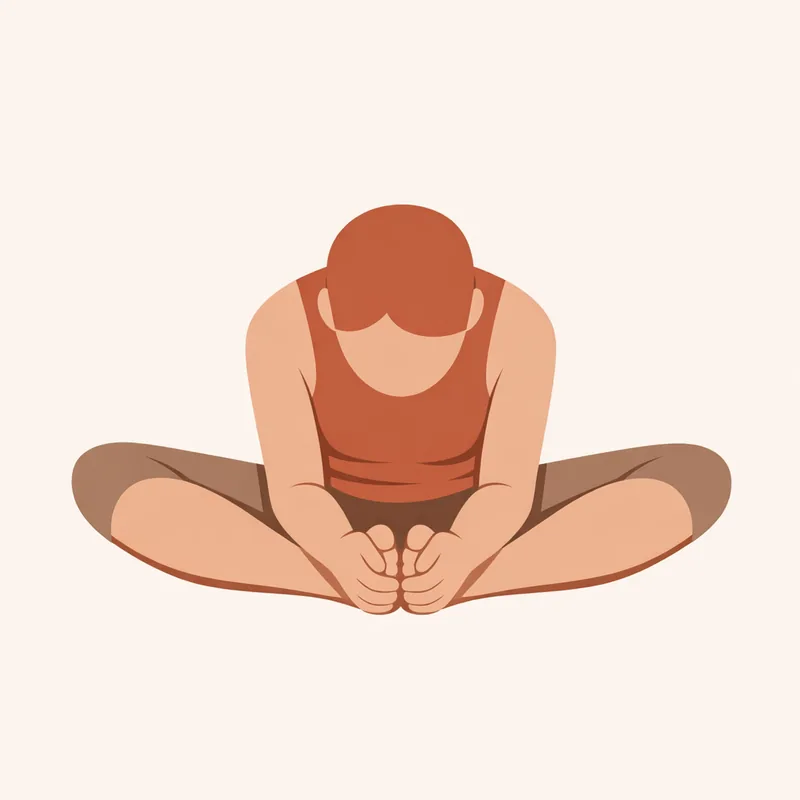
Common mistake: rounding the back and dropping only the head. The fold should hinge at the hips, not the waist. Easier version: sit up on a cushion to raise the hips and put pillows under the knees. If your hips are especially stiff, do a separate round of hip and glute stretches during the day.
④ Child's pose — putting the back and shoulders down
Kneel and fold forward until your forehead rests on the floor, arms stretched ahead. The back and shoulders lengthen, and the simple fact of the forehead touching down shifts the body into a resting state. Of the five, this is the one you can stay in longest.
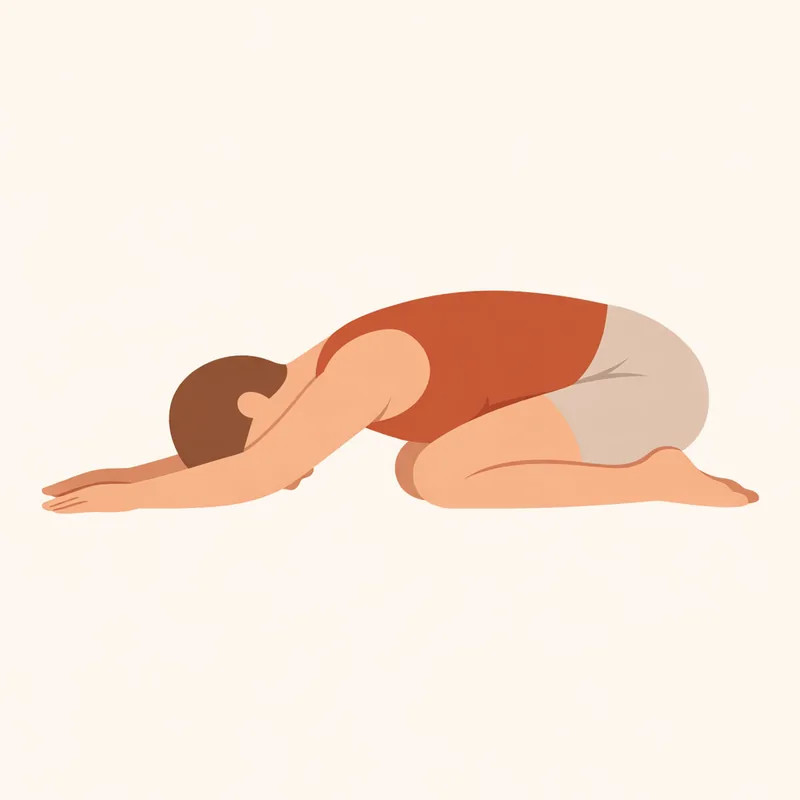
Common mistake: letting the hips float off the heels, which compresses the lower back instead of opening the upper back. Easier version: widen the knees and let the belly settle between them; if the ankles hurt, roll a towel underneath them. If the shoulders won't come down, try shoulder mobility stretches first.
⑤ Legs up the wall — the last five minutes of the day
Lie down, rest your legs up against a wall, close your eyes and breathe slowly. The weight that pooled in your legs drains away and the whole body quiets. Don't rush this one — three minutes and five minutes are noticeably different.
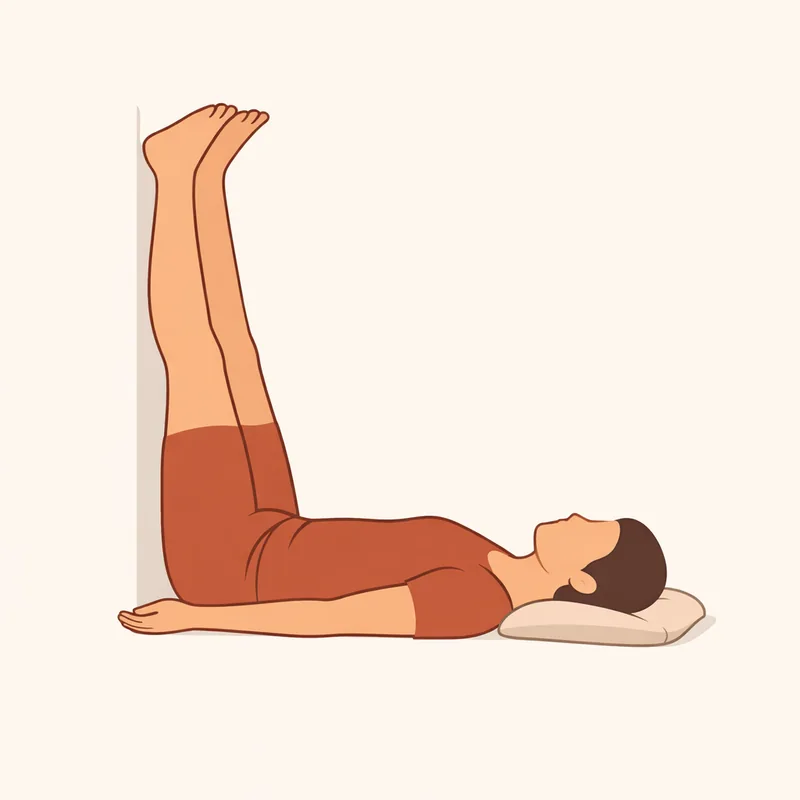
Common mistake: pressing the hips flat against the wall so the lower back lifts. A hand's width of gap fixes it. Easier version: bend the knees slightly if your legs go numb. If your legs swell during the day too, pair this with stretches for swollen legs.
What are the common mistakes
Bedtime stretching is low-intensity enough that doing it wrong doesn't hurt at the time. The night tells you instead.
| What you notice | What went wrong | Change this |
|---|---|---|
| You feel more awake after stretching, not less | You pushed to the edge of the range and the discomfort became arousal | Stop at 70% of the stretch and add time instead |
| Knees or ankles hurt in ④ | Body weight is landing on the ends of the joints | Widen the knees and roll a towel under the ankles |
| Legs go numb in ⑤ | Knees held fully locked for too long | Soften the knees and move the hips off the wall |
| Shoulders are still up by your ears at the end | You breathed shallowly the whole way through | Set the breath first — 4 seconds in, 8 seconds out. If mornings are stiff too, pair this with a morning stretch routine |

When do you progress
“Progress” here doesn't mean stretching harder. It means releasing deeper. In this order:
- Lengthen the exhale. 4 seconds in, 6 out, then 8. Change the breath before the body.
- Extend the hold. 20 seconds to 30 to a minute, with the range unchanged.
- Fix the light and the hour. Same time, same dimness, and the body learns the cue.
- Take ⑤ to five minutes. Of the five, it's the one that repays extra time most.

When to stop
If any of these apply, stop for the night — and if they repeat, get checked before continuing.
- Stop for the night if a move hurts, or if ⑤ brings head pressure or dizziness
- Pain or tingling down a leg no better after a few weeks: a GP; weakness in both legs, numbness around the genitals or anus, or bladder or bowel changes: 999 (NHS sciatica)
- One leg swollen for no known reason, or red or hot: urgent care (NHS oedema)
- Changing your sleeping habits has not helped, trouble sleeping for months, or hard to cope: a GP (NHS insomnia)
This list first used unsourced thresholds such as “sharp pain in the twist” and “30 minutes, three nights a week, for a month”; on 15 October 2026 we replaced them with the NHS wording.
Protecting your neck, back and joints at work is in work-related injury prevention.
Questions that remain
Week 4 says about 10 minutes — what do the moves add up to?
Take every time the article gives at its upper end and you get 8 minutes — ① 30 sec + ② 60 sec across both sides + ③ 30 sec + ④ 60 sec + ⑤ 5 minutes (our arithmetic). At the lower end it is 4 min 50 s, and on the four-in, eight-out breath ruler it is 32 breaths, 6 min 24 s. So the “about 10 minutes” has dimming the lights and changing position folded into it. Counting only the holds and concluding it never reaches ten would be reading it wrong.
If I only do one of the five, which one?
⑤, legs up the wall. Converted to breaths, the five moves come to 32 and 20 of them belong to ⑤ alone — five-eighths of the whole (our arithmetic). It is why week 1 is only ① and ⑤, and why the last step in progressing is taking ⑤ to five minutes. The other four are closer to preparation for the fifth.
When should I see someone?
The NHS insomnia page sets the line: see a GP if changing your sleeping habits has not helped, if you have had trouble sleeping for months, or if it makes it hard to cope. It calls insomnia of under 3 months short-term and 3 months or longer long-term. The “two weeks” and “a month” this post first gave had no source and are gone. More in insomnia (NHS).
Stretching leaves me more awake, not less.
That is what pushing the range does — the discomfort turns into arousal. Stop at 70% of the stretch and add time instead. “Intensity” here means releasing deeper, not hurting more, which is why the first step in the progression is not the body but the breath: 4 seconds in, 6 out, then 8.
Are numb legs and a heavy head in ⑤ the same thing?
No. Numbness comes from holding the knees locked too long — soften them and slide the hips a hand's width off the wall. Head pressure or dizziness is the one where you bring the legs down immediately. And one more: a single calf that is swollen, painful and warm is not something to stretch at all.
Where to check further
- Whether stretching is the right tool for your insomnia. Three or more nights a week for over three months is a different problem — it may need polysomnography, handled by psychiatry, neurology or a sleep clinic. Korean guidance is in the KDCA health information portal insomnia entry.
- If snoring or sleep apnoea is also present. Not something posture or stretching addresses — ENT or a sleep clinic should rule it out first.
- Light, temperature and caffeine before bed. This article covers the moves only — sleep hygiene overall is in the KDCA health information portal and in our sleep duration article.
Where the moves and counts come from
The order of the moves and the repetitions, sets and hold times in this post are our own example. The sources below give weekly activity amounts and condition information; they do not set counts for these moves. Where an agency gives the moves and counts itself, we carry them in its own words in stretching after exercise and insomnia (NHS).
Sources used
- NHS — Insomnia · reviewed 19 March 2024, checked 15 October 2026 · source for the GP thresholds and the 3-month split
- CDC — Recommended hours of sleep by age · source for the 7+ hours (18–60), 7–9 hours (61–64) and 7–8 hours (65+) figures
- WHO — Be Healthy, Be Mobile: physical activity · 150 minutes of moderate activity a week and muscle-strengthening on 2 or more days
- WHO — Low back pain fact sheet · public reference for recurring back pain
This is general health information and does not replace medical diagnosis or treatment. The sleep figures above are the CDC's published age-based recommendations; the cause of an individual sleep problem can only be determined by a clinician. If sleeplessness continues for more than a month, talk to a professional. Written as of July 2026.