The moment you stand up after hours of sitting, your lower back is locked and won't straighten in one go. Sitting loads the back more than most people realize. Even before it earns the word “pain,” that stiffness slides into chronic low-back trouble if you leave it alone.
The World Health Organization counts 619 million people living with low back pain in 2020, rising to a projected 843 million by 2050. It is the single leading cause of disability worldwide, and the highest number of cases occurs at ages 50–55. The encouraging part: roughly 90% of cases are non-specific low back pain — no identifiable structural cause. Most of it comes from moving too little, not from damage. Below are five moves you can do at a chair or on the floor, plus a four-week schedule. Written as of July 2026.
1. What changes. Roughly 90% of low back pain is non-specific — no identifiable structural cause. Most of it comes from moving too little, not from damage. The WHO calls it the single leading cause of disability worldwide, with the highest number of cases at ages 50–55.
2. What is the risk. Stop if a move hurts. Tingling or weakness in both legs, numbness around the genitals or anus, or bladder or bowel changes are NHS signals for 999 or A&E; no better after a few weeks, or worse at night, means a GP.
3. How to start. Frequency before flexibility. Some of these work from a chair, so spread them out — short and often beats one long session.
Move slowly, no bouncing. Stop immediately if you feel numbness running down a leg or sharp pain. If you are in an acute flare or have a disc history, check with a professional first.
Stiffness, or a signal?
We cannot set our own line between stiffness that stretching handles and pain that needs a clinician first. The NHS sorts back pain into three levels (in its own words in back pain (NHS)).
- GP — no better after a few weeks of home treatment, stopping your daily activities, unexplained weight loss, a lump, swelling or change in shape, no better with rest or worse at night, worse when sneezing, coughing or pooing, pain between the shoulders rather than the lower back
- Urgent (NHS 111 in the UK) — hot, cold, shivery or generally unwell; severe pain that starts suddenly or gets worse quickly
- 999 or A&E — pain, tingling, weakness or numbness in both legs; loss of feeling around the genitals or anus; bladder or bowel changes; changes in sexual sensation; chest pain; pain that started after a serious accident
For ordinary stiffness with none of these, the 4-week plan below applies. This post first gave five self-checks and a verdict table (“morning stiffness over 30 minutes means ruling out inflammation”, “a jolt when coughing means possible nerve irritation”) without a source; on 15 October 2026 we replaced them with the NHS levels.

How to use the four weeks
Backs respond far better to frequent movement than to hard stretching. So weeks 1–2 go into raising frequency, and weeks 3–4 add stabilizing work on top.
| Week | Times per day | One session | New this week | Goal |
|---|---|---|---|---|
| Week 1 | 3× daily + stand once an hour | ① 15 sec × 2 · ② 20 sec × 2 | The hourly stand-up habit | Back straightens as you rise |
| Week 2 | 4× daily | ①–③, 2 sets each | Add ③ cat-cow | Feel the spine move segment by segment |
| Week 3 | 4× daily | ①–④, 2 sets each | Add ④ pelvic tilt (stabilization) | Hold the back flat to the floor for 5 sec |
| Week 4 | 4–5× daily | ①–⑤, 2–3 sets | Add ⑤ hamstring stretch | Fingertips below the knees while standing |
WHO recommends adults get 150–300 minutes of moderate-intensity aerobic activity per week plus muscle-strengthening work on 2 or more days a week. For low back pain the direction is the same — stay active rather than rest — and WHO explicitly advises that painkillers should not be the first-line treatment. To cover the aerobic side by walking, see the BMI calculator and how much walking is recommended.
The five moves — what each one does
① and ⑤ work in a chair; ②, ③ and ④ need the floor. If you can only do one at the office, make it ①.
| Move | What it releases | Where | Reps / time | If it's too much |
|---|---|---|---|---|
| ① Spinal twist | Erector spinae, quadratus lumborum | Chair | 15–20 sec each side × 2 | Knees together, half the rotation |
| ② Knee-to-chest | Back extensors, glutes | Floor | 20 sec each side × 2 | Bend the other knee up to unload the back |
| ③ Cat-cow | Whole-spine mobility | Floor | 10 slow reps | Make fists if your wrists hurt |
| ④ Pelvic tilt | Transverse abdominis, multifidus | Floor | Hold 5 sec × 10 | Put a cushion between the knees |
| ⑤ Hamstring stretch | Hamstrings | Chair | 20 sec each side × 2 | Keep a slight knee bend |

① Seated Spinal Twist
Sit tall, rotate your torso slowly to one side, place the opposite hand on your knee and the same-side hand on the chair back to twist a little further. It releases the lower back up through the mid-back.
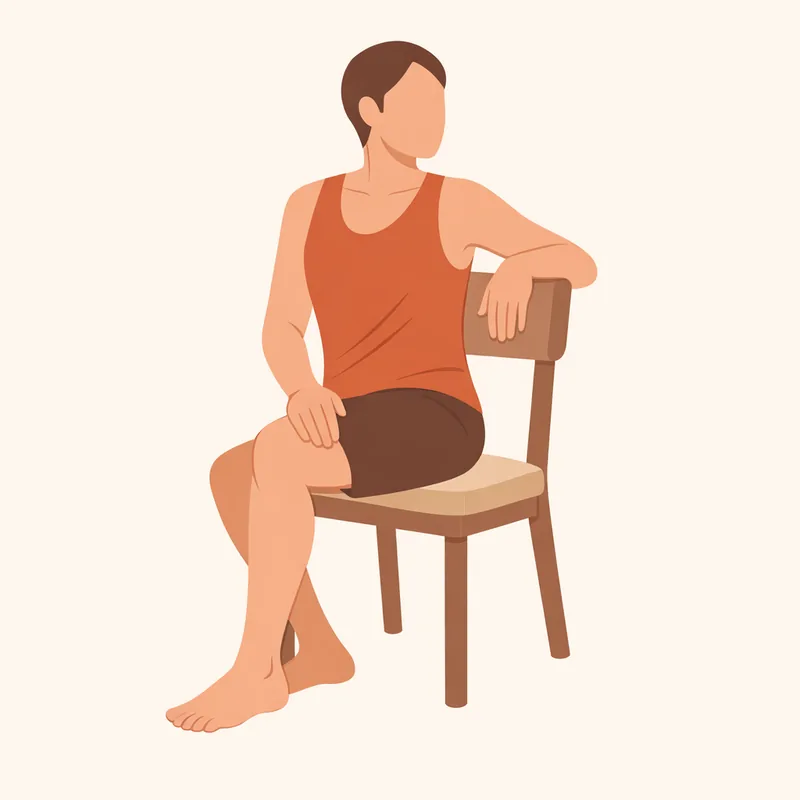
Common mistake: hauling on the chair back to force more rotation. Rotation should come from the thoracic spine, not the lumbar. Easier version: hold your knees together and turn only half as far.
② Knee-to-Chest
Lie on your back and hug one bent knee toward your chest with both hands, keeping the other leg extended. You'll feel the lower back lengthen.
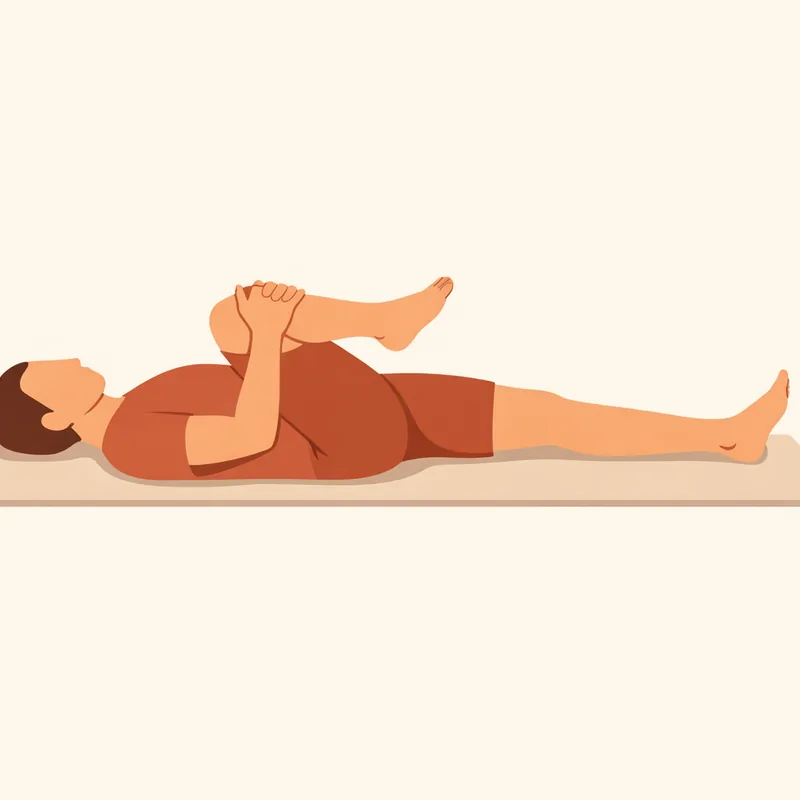
Common mistake: lifting your head along with the knee, which tenses the neck. Easier version: bend the extended leg and plant that foot — it takes a lot of load off the back.
③ Cat-Cow
On hands and knees, round the back up, then slowly reverse, letting the belly drop, moving the spine gently. It wakes up the spine segment by segment.
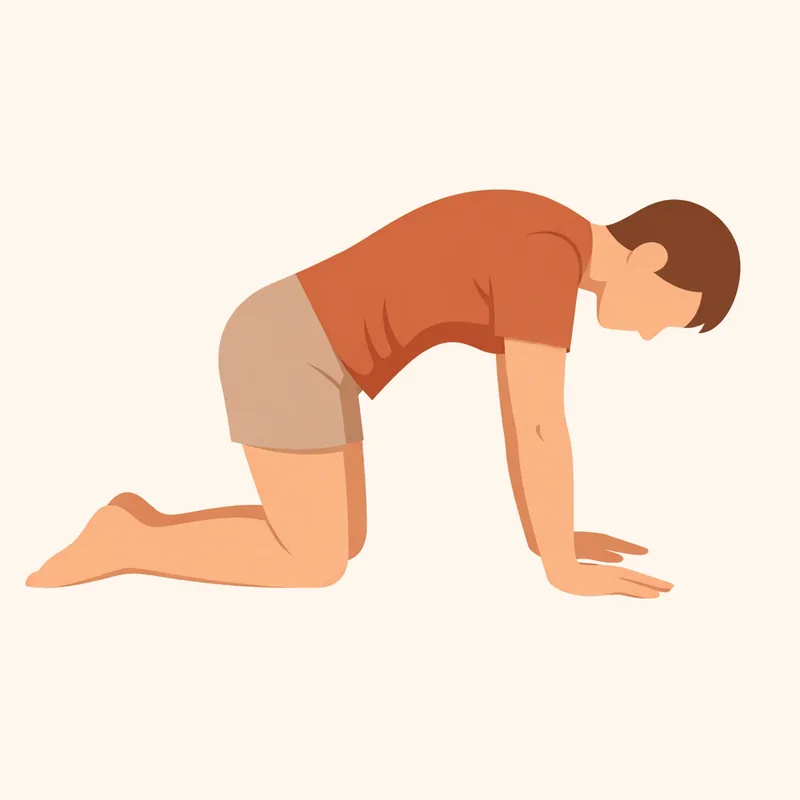
Common mistake: hinging only at the lower back. Neck, mid-back and lower back should move in sequence. Easier version: make fists if your wrists hurt, or do it standing with your hands on a chair.
④ Pelvic Tilt
Lie with knees bent, then gently press the lower back into the floor by tilting the pelvis up slightly. Small but powerful for back stability — this is closer to a strengthening move than a stretch.
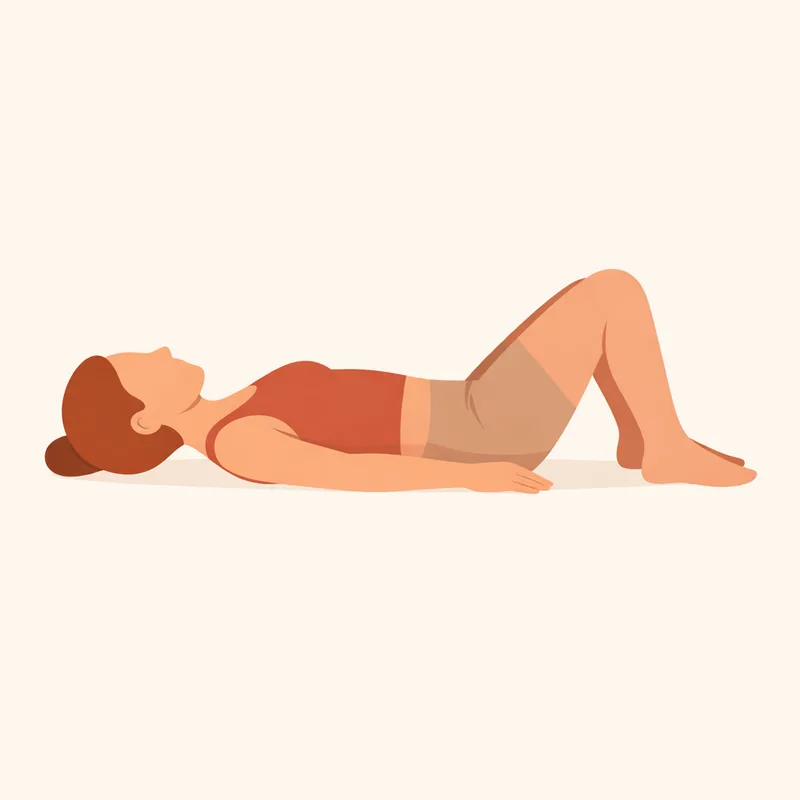
Common mistake: lifting the hips so it becomes a bridge. Keep the hips down and tilt only the pelvis. Easier version: a cushion between the knees makes the sensation easier to find.
⑤ Seated Hamstring Stretch
Short hamstrings tuck the pelvis under, so the lower back bends instead. Sit at the front edge of a chair, extend one leg forward with toes up, and hinge your torso forward from the hips.
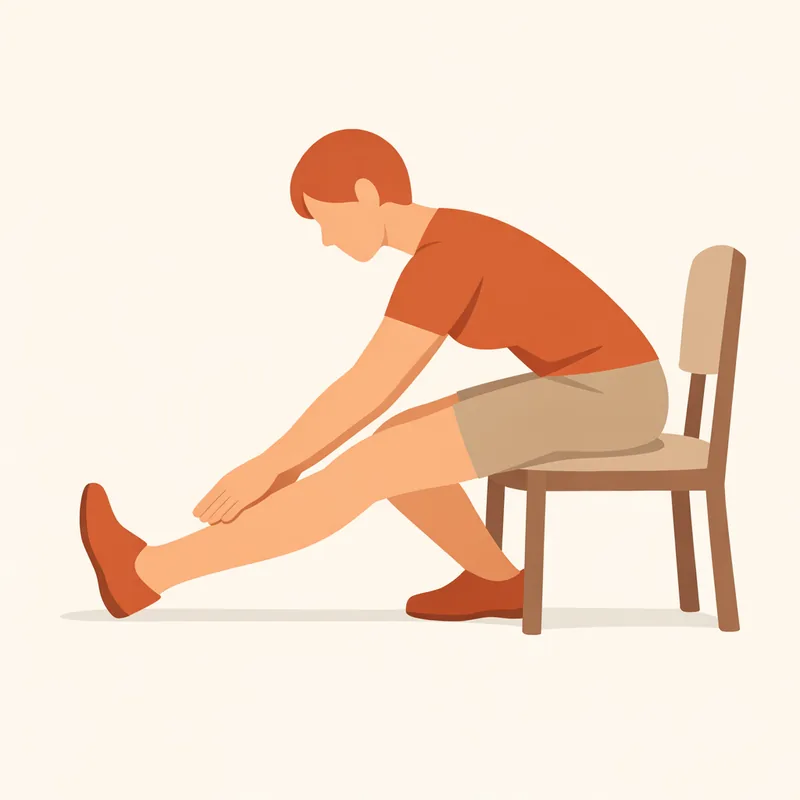
Common mistake: rounding the back to get your fingers to your foot. That stretches the back, not the hamstring. Easier version: bend the knee about 15° and keep the chest open.
What are the common mistakes
Almost every “I stretched and it got worse” comes down to one of these four.
| What your body does | What went wrong | Fix |
|---|---|---|
| Back is stiffer after stretching | You pushed range into the painful zone | Stop at “pleasant” and halve the hold time |
| Neck aches during ③ | You threw your head back too far | Keep your gaze on the floor about a foot ahead |
| Hips lift during ④ | It turned into a bridge | Hips stay down; tilt the pelvis only a few degrees |
| Back pulls during ⑤ | You folded by rounding the spine | Chest open, hinge from the hip joint |

When do you progress
If sitting still tightens you up after four weeks, the missing piece is endurance, not flexibility. Work through these in order.
- Take ④ pelvic tilt from 5 seconds to 10, then do it with one leg extended.
- Add dead bugs (lying, extending opposite arm and leg) for 8 reps per side.
- Weak glutes make the back do their job. Move on to 5 glute strengthening exercises.
- To build the core itself, the 5-stage plank progression is next. Sit-ups are not recommended — they load the back hard.
Stiff hips also push work onto the back. Adding hip and glute stretches for people who sit all day beforehand makes ② and ⑤ much easier. If your neck is tight too, pair this with the 5 turtle-neck stretches.
When to stop
Of the NHS levels above, the 999 or A&E line — pain, tingling, weakness or numbness in both legs, loss of feeling around the genitals or anus, bladder or bowel changes, chest pain, pain after a serious accident — calls for emergency care, not stretching. With fever or shivering, or pain that comes on suddenly, get seen urgently.
The WHO low back pain fact sheet says painkillers should not be the first-line treatment and lists being physically active as self-care. If the signals above are present, finding the cause comes first.
Protecting your neck, back and joints at work is in work-related injury prevention.
Questions that remain
How do I fit in three to five sessions a day?
This isn't a routine you do in one sitting. ① and ⑤ work in a chair; ②, ③ and ④ need the floor. That is why what week 1 adds is not a move but the hourly stand-up habit, and why ① is the one to keep if you can do only one at the office. Counted week by week, week 3 is three-of-four on the floor — the least desk-friendly week. Bank that one for the evening and the rest works at your desk.
④ pelvic tilt doesn't feel like a stretch.
It isn't. The article says as much — it is closer to a strengthening move, working the transverse abdominis and multifidus. If sitting still tightens you after four weeks, what is missing is endurance, not flexibility, which is why the first step in progressing is taking ④ from 5 seconds to 10. Dead bugs come next, then glute strengthening and the plank progression.
If 90% of low back pain is non-specific, is mine?
That is the rate, not a verdict on your back. By the NHS levels, tingling or weakness in both legs, or bladder or bowel changes, mean emergency care, and no better after a few weeks means a GP (the three levels above).
Should I rest, or keep moving?
WHO advises staying active rather than resting in bed, and states explicitly that painkillers should not be first-line treatment for low back pain. Putting frequency ahead of flexibility, as this article does, points the same way. The exception is anything under “When to stop” — there, identifying the cause comes first.
I stretched and my back got stiffer.
All four common mistakes are the same one — going too far — and every fix is less. If you pushed the range into the painful zone, stop at “pleasant” and halve the hold. Neck aching in ③ means looking about a foot ahead instead; hips lifting in ④ means tilting the pelvis only a few degrees; the back pulling in ⑤ means opening the chest and hinging at the hip. Going further is not doing it better.
Where to check further
- Whether yours is the non-specific kind. Even at 90%, numbness or weakness alongside it changes the picture — separate the two with the KDCA health information portal low back pain entry and an examination.
- Whether your form is actually right. Text and diagrams only go so far — Korea's National Fitness Award (Gukmin Cheryeok 100) centres run free fitness testing and exercise prescription in person.
- What you can do with a disc history or during an acute episode. This article goes only as far as “ask first” — a rehabilitation physician or physiotherapist can specify what is safe in your current state.
If pain runs from the buttock down the back of one leg it may be sciatica — the NHS says to keep moving rather than lie down, and treats symptoms in both legs or loss of bladder or bowel control as an emergency (sciatica).
Where the moves and counts come from
The order of the moves and the repetitions, sets and hold times in this post are our own example. The sources below give weekly activity amounts and condition information; they do not set counts for these moves. Where an agency gives the moves and counts itself, we carry them in its own words in back pain (NHS) and sciatica (NHS).
Sources used
- NHS — Back pain (reviewed 5 March 2026; checked 15 October 2026). Source for the three levels.
- WHO — Low back pain (619 million in 2020 · leading cause of disability · ~90% non-specific · painkillers not first-line · 19 June 2023, checked 15 October 2026)
- WHO — Physical activity (150–300 min/week aerobic · strengthening 2+ days)
- NIH NIAMS — Back Pain (US National Institutes of Health)
- Korea Disease Control and Prevention Agency — Low back pain (Korean)
This covers non-specific low back pain — the common, no-identified-cause kind — as general health information, and does not replace diagnosis or treatment. If any of the NHS levels above applies to you, don't self-assess; see a clinician. Written as of July 2026.