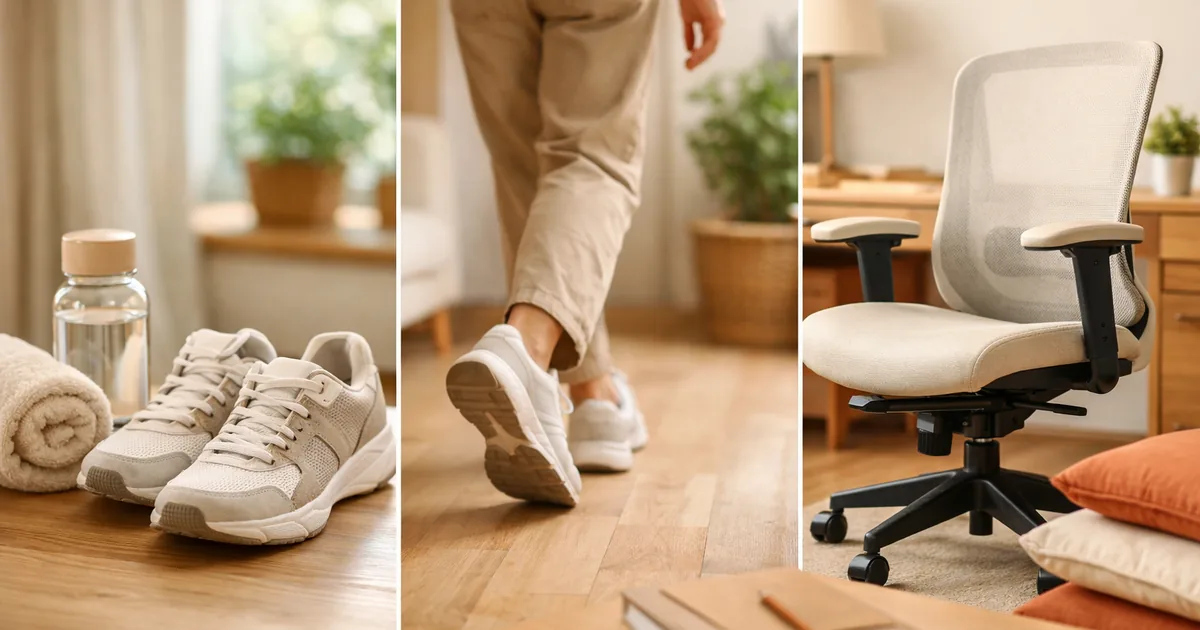
After a day in the same seat, the neck, lower back and wrists are usually first to complain. NHS inform, NHS Scotland’s health information service, says musculoskeletal (MSK) disorders — muscle, back and joint problems — are the single biggest cause of work absence in Scotland, with over a million people a year seeing their GP with one. Yet they are by no means an inevitable consequence of work. We set out its advice for workers and managers as written.
1. MSK disorders are the biggest single cause of work absence — over a million GP visits a year (Scotland).
2. Most come from poorly set-up workspaces and a lack of health and safety education — they are not inevitable.
3. A 20-minute walk twice a day, stretches, changing position often, setting up chair and equipment, correct lifting.
Why it happens — NHS inform
| Type | What the NHS says | Worth noting (ours) |
|---|---|---|
| How common | MSK disorders are the single biggest cause of work absence in Scotland; over a million people a year see their GP with one | We didn’t read Korean figures |
| Inevitable? | Very common but by no means an inevitable consequence of work | — |
| Main causes | Most work-related MSK disorders come directly from poorly set-up workspaces and a lack of health and safety education among managers and workers | — |
What you can do — NHS inform
The page lists five quick, simple things: a 20-minute walk twice a day, stretches, changing position regularly, setting up your chair and equipment properly, and correct moving and handling. In more detail:
| Type | What the NHS says | Worth noting (ours) |
|---|---|---|
| Walk | If you sit for long periods, walk during breaks. Longer walks help most, but short walks are still much better than sitting. If you stand a lot, build in periods of sitting or walking | brisk walking |
| Stretch | Stretches keep you supple; stretches plus walks are recommended for all workers who sit for long periods. Most benefit from repeating them little and often through the day | neck, lower back, wrist stretches |
| Change position | Changing your working position regularly is very important; one position for long raises the risk. With stretching, it also helps prevent repetitive strain injuries | — |
| Plan your day | Take the long way to the photocopier; break up a drive for a quick stretch | — |
| Driving | Sit correctly in a car or lorry; a better driving position makes a big difference to prevention and recovery | — |
| Chair | Always test chairs before choosing. Jobs differ — computer and office workers need different chairs and positions from hairdressers and dentists | — |
| Screens | Nearly every workplace uses computers. Beyond long sitting, consider your eyes; glasses or contacts, especially bifocals, should be taken into account by your employer | — |
| Moving and handling | Every lift has its own risks. Plan ahead and discuss concerns with your employer | — |
A 20-minute walk twice a day — our sums
| Sum (our example) | Result | Worth noting (ours) |
|---|---|---|
| 20 minutes × 2 a day | 40 minutes a day | — |
| 40 minutes × 5 working days | 200 minutes a week | If the pace is moderate — below |
| NHS adult guideline | 150 minutes a week of moderate activity | 200 is more than 150 |
The page doesn’t set a pace. If the walk is brisk enough that you can talk but not sing, it counts as moderate, and working-day walks alone pass the 150 minutes in the adult activity guidelines (our sum). A stroll would not.
WHO guidance on sitting is in sitting time.
For managers — NHS inform
| Type | What the NHS says | Worth noting (ours) |
|---|---|---|
| Expect | Employees with MSK disorders are common in most workplaces; absence and reduced hours are to be expected during treatment and recovery | — |
| What you can do | Encouraging staff health is helpful and productive; lead by example — encourage full use of breaks away from desks, give training on good posture and safe lifting | We didn’t read Korean workplace rules |
Checklist
- ☐ Walk in breaks — aim for 20 minutes twice a day
- ☐ Stretch little and often
- ☐ Change position regularly; take the long way
- ☐ Test chairs; check screens and eyes (glasses, bifocals)
- ☐ Plan lifts; raise concerns with your employer
Questions that remain
Are there monitor or desk heights?
The page says to set equipment up properly but gives no heights or distances.
What if it already hurts?
Care for sprains and strains is in soft tissue injury; avoiding injury when exercising is in exercise injury prevention.
Sources
- NHS — inform (Scotland) — Preventing work-related injuries — source (page shows: last updated 28 July 2026; source NHS 24 MSK Clinical Advisory Group; checked 26 October 2026). Overview (biggest cause of absence, over a million GP visits a year, causes), what you can do (20-minute walk twice a day, stretches, position, planning, driving, chairs, screens, lifting), advice for managers.
- Not read. Korean workplace health and safety rules and statistics; other organisations linked from the page.
- What we added. The “worth noting” column and the Korean care gloss.
Where to check further
- Your workplace health and safety contact — workspace and equipment.
- Rehabilitation medicine or orthopaedics — if pain lasts.
Written on 26 October 2026. The content is from the NHS; the glosses are ours.