
A full day of gripping a mouse and hammering a keyboard leaves the wrists achy and the fingers stiff — sometimes with a tingle running through them. Wrists and fingers repeat the same small motion thousands of times a day, and they need loosening up just like the neck and the back.
The US National Institute for Occupational Safety and Health (NIOSH) defines musculoskeletal disorders as disorders of the muscles, nerves, tendons, ligaments, joints, cartilage or spinal discs, and names repetitive motion and awkward postures — alongside sustained force and vibration — as the conditions that produce them. A wrist that bends to the same angle a few thousand times a day fits that description exactly. Here are five stretches that take 30 seconds at your desk. Let go of the mouse and try them.
1. What changes. NIOSH names repetitive motion and awkward postures — alongside sustained force and vibration — as what produces musculoskeletal disorders. A wrist bending to the same angle a few thousand times a day fits that description exactly.
2. What is the risk. Wrist trouble mixes “loosen it” with “do not loosen it.” If backs of the hands pressed together for a minute brings tingling, and that tingling concentrates in the thumb, index and middle fingers, it may be carpal tunnel compression — our rule is a clinician before a stretch.
3. How to start. Remove the bent angle before you stretch. If your wrist is cocked upward while typing, or you move the mouse with the wrist rather than the arm, fixing that posture is what makes the stretching worth doing.
Gentle, only to a pain-free range. If tingling in the hand or fingers persists or worsens (e.g. carpal tunnel), don't push it — get it checked.
Tired, or a nerve signal?
Wrist trouble comes in two kinds: the kind stretching helps, and the kind stretching should not touch. Work out which one you have before you start. The items and what follows from them are our own guide, not a diagnosis — for when to see a doctor, use the NHS wording under “When to stop”.
- Hold the backs of your hands together for a minute — do the fingers start to tingle?
- Is the tingling concentrated in the thumb, index and middle fingers?
- Do you wake up with stiff hands that won't close into a fist?
- While typing, is your wrist bent upward rather than level?
- When you move the mouse, does only the wrist move instead of the whole arm?
| What applied | What it usually means | What to do in this article |
|---|---|---|
| 1 and 2 together | Possible carpal tunnel compression | See a clinician before stretching |
| Only 1 | Likely ordinary fatigue | Do ① and ② every 1–2 hours |
| 3 applied | Hands stiffened overnight in a curled position | Start the day with ④ and ⑤ |
| 4 applied | The wrist angle itself is the cause | Extend ② and fix your desk height |
| 5 applied | A small joint is doing a big joint's work | ③ and ⑤ plus moving the mouse from the arm |
How to use the four weeks
The wrist is hard to win back with 30 seconds a day of stretching alone. Stretching is half of it; the other half is cutting the hours you spend at a bent angle. The table below runs the two side by side.
| Week | Times per day | What to do each time | What to change in your setup | Goal for the week |
|---|---|---|---|---|
| Week 1 | 3 times | ① and ② (15–20 sec each) | Add a palm rest | Wrists never pressed on the desk edge |
| Week 2 | 4 times | ① ② ④ | Pull the keyboard closer to you | Wrists stay level while typing |
| Week 3 | 4 times | ① ② ④ ⑤ | Move the mouse from the arm | Elbows stay beside the ribs |
| Week 4 | 5 times | All five, ①–⑤ (about 2 min) | Raise the monitor to eye level | Hands still loose in the afternoon |
For the record, those two minutes do not count as exercise. WHO recommends adults get at least 150 minutes of moderate-intensity activity a week (or 75 minutes of vigorous activity), plus muscle-strengthening work on 2 or more days a week, and wrist stretches fall under neither heading. If you sit for long stretches, cover that quota separately with something like these home workout basics.

The five moves — what each one releases
| Move | Where you'll feel it | Type · load | Reps · time | If it's too much |
|---|---|---|---|---|
| ① Wrist flexor stretch | Underside of the forearm | Stretch / no load | 15–20 sec each hand | Bend the elbow slightly |
| ② Wrist extensor stretch | Top of the forearm | Stretch / no load | 15–20 sec each hand | Halve the pulling force |
| ③ Prayer stretch | Both wrists at once | Stretch / some shoulder load | 15–20 sec × 2 | Stop at chest height |
| ④ Finger spread | Palm and finger muscles | Mobility / no load | Spread and close × 10 | Warm the hands in water first |
| ⑤ Wrist circles | The wrist joint | Mobility / no load | 10 each direction | Make the circles smaller |
① Wrist Flexor Stretch — giving back the muscle that held the mouse
Extend one arm forward, palm up and fingers pointing down, then use the other hand to pull the fingers gently toward you. You'll feel it from the inside of the forearm down to the wrist. These are the muscles that grip, so this is the one that responds most clearly after a long day on the mouse.
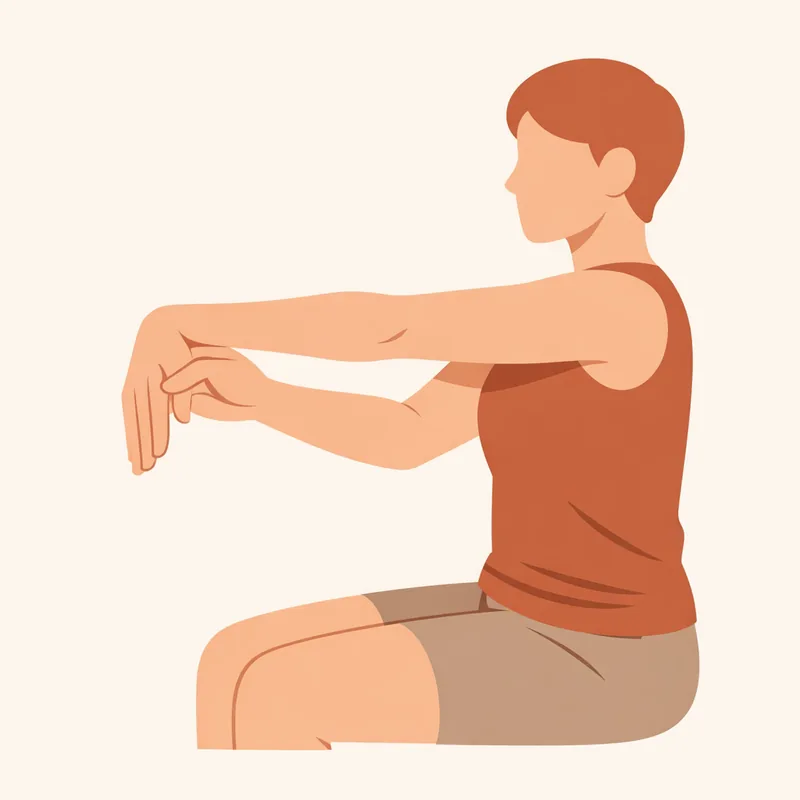
Common mistake: grabbing only the fingertips and levering them back. Wrap the whole palm so the pull spreads evenly. Easier version: if a fully straight elbow hurts, start with the elbow slightly bent.
② Wrist Extensor Stretch — the ache your keyboard angle built
Now turn the palm down with the fingers pointing down, and press the back of the hand toward you with the other hand. This releases the outside of the forearm through the wrist. It's the move people whose wrists bend upward while typing need most.
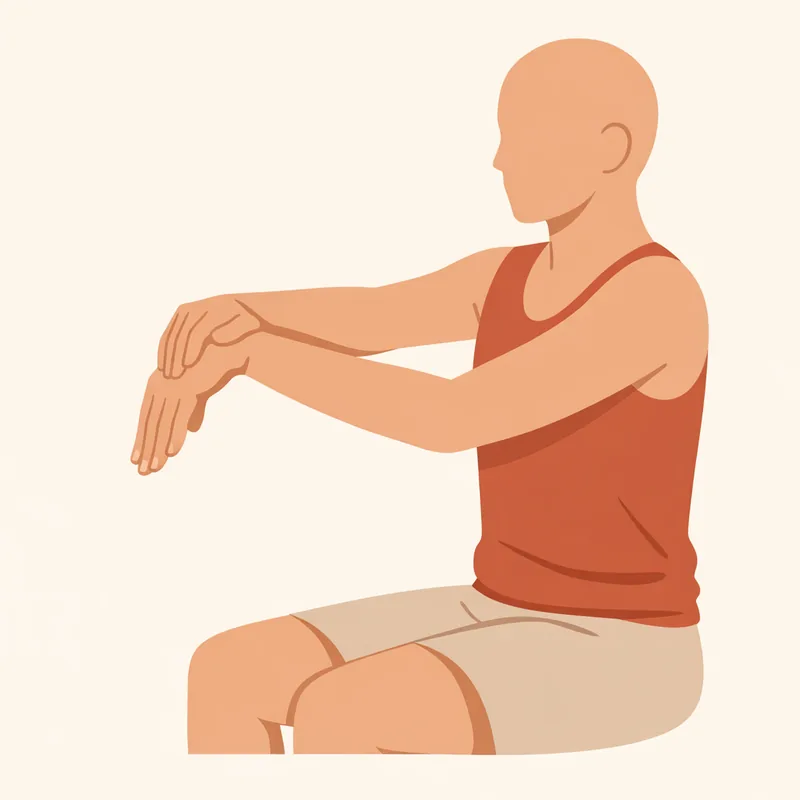
Common mistake: letting the shoulder ride up. Keep the shoulder down and move only the arm. Easier version: if it hurts out at the outer elbow (the tennis-elbow spot), halve the pulling force. If your shoulders are stiff too, do the shoulder mobility stretches first.
③ Prayer Stretch — both wrists in one move
Press both palms together in front of the chest, then lower the hands slowly until the wrists feel the stretch. The lower the hands go, the greater the wrist angle — so height is intensity here. The key is keeping the elbows spread out to the sides throughout.
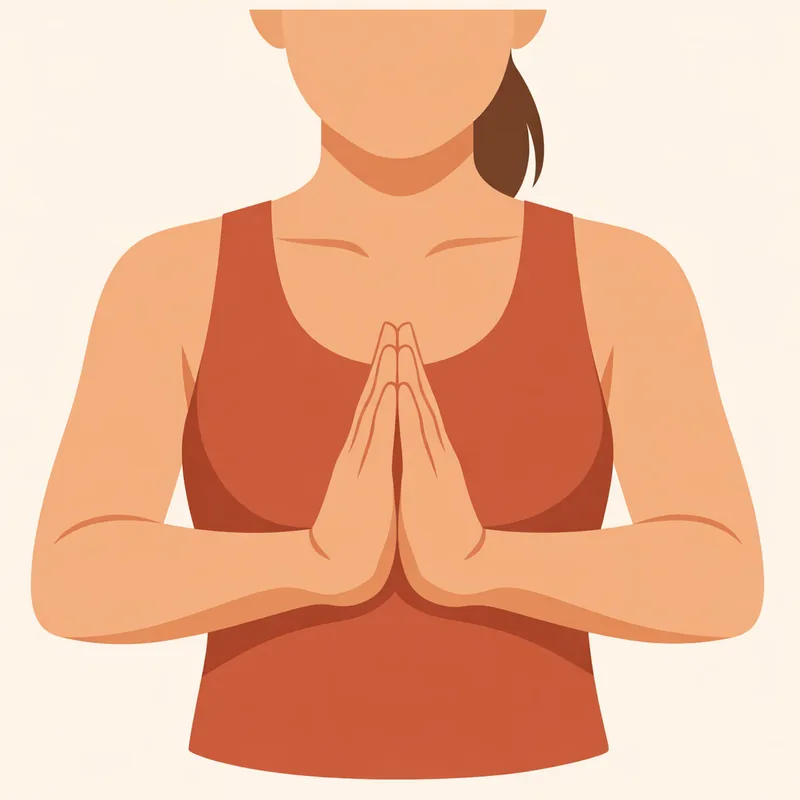
Common mistake: letting the palms separate and bending only at the wrist. A gap between the palms cancels the stretch. Easier version: stop at chest height, and if your shoulders round forward, add the back and posture workout.
④ Finger Spread — reversing a day of gripping
Spread all five fingers as wide as you can, then release into a loose fist. It moves the hand in the opposite direction to the one it has been working in all day. It's especially good for people whose hands are stiff in the morning.
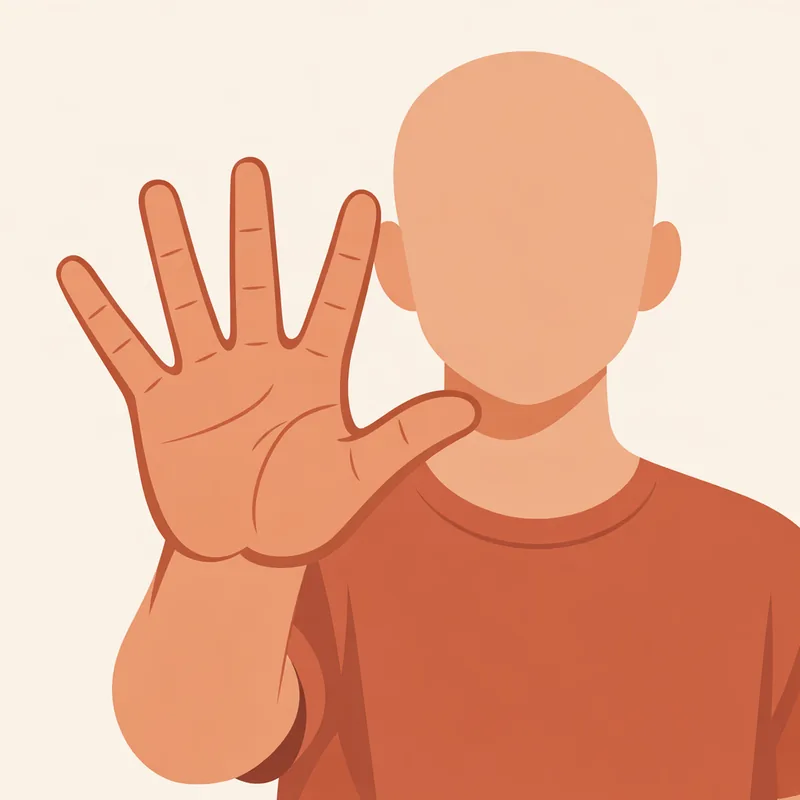
Common mistake: clenching the fist hard. Put the effort into the spread and none into the close. Easier version: if the hands won't open in the morning, soak them in warm water for a minute first. If the whole body feels locked up, chain this onto the morning stretch routine.
⑤ Wrist Circles — a smooth finish for the joint
Make a loose fist and rotate the wrist in big slow circles, both directions, to mobilize the joint. Where the first four moves lengthen muscle, this one moves the joint itself — which is why it belongs at the end.
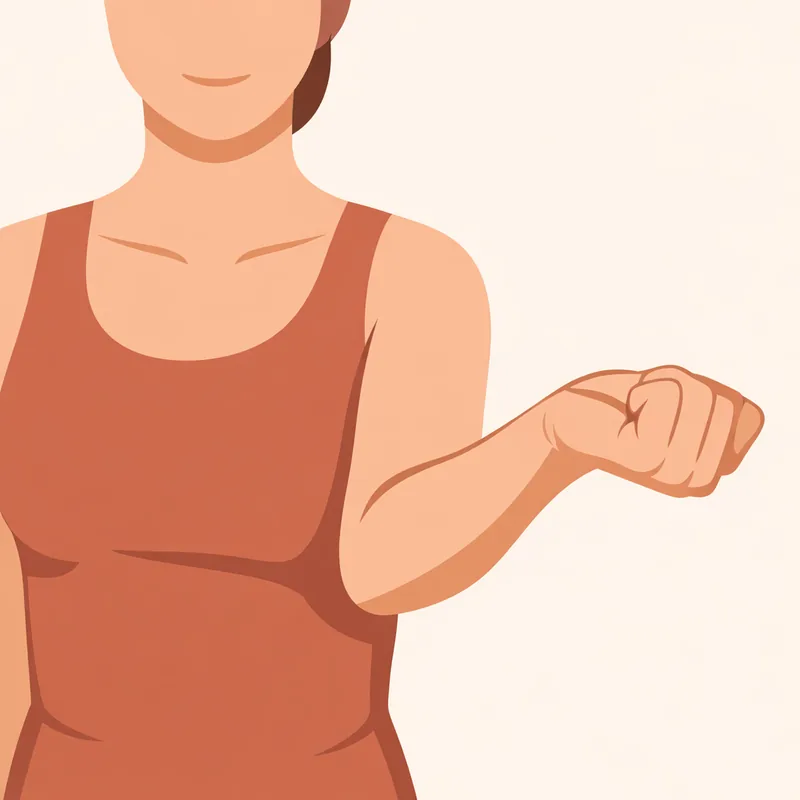
Common mistake: swinging the whole forearm around with it. Anchor the elbow and only the wrist will move. Easier version: if you hear clicking, make the circles smaller. And if you train with your body weight on your hands, always run this before the push-up progression.
What are the common mistakes
The wrist is small enough that you rarely notice the moment you overdo it. It tells you the next day instead.
| What your body does | What went wrong | How to fix it |
|---|---|---|
| Fingertips tingle during the stretch | You pushed to an angle that compresses the nerve | Reduce the range immediately; if it repeats, get it checked |
| The outer elbow hurts during ② | You pulled on a tendon that is already inflamed | Halve the force, keep the time the same |
| Your shoulder tightens before your wrist in ③ | The angle came from the shoulder, not the wrist | Drop the shoulders and raise the hands |
| Stiff again by afternoon despite stretching | You stretched but left the bent angle in place | Pull the keyboard closer and keep elbows beside the ribs. If your neck aches too, add the forward-head posture stretches |


When do you progress
The wrist is not a place to add intensity — it's a place to add frequency. Move through the steps in this order.
- Frequency first. Three times a day to five. Keep each session at 30 seconds.
- Then hold longer. Take ① and ② from 15 to 20 to 30 seconds. The pulling force stays the same.
- Lower the hands in ③. Chest height to sternum height. That is far enough.
- Add light grip work. Don't only lengthen — squeeze a soft ball for three seconds at a time so the muscles work as well as stretch.
When to stop
If it tingles or hurts during a move, stop for the day. These are the signals the NHS wrist pain and carpal tunnel pages use to send you to a doctor.
- Wrist pain that stops normal activities, is getting worse or keeps coming back, or has not improved after 2 weeks of home treatment — GP
- Tingling or loss of sensation in the hand or wrist; a wrist that is painful, warm, swollen and stiff; pain with a high temperature; or if you have diabetes — GP
- Carpal tunnel symptoms (pain, numbness, a weak thumb or difficulty gripping) that are getting worse or not going away — GP
- Severe pain, a snap at the time of injury, cannot move the wrist or hold things, the wrist has changed shape or colour, or lost feeling in the hand — urgent care (NHS 111)
This list first carried unsourced lines — tingling that wakes you, a thinner thumb pad, tingling for two weeks or more — and was replaced with NHS wording on 15 October 2026.
Outer elbow pain (tennis elbow) is in tennis elbow.
Questions that remain
Why does the four-week plan run in two rows?
Because stretching is only half of it — the other half is cutting the hours you spend at a bent angle. So each week changes one move and one thing on the desk, four of each. The weekly targets are written as postures rather than counts, too: “keep the wrist off the desk edge”. Stretch but leave the bent angle alone and the stiffness returns by afternoon.
The wrist is the problem, so why do the signals come from elsewhere?
None of the four common-mistake signals comes from the wrist itself — fingertips, outer elbow, shoulder, and the last one from outside the body (stiff again by afternoon). The further out the signal sits, the different the fix: fingertips means cut the range, the elbow means halve the pull, the shoulder means raise the hands — and the afternoon stiffness is fixed at the desk, not in the stretch.
Can I do just ① or just ②?
That does half the job. Both sides stiffen — the mouse shortens the inside of the forearm and the keyboard angle tightens the outside. Gripping and bending load opposite sides, so stretching one leaves the other exactly as it was. ③ prayer stretch is where both lengthen at once, and ④⑤ are movement rather than stretching, which is why they are counted in reps rather than seconds.
Should the wrist get more intensity over time?
The wrist is a place to add frequency, not intensity. In order: three sessions a day to five (each still 30 seconds); ① and ② from 15 to 20 to 30 seconds; ③ lowered from chest height to sternum height; and finally light grip work, squeezing a soft ball three seconds at a time. The pulling force never goes up at any stage.
If I have tingling, is stretching off the table?
It depends which tingling. If holding the backs of the hands together for a minute brings tingling and it concentrates in the thumb, index and middle fingers, that may be carpal tunnel compression — a clinician before a stretch. Tingling that isn't in those three fingers reads as ordinary fatigue, so ① and ② every 1–2 hours is the answer. Confirmation needs nerve conduction testing, done in orthopaedics or neurology.
Where to check further
- Whether your tingling is carpal tunnel syndrome. The self-check here only raises the possibility — confirmation needs nerve conduction testing, done in orthopaedics or neurology. Korean guidance is on the KDCA health information portal.
- Correct keyboard and mouse height. We say “not bent” but give no numbers — Korea's Ministry of Employment and Labor VDT work management guidance sets desk, chair and keyboard heights as actual figures.
- Claiming a work-related wrist condition. Outside the scope here — Korea's Workers' Compensation and Welfare Service (1588-0075) explains the occupational disease claim process.
Where the moves and counts come from
The self-check items and what we suggest for each, and the order of the moves with their repetitions and hold times, are our own example. The sources below give activity amounts, condition information and when to see a doctor; they do not set counts for these moves. Where an agency gives the moves and counts itself, we carry them in its own words in stretching after exercise and strength and flexibility (NHS).
Sources used
- NHS — Wrist pain · reviewed 5 November 2025, checked 15 October 2026 · source for the GP and 111 thresholds
- NHS — Carpal tunnel syndrome · reviewed 17 April 2024, checked the same day · source for the carpal tunnel symptoms and GP threshold
- CDC NIOSH — Ergonomics and musculoskeletal disorders · source for the definition of MSDs and for repetitive motion and awkward posture as causes
- WHO — Musculoskeletal health fact sheet · the global estimate that around 1.71 billion people live with a musculoskeletal condition
- WHO — Be Healthy, Be Mobile: physical activity · 150 minutes of moderate or 75 minutes of vigorous activity a week, plus strengthening on 2 or more days
This is general health information and does not replace medical diagnosis or treatment. The definition and the activity figures above are taken from material published by CDC NIOSH and WHO, and the cause of hand tingling can only be established in a clinical examination. If tingling or pain persists, consult a professional. Written as of July 2026.