Not sure where to start with exercise? Walk. The NHS says a brisk 10-minute walk every day has lots of health benefits and counts towards the recommended 150 minutes a week. “Brisk” means about 3 miles an hour (roughly 4.8 km/h), and a pace at which you can still talk but cannot sing. We set out the original and added the arithmetic for reaching 150 minutes.
1. Start with 10 brisk minutes a day. The NHS says a brisk 10-minute daily walk has lots of health benefits and counts towards your 150 minutes of weekly exercise.
2. “Brisk” is about 3 miles an hour. Faster than a stroll; you are walking briskly if you can still talk but cannot sing the words to a song.
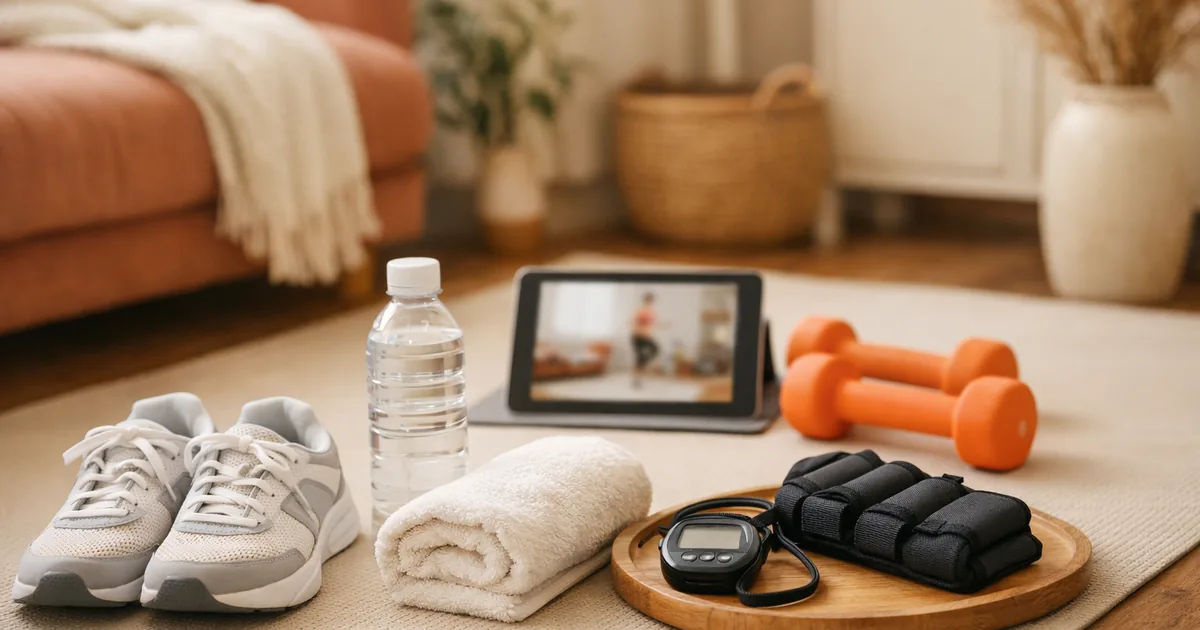
3. All you need is shoes. Any shoes that are comfortable, give adequate support and do not cause blisters will do.
What the NHS says
- Benefits — walking briskly can help you build stamina, burn excess calories and make your heart healthier.
- Amount — a brisk 10-minute daily walk has lots of health benefits and counts towards your 150 minutes.
- Speed — a brisk walk is about 3 miles an hour, faster than a stroll.
- The check — you can still talk but cannot sing the words to a song.
- If you are not very active — but able to walk, increase your walking distance gradually.
“Talk but not sing” works like the US CDC talk test — see our talk test on exercise intensity. Three miles an hour is 3 × 1.609 = about 4.8 km/h (our conversion).
How far 10 minutes goes — our arithmetic
| Brisk walking time | Distance (about 4.8 km/h) | Towards 150 minutes |
|---|---|---|
| 10 minutes | About 800 m | 70 minutes a week if daily |
| 22 minutes | About 1.8 km | 154 minutes a week if daily |
| 30 minutes | About 2.4 km | 150 minutes on 5 days |
Distances and weekly totals are our multiplication. Ten minutes a day is 70 minutes a week, a little under half the recommendation; about 22 minutes a day passes 150. For a step-count view, see daily steps.
What you need
- Shoes — any shoes or trainers that are comfortable, provide adequate support and do not cause blisters.
- For longer walks — water, healthy snacks, a spare top, sunscreen and a sun hat in a small backpack.
Keeping it going — the NHS’s four ideas
| Idea | NHS examples | Try today (ours) |
|---|---|---|
| Make it a habit | Walk part of the commute, walk to the shops, use the stairs, leave the car for short trips, walk children to school, walk after dinner | Get off one stop early |
| Listen to music | Music or a podcast while walking | A 10-minute playlist |
| Mix it up | Parks, heritage trails, canal towpaths, nature reserves | A different route at weekends |
| Join a walking group | Walk with a group | A regular walk with family or neighbours |
The NHS also points to its own Active 10 app, which tracks how much and how fast you walk, and to UK walking organisations.
If walking is hard
For joint problems the NHS suggests exercise classes in a swimming pool, where the water supports your weight, and free exercise videos if you cannot leave the house. Among our articles, sitting exercises fits here.
Checklist
- ☐ Comfortable shoes that fit
- ☐ Ten minutes today, at a pace where you can talk but not sing
- ☐ Build distance gradually
- ☐ Aim for 150 minutes a week (22 minutes daily, or 30 minutes on 5 days)
Questions that remain
Is slow, long walking pointless?
What this guidance counts towards 150 minutes is brisk walking. The WHO guidelines say even light activity beats sitting — see sitting too long, by WHO.
Can the 10 minutes be split up?
This NHS page says a daily 10 minutes counts towards 150; it gives no rule about splitting.
Sources
- NHS — Walking for health (reviewed 15 December 2022; next review shown as due 15 December 2025; checked 2 October 2026). Benefits, the daily 10 minutes and 150 minutes, about 3 miles an hour, the talk-and-sing check, shoes and kit, building up gradually, and four ways to stay motivated.
- Our own working. The 4.8 km/h conversion, distances and weekly totals are ours.
Where to check further
- Moving on to running — Couch to 5K running plan.
- Step counts — daily steps.
Written on 2 October 2026. The guidance is from the NHS; the conversions and arithmetic are ours.