A whole roast turkey is a fixture of US Thanksgiving and of many Christmas tables. The US Department of Agriculture’s Food Safety and Inspection Service (USDA FSIS) says to allow about 24 hours for every 4 to 5 pounds when thawing in the refrigerator and about 30 minutes per pound in cold water; to set the oven no lower than 325 °F (about 163 °C); and to judge doneness not by the clock but by a food thermometer reading 165 °F (about 74 °C). We set out the weight-by-weight thawing and roasting tables and add a calculator that takes the weight and your meal time and counts back to when the bird goes in the fridge and in the oven. A 6 kg (about 13.23 lb) turkey roasted unstuffed, for example, takes 3 hours to 3 hours 45 minutes in the USDA table.
1. Only three safe ways to thaw — refrigerator, cold water, microwave — more than 2 hours on the counter is not a safe temperature (USDA).
2. Cold water or microwave? Cook it right away — only a fridge-thawed bird can wait another 1 or 2 days.
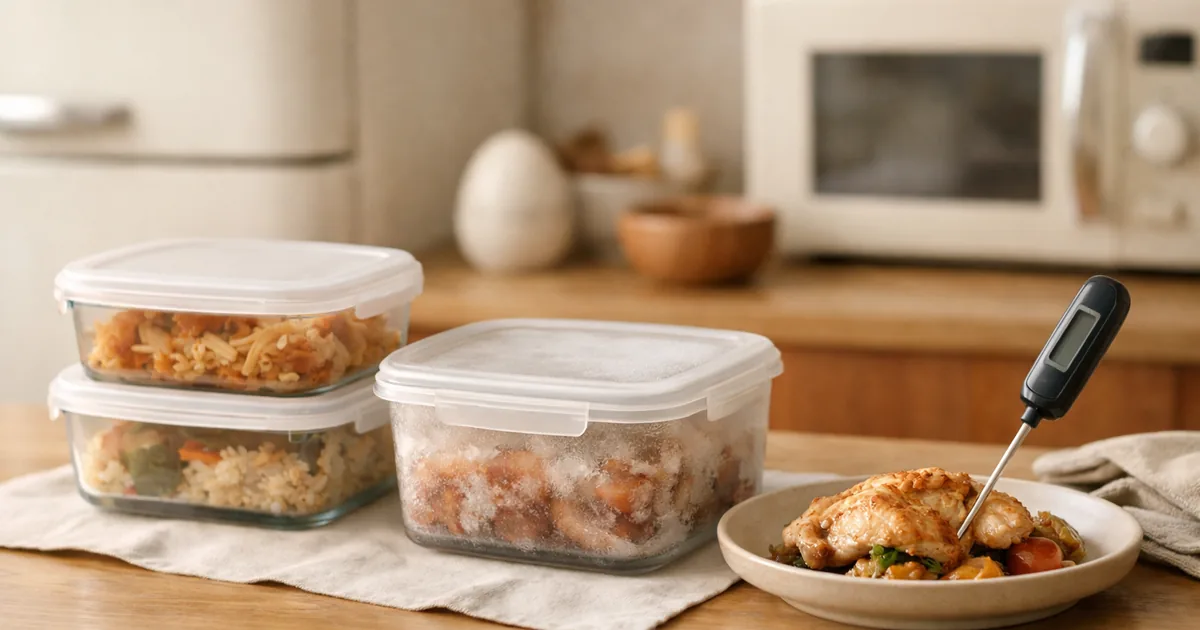
3. Done means 165 °F (about 74 °C) on a thermometer — innermost thigh, innermost wing and thickest part of the breast, plus the centre of any stuffing.
Why it matters — USDA
- Bacteria wake up as it thaws — a frozen turkey is safe indefinitely, but once it begins to thaw any bacteria present before freezing can begin to grow again.
- The 40 to 140 °F danger zone — frozen meat or poultry left on the counter more than 2 hours is not at a safe temperature: the centre may still be frozen, but the outer layer sits between 40 and 140 °F (about 4 to 60 °C, our conversion), where foodborne bacteria multiply rapidly.
- Where it waits — take it home straight from the checkout and into the freezer; not the back porch, the car trunk, the basement or anywhere the temperature cannot be constantly monitored.
Thawing times — the USDA table
| Whole turkey | Refrigerator (40 °F or below) | Cold water (changed every 30 min) |
|---|---|---|
| 4 to 12 lb (about 1.8 to 5.4 kg) | 1 to 3 days | 2 to 6 hours |
| 12 to 16 lb (about 5.4 to 7.3 kg) | 3 to 4 days | 6 to 8 hours |
| 16 to 20 lb (about 7.3 to 9.1 kg) | 4 to 5 days | 8 to 10 hours |
| 20 to 24 lb (about 9.1 to 10.9 kg) | 5 to 6 days | 10 to 12 hours |
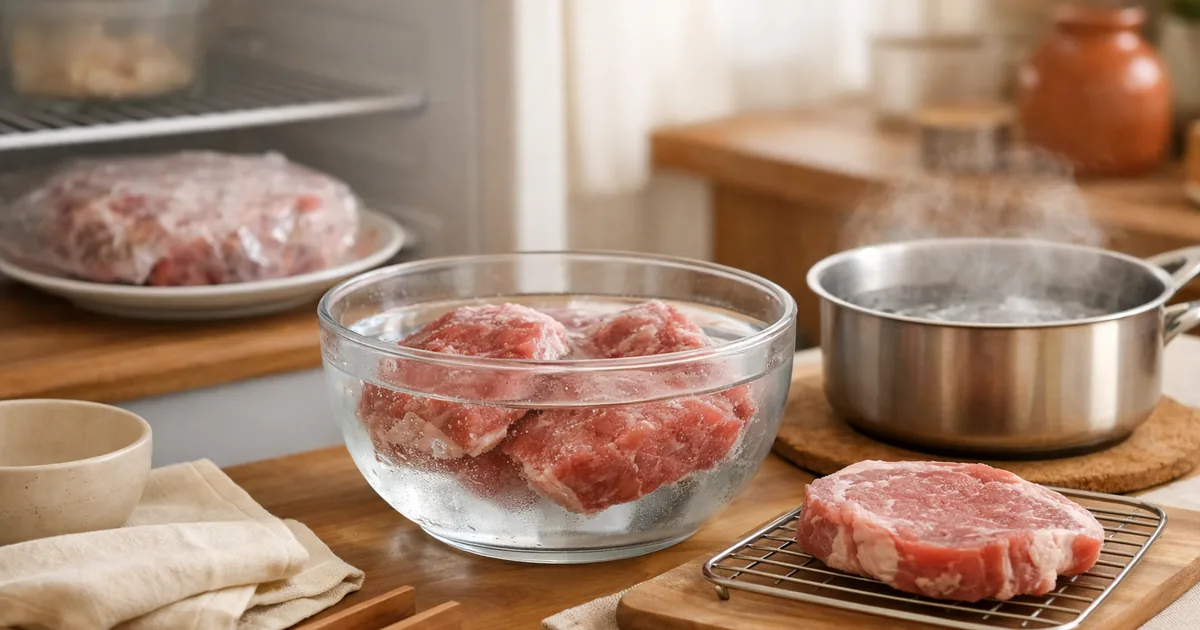
The kilograms in brackets are our conversion (1 lb = 0.45359237 kg). In a refrigerator set at 40 °F (about 4 °C) or below, plan on about 24 hours for each 4 to 5 pounds, with the turkey in a container so juices do not drip on other food. A fridge-thawed turkey can stay in the refrigerator 1 or 2 days before cooking, and can be refrozen without cooking, with some loss of quality.
Cold water takes about 30 minutes per pound. The turkey goes in a leak-proof plastic bag (to prevent cross-contamination and to stop it absorbing water and turning watery), fully under cold tap water, with the water changed every 30 minutes until it has thawed. Cook it immediately; once cooked, the meat can be refrozen. In a microwave, follow the oven maker’s instructions and cook straight away, because parts may warm and begin to cook; holding partly cooked food is not recommended, since any bacteria present would not have been destroyed.
Our thawing frozen meat (USDA) guide follows a different USDA page and puts fridge thawing at a day per 5 pounds. This turkey page says about 24 hours per 4 to 5 pounds, a slightly more generous allowance. The calculator uses the turkey page’s figures.
Roasting times — the USDA table (325 °F oven)
| Weight | Unstuffed | Stuffed |
|---|---|---|
| 4 to 6 lb breast (about 1.8 to 2.7 kg) | 1 h 30 min to 2 h 15 min | (not in the table) |
| 6 to 8 lb breast (about 2.7 to 3.6 kg) | 2 h 15 min to 3 h 15 min | (not in the table) |
| 8 to 12 lb (about 3.6 to 5.4 kg) | 2 h 45 min to 3 h | 3 h to 3 h 30 min |
| 12 to 14 lb (about 5.4 to 6.4 kg) | 3 h to 3 h 45 min | 3 h 30 min to 4 h |
| 14 to 18 lb (about 6.4 to 8.2 kg) | 3 h 45 min to 4 h 15 min | 4 h to 4 h 15 min |
| 18 to 20 lb (about 8.2 to 9.1 kg) | 4 h 15 min to 4 h 30 min | 4 h 15 min to 4 h 45 min |
| 20 to 24 lb (about 9.1 to 10.9 kg) | 4 h 30 min to 5 h | 4 h 45 min to 5 h 15 min |
The USDA writes the times as fractions (“2 3/4”); hours and minutes are our rewriting. The top two rows are turkey breast weights, not whole birds. The times assume a fresh or fully thawed bird at a refrigerator temperature of 40 °F or below.
How to roast — USDA
- Oven at 325 °F (about 163 °C) or higher — never lower. Preheating is not necessary, the page says.
- Make sure it is completely thawed — the table assumes a thawed bird.
- Breast side up — on a flat wire rack in a shallow roasting pan 2 to 2½ inches (about 5 to 6.4 cm, our conversion) deep.
- Stuffing on the side — for optimum safety, cook stuffing in a casserole. If you stuff the bird, mix the ingredients just before stuffing, stuff loosely, and allow extra time for the turkey and stuffing to reach a safe temperature.
- Thermometer to 165 °F — the turkey and the centre of the stuffing must both reach 165 °F. Check the innermost part of the thigh and wing and the thickest part of the breast.
- Let it stand 20 minutes — for quality, rest the bird 20 minutes before removing the stuffing and carving, so the juices set and it carves more easily.
Optional steps: tuck the wing tips under the shoulders, add half a cup of water to the pan, and tent foil loosely over the breast for the first 1 to 1½ hours, then remove it for browning (or tent it once the bird is golden brown).
Calculator
| In pounds | - lb |
| Fridge thawing (USDA table) | - |
| Fridge thawing (24 hours per 4 to 5 lb) | - |
| Into the fridge no later than | - |
| Cold-water thawing (USDA table) | - |
| Cold-water thawing (30 minutes per lb) | - |
| Cold water: start no later than | - |
| Roasting time (325 °F, USDA table) | - |
Results update as you type. Thawing and roasting times come straight from the USDA tables; a weight on a boundary (say 12 lb) is read into the lower row. The kilogram conversion, the countdown “meal time − longest table time − 20 minutes standing”, and taking the longest fridge days and cold-water hours off that time are our arithmetic. The USDA says the thermometer, not the clock, decides — check for 165 °F (about 74 °C). Below 8 lb the breast rows apply; outside 4 to 24 lb the tables say nothing.
A 6 kg turkey, for instance, is about 13.23 lb, so it falls in the 12 to 16 lb thawing row: 3 to 4 days in the fridge (2.6 to 3.3 days at 24 hours per 4 to 5 lb) or 6 to 8 hours in cold water (6.6 hours at 30 minutes a pound). Roasted unstuffed it sits in the 12 to 14 lb row, 3 hours to 3 hours 45 minutes, so for a meal at 18:00 on 25 December it goes in the oven by 13:55 once the 20-minute rest is counted, and fridge thawing starts by 21 December (4 days before that). Thawing in cold water instead, it must be in the water by 05:55 that day. Stuffed, the same bird takes 3 hours 30 minutes to 4 hours, so 13:40. A 10 kg bird (about 22.05 lb) roasts unstuffed in 4 hours 30 minutes to 5 hours, so 12:40, and needs 5 to 6 days in the fridge, from 19 December (all our arithmetic).
After the meal — briefly
These two pages stop at the roast. Rules for what is left, such as getting it into the fridge within 2 hours, are in how long leftovers keep (USDA). It is also worth checking ahead that the fridge and oven have room for the whole bird — the USDA notes that a turkey or pan too large for the oven blocks heat circulation.
Why times vary — USDA
- A partially frozen turkey takes longer.
- A stuffed turkey takes longer.
- The oven may heat unevenly, or its temperature may be off.
- Dark roasting pans cook faster than shiny metal ones.
- The depth and size of the pan can cut heat circulation.
- A foil tent left on the whole time slows cooking; the pan’s lid speeds it; an oven cooking bag can speed it too.
- Rack position affects even cooking, and a turkey or pan too large for the oven blocks heat circulation.
Checklist
- ☐ Weigh it → set the day it goes in the fridge (calculator)
- ☐ Fridge at 40 °F (about 4 °C) or below, turkey in a container
- ☐ Cold water: leak-proof bag, change the water every 30 minutes, cook as soon as thawed
- ☐ Oven at 325 °F (about 163 °C) or higher; breast up, shallow pan, rack
- ☐ Thermometer to 165 °F (about 74 °C) in thigh, wing and breast, plus the centre of any stuffing
- ☐ Rest 20 minutes before carving
Questions that remain
My oven is in Celsius — is 163 °C right?
325 °F is about 162.8 °C by our conversion. The USDA says no lower than 325 °F, so on a dial marked in 5-degree steps, 165 °C keeps to “no lower” (our reading).
It is still partly frozen and has to be roasted today
The roasting table assumes a thawed bird and only says a partially frozen one takes longer. Times for roasting from frozen are not on these two pages, so we give none. Our thawing frozen meat (USDA) guide, from another USDA page, carries the general rule of about 50% longer when cooking from frozen.
What about chicken?
These are turkey tables. We did not read chicken roasting times this time; doneness is judged the same way at 165 °F (also in four steps to food safety).
Sources
- USDA FSIS — Turkey Basics: Safe Thawing — source (last updated 24 October 2023; checked 26 November 2026). Bacteria once thawing starts, where not to keep it, 2 hours and 40 to 140 °F, refrigerator (24 hours per 4 to 5 lb, 1 to 6 days by weight, 1 to 2 days after thawing, refreezing), cold water (30 minutes per lb, bag, every 30 minutes, 2 to 12 hours by weight, cook immediately), microwave.
- USDA FSIS — Turkey Basics: Safe Cooking — source (last updated 22 October 2019; checked 26 November 2026). 165 °F thermometer, 11 things that change roasting time, six roasting steps and optional steps, the 325 °F unstuffed and stuffed time tables.
- Not read. The other pages in the series (“Turkey Basics: Stuffing”, “Handling Cooked Dinners”, “Turkey: Alternate Routes to the Table” on frying, grilling and so on), the “Let’s Talk Turkey” guide, times for roasting from frozen, chicken and duck times, and Korean food-safety agency guidance on thawing and cooking poultry.
- What we added. The calculator and its arithmetic (kg and pounds, Celsius conversions, fractions as hours and minutes, the countdowns to the oven, the fridge and cold water, boundary weights read into the lower row) and the everyday notes. The hotline number on the pages is not reproduced.
Where to check further
- The weight on the turkey’s label — pounds or kilograms.
- Your oven manual — whether the real temperature matches the dial, and rack positions.
Written 26 November 2026. The content follows the sources; the notes and the calculator are ours. This is general information — check doneness with a food thermometer.