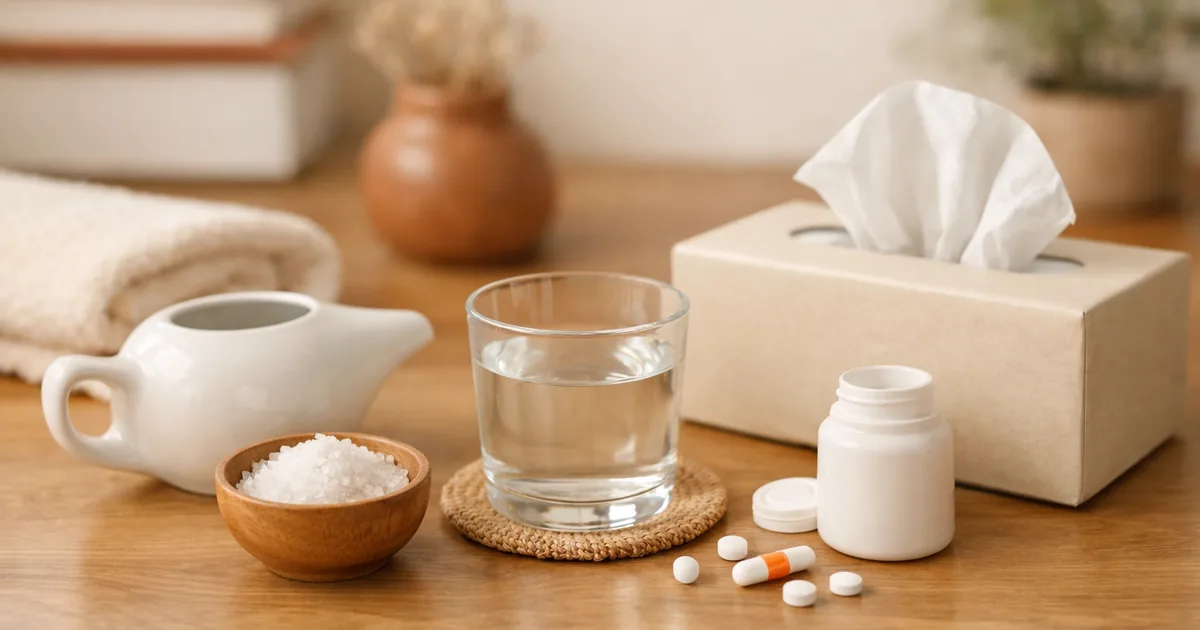
The cold has gone, but your cheeks and the area around your eyes ache and the yellow mucus won’t stop — that’s when people wonder about sinusitis. The NHS says sinusitis is usually caused by an infection and is common after a cold or flu. It usually clears up on its own within 4 weeks. Self-care is rest, plenty of fluids, painkillers and rinsing your nose with salt water. See a GP if you haven’t improved after 7 days of pharmacy treatment or 3 weeks of treating yourself. Antibiotics are prescribed only rarely, because sinusitis is usually caused by a virus, not bacteria. This sets out the NHS page “Sinusitis (sinus infection)”.
1. Common after a cold or flu; usually clears up on its own within 4 weeks.
2. Rest, fluids, painkillers, salt-water nose rinse (up to 3 times a day). No aspirin under 16.
3. No better after 7 days of pharmacy treatment or 3 weeks of self-care: GP. Antibiotics rarely — usually a virus.
Symptoms — NHS
| Who | Symptoms (NHS) | Worth noting (our gloss) |
|---|---|---|
| Adults (main) | Pain, swelling and tenderness around the cheeks, eyes or forehead | — |
| Adults (main) | Blocked or runny nose; reduced sense of smell | — |
| Adults (main) | Green or yellow mucus; high temperature | — |
| Adults (other) | Headache, toothache, bad breath, cough, pressure in the ears, snoring, sounding nasal | Overlaps with toothache, bad breath and snoring posts |
| Young children | Irritability, difficulty feeding, breathing through the mouth | — |
The page explains that swelling of the sinus lining stops mucus draining, which causes the blocked feeling. The NHS lists toothache as a sinusitis symptom too — tooth pain itself is covered in toothache. Snoring is in snoring and bad breath in bad breath.
Treating it yourself — NHS
- Rest and drink plenty of fluids
- Painkillers such as paracetamol or ibuprofen — no aspirin for children under 16
- Avoid your allergy triggers; don’t smoke
- With a high temperature or if you feel too unwell for normal activities, stay at home and avoid other people until you feel better
Salt-water nose rinse — the NHS recipe
| Step | What the NHS says | Worth noting (our gloss) |
|---|---|---|
| 1 | Boil about 570ml of water and let it cool | — |
| 2 | Mix in 1 teaspoon of salt and 1 teaspoon of bicarbonate of soda | — |
| 3 | Rinse each nostril, up to 3 times a day | — |
| 4 | Make a fresh solution each time | Don’t store it |
This page doesn’t cover warm packs or how long to use decongestant sprays. The NHS advice not to use sprays for more than a week is in common cold.
Pharmacy, GP and urgent help — NHS
| Where | When | Worth noting (our gloss) |
|---|---|---|
| Pharmacy | You think you have sinusitis, or your child is 12 or older and you think they have it | A pharmacist can give the same treatments as a GP (UK system) |
| GP | No better after 7 days of pharmacy or GP treatment, or 3 weeks of self-care | — |
| GP | You keep getting it; your child is 11 or younger | — |
| Urgent GP or 111 | Very unwell; painkillers don’t help or symptoms get worse; weakened immune system | — |
| 111 | Advice about a child under 5 | — |
What pharmacies can do in Korea may differ, so read “the same treatments as a GP” as describing the UK system (our view). The page doesn’t mention 999.
What a GP may do — NHS
- Steroid nasal sprays or drops to reduce swelling — you may need them for a few months
- Antihistamines if an allergy is the cause
- Antibiotics rarely — sinusitis is usually caused by a virus, not bacteria
- Referral to an ear, nose and throat (ENT) specialist if it lasts after 3 months of treatment, keeps coming back, or is only on one side of your face
- For some, an ENT specialist may suggest surgery (FESS) under general anaesthetic
Checklist
- ☐ Cheek, eye or forehead pain and yellow or green mucus after a cold
- ☐ Rest, fluids, painkillers; salt-water rinse up to 3 times a day
- ☐ Often clears up on its own within 4 weeks
- ☐ No better after 7 days of pharmacy treatment or 3 weeks of self-care: GP
- ☐ Symptoms on one side only that keep going: tell your GP
Questions that remain
Does yellow mucus mean I need antibiotics?
The NHS lists green or yellow mucus as a common symptom, but says antibiotics are prescribed only rarely because sinusitis is usually viral.
How is it different from a cold?
The NHS says sinusitis is common after a cold or flu. Advice on colds themselves is in common cold.
Sources
- NHS — Sinusitis (sinus infection) — source (page shows: reviewed 31 January 2024, next review 31 January 2027; checked 14 October 2026). Causes, adult and child symptoms, 4 weeks, 570ml, 1 teaspoon, 3 times a day, 12 or older, 7 days, 3 weeks, 11 or younger, under 5, 3 months, antibiotics, FESS.
- Not read. Korean agency guidance on sinusitis.
- What we added. The “worth noting” column.
Where else to check
- Your GP or an ENT clinic — if it lasts or keeps coming back.
Written on 14 October 2026. The content is from the NHS; the glosses are ours. It does not replace diagnosis or treatment.