Sore soles or arches and finding it hard to stand for long — how do you strengthen the feet and calves? NHS inform, the health information site run by NHS 24 in Scotland, has an exercises for foot conditions page with 7 exercises and videos (7 minutes 20 seconds in total, our sum): two calf stretches (gastrocnemius and soleus), doming of the foot to lift the arch, seated and standing heel raises, tibialis posterior strengthening with a resistance band, and toe curling by scrunching paper. Start with 2 to 3 repetitions and build to a maximum of 2 sets of 15, hold stretches for 20 to 30 seconds, and get advice if there is no improvement within 6 weeks. Here it is as written.
1. Seven exercises — 2 calf stretches, foot doming, 2 heel raises (seated, standing), band tibialis posterior, toe curling.
2. Start at 2 to 3 → 8 × 2 sets, 2 to 3 times a day → up to 2 sets of 15. Stretches: 20 to 30 seconds, 2 to 3 sets.
3. Pain within 0 to 5; stop if worse or new pain; get advice if no better within 6 weeks.
First — NHS inform
| Type | What NHS inform says | Worth noting (ours) |
|---|---|---|
| Who for | The exercises in these videos are suitable for most people | Not diagnosed yet? See someone first (ours) |
| Why | Getting movement and strength back supports tissue healing and gets you moving. You may not return to usual levels straight away and progress may be slow at first, but a gradual return to normal activities gives the best short and long term results | — |
| At first | Listen to your pain, especially early on. Symptoms may increase slightly at first but should get easier. Prescribed medicine from a GP or pharmacist may help you keep exercising | — |
| Safety | Somewhere safe, only if you feel well enough; stop at once if you feel unwell. First time? Read the guidance below first | — |
The page doesn’t name which foot conditions these are for. NHS inform’s separate foot problems page is in foot exercises (NHS inform).
Foot conditions exercises: 7 — NHS inform
| Exercise | What NHS inform says | Worth noting (ours) |
|---|---|---|
| ① Calf Muscle Stretch — gastrocnemius (1:06) | Standing, using a wall or worktop. One foot behind the other, back knee straight, heel on the ground, both feet pointing forwards. Lean towards the wall until you feel a stretch in the calf. As many as you can, then the other leg | Straight knee: the upper calf (ours) |
| ② Calf Muscle Stretch — soleus (0:58) | Standing, using a wall or worktop. One knee behind the other, both heels on the ground, feet forward. Bend both knees until you feel a stretch in the lower calf. Then the other leg | Unlike ①, the knees bend |
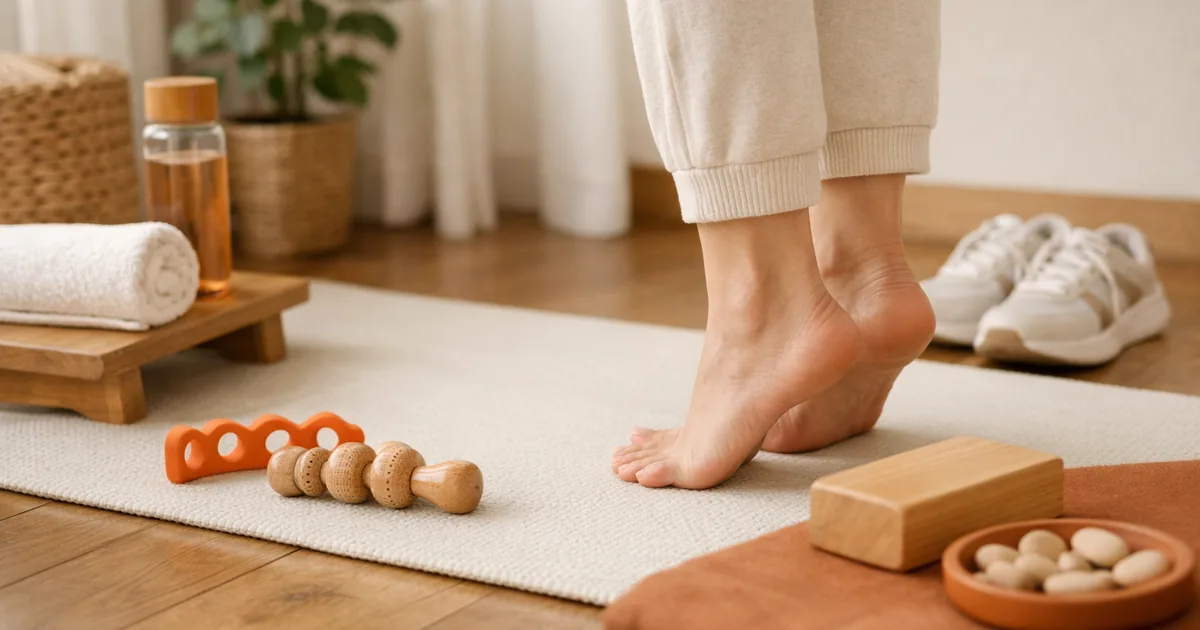
| ③ Doming of the foot (1:00) | Sitting or standing. Press your toes into the ground: the arch shortens and rises a little. Hold 2 to 3 seconds, return. As many as you can, then the other foot | Not the same as curling the toes (ours) |
| ④ Seated Heel Raise (0:58) | Sitting. Slowly raise your feet onto your toes, hold a second, slowly lower. As many as is comfortable. Harder: light weight such as books or dumbbells on your knees, only if safe | — |
| ⑤ Standing Double and Single Leg Heel Raise (1:08) | Standing, using a wall or worktop. Slowly rise onto tiptoes, hold a second, slowly lower. As high as possible, as many as is comfortable. Harder: one leg only, then the other | Reads as the step after ④ (our reading) |
| ⑥ Tibialis posterior strengthening with band (1:17) | Sitting. Secure a resistance band around a stable object such as a chair or table leg and bring your foot in against it. Hold a second, slowly return. Keep the foot close to the ground; don’t pull it up towards your shin. Then the other foot | Tibialis posterior: an inner calf muscle supporting the arch (ours) |
| ⑦ Toe Curling (0:53) | Sitting or standing. Scrunch paper with your toes, hold 2 to 3 seconds, release. Or pick up a sock, pen or small ball. Then the other foot | — |
Video lengths are as shown on the page; together 440 seconds, or 7 minutes 20 seconds (our sum). The written steps follow the video titles in order, so we paired them in order. The exercise notes say “as many as you can”, but the dose rules below say start with 2 to 3, so following those at first is the safer reading (ours).
How much pain is OK — NHS inform
| Type | What NHS inform says | Worth noting (ours) |
|---|---|---|
| Pain score | Rate pain out of 10 (0 = none, 10 = the worst you have had). 0 to 3 minimal, 4 to 5 acceptable, 6 to 10 excessive | — |
| During | Keep pain within 0 to 5. If it goes above, do fewer, go slower, or rest longer between movements | Changing one of the three may be enough (our reading) |
| After | Your existing foot pain should not be worse overall. New exercises can cause short-term muscle pain, but it should ease quickly and be no worse the next morning | The next morning is the test |
How many and how often — NHS inform
Add exercises gradually. For videos labelled stretches (① and ②), once a short hold is comfortable, hold longer to improve your range of movement, the page says.
| Type | What NHS inform says | Worth noting (ours) |
|---|---|---|
| Start | Begin new exercises with 2 to 3 repetitions at a time | — |
| Often | Small amounts through the day — for example every hour | — |
| Build | As it gets easier, add 1 or 2 repetitions every few days | “Few days” has no number |
| Sets | When you can do more, use sets — e.g. 8 repetitions, rest a minute, another 8, 2 to 3 times a day | 8 × 2 = 16, so 32 to 48 a day (our sum) |
| Aim | Increase over time to a maximum of 2 sets of 15 | 30 at a time (our sum) |
| Stretches | For exercises labelled stretches, once a short hold is comfortable, hold longer: 20 to 30 seconds, a gentle stretch (not sore). 2 to 3 sets, 2 to 3 times a day | 40 to 90 seconds a round (20 to 30 × 2 to 3 sets, our sum) |
In short: movement exercises such as ③–⑦ start at 2 to 3, a little every hour, then 8 × 2 sets, 2 to 3 times a day, up to a maximum of 2 sets of 15. The calf stretches are held 20 to 30 seconds, 2 to 3 sets, 2 to 3 times a day.
Days to reach 15 — our examples
| Example (ours) | To 15 | Worth noting (ours) |
|---|---|---|
| Start at 3, add 2 every 3 days | 6 steps (3 → 5 → … → 15) → 18 days | We took “a few days” as 3 |
| Start at 2, add 1 every 3 days | 13 steps → 39 days | Inside 6 weeks (42 days) |
| 6 weeks | 6 weeks = 42 days | Still no better: get advice |
To plan your own start and step, use the planner in how to progress exercise with pain.
When to stop and get advice — NHS inform
| Type | What NHS inform says | Worth noting (ours) |
|---|---|---|
| Stop | Stop if exercises make symptoms worse or cause new pain; stop at once if you feel unwell | — |
| Talk to someone | If your foot pain worsens while following the advice, talk to a healthcare professional | In Korea, orthopaedics or rehabilitation medicine (ours) |
| 6 weeks | If it hasn’t improved within 6 weeks, talk to a healthcare professional | 6 weeks = 42 days (our sum) |
Heel pain on first steps is in plantar fasciitis (NHS); ankle and calf exercises are in calf and ankle exercises.
Checklist
- ☐ ①, ② and ⑤ standing, holding a wall or worktop
- ☐ Stretches (①②) 20 to 30 seconds, a gentle pull
- ☐ Movement exercises: start at 2 to 3 → 8 × 2 sets, 2 to 3 times a day → up to 2 sets of 15
- ☐ Band round a stable furniture leg; foot close to the ground
- ☐ Pain within 0 to 5 of 10, no worse the next morning
- ☐ Stop if worse or new pain; get advice if no better within 6 weeks
Questions that remain
What band should I use?
The page just says “resistance band” with no strength or colour. One you can hold for a second within 0 to 5 pain fits the page’s rules (ours).
Is this for flat feet or plantar fasciitis?
The page says “after any foot problem” and “suitable for most people” without naming conditions. If you have a diagnosis, follow your clinician first (ours).
Shoes on or off?
The page doesn’t say.
Sources
- NHS inform (NHS 24, Scotland) — Exercises for foot conditions — source (no review date shown; page metadata modified 28 July 2026; checked 5 November 2026). Why, at first, who for, safety; the 7 exercises (video titles, lengths, movement, harder versions); the 0 to 10 scale and 0 to 5; pain after; 2 to 3, every hour, 1 or 2 every few days, 8 × 2 sets 2 to 3 times a day, up to 2 sets of 15; stretches 20 to 30 seconds, 2 to 3 sets, 2 to 3 times a day; when to stop; 6 weeks.
- Not read. The content of the 7 videos (written steps only); the managing a foot problem page (linked only); NHS inform’s individual foot condition pages.
- What we added. Exercise numbers, the video total, muscle glosses (tibialis posterior etc.), the “worth noting” column, our sums and readings, the Korean care gloss.
Where to check further
- Orthopaedics or rehabilitation medicine — if no better after 6 weeks, or worse.
- A pharmacy — painkillers to help you keep exercising.
Written on 5 November 2026. The content is from NHS inform; the glosses are ours.