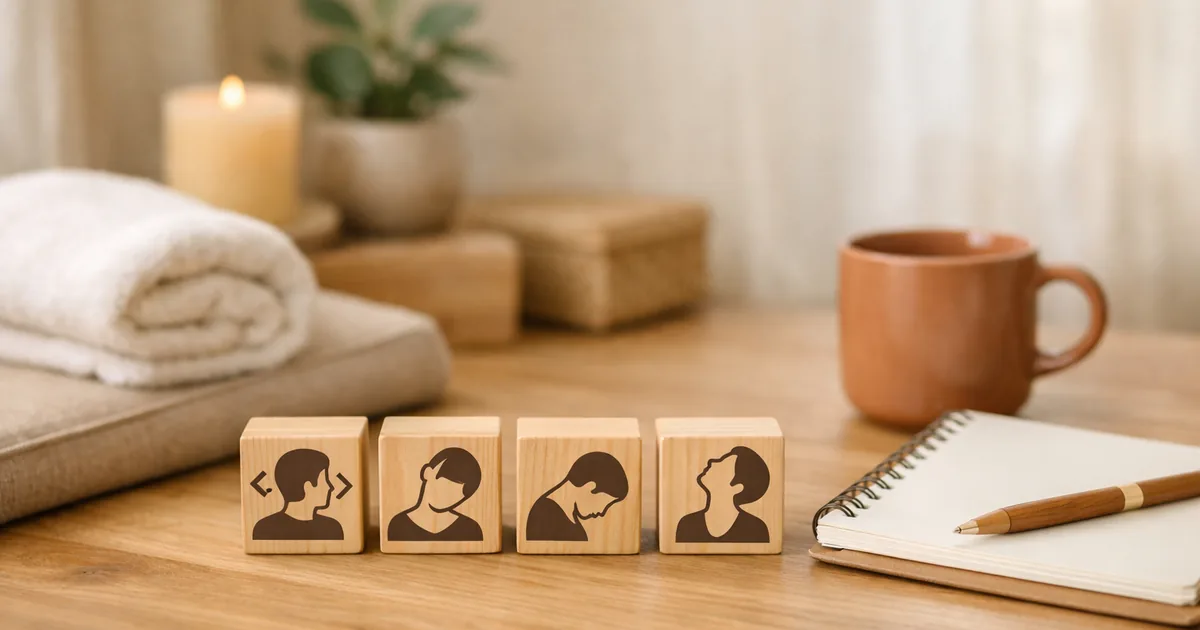
Diagnosed with cervical spondylosis — a stiff, painful neck from wear in the neck bones and discs with age — and wondering what exercise to do? NHS inform, the health information site run by NHS 24 in Scotland, sets out 6 exercises for people diagnosed with cervical spondylosis, with videos (2 minutes 32 seconds in total, our sum). Four sitting or standing movements — head turn, head tilt, forward head tilt and a wide shoulder stretch — are joined by two neck exercises done lying on a bed. Start with 2 to 3 repetitions and build to a maximum of 2 sets of 15, hold stretches for 20 to 30 seconds, and get advice if there is no improvement within 6 weeks. Here it is as written.
1. Six exercises — head turn, head tilt, forward head tilt, wide shoulder stretch, plus neck stretch and strengthening in lying.
2. Start at 2 to 3 → 8 × 2 sets, 2 to 3 times a day → up to 2 sets of 15. Stretches: 20 to 30 seconds, 2 to 3 sets.
3. Pain within 0 to 5; stop if worse or new pain; get advice if no better within 6 weeks.
First — NHS inform
| Type | What NHS inform says | Worth noting (ours) |
|---|---|---|
| Who for | The exercises in these videos are suitable for people diagnosed with cervical spondylosis | Not diagnosed yet? See someone first (ours) |
| Why | Getting movement and strength back supports tissue healing and gets you moving. You may not return to usual levels straight away and progress may be slow at first, but a gradual return to normal activities gives the best short and long term results | — |
| At first | Listen to your pain, especially early on. Symptoms may increase slightly at first but should get easier. Prescribed medicine from a GP or pharmacist may help you keep exercising | — |
| Safety | Somewhere safe, only if you feel well enough; stop at once if you feel unwell. First time? Read the guidance below first | — |
“Wear in the neck bones and discs” is our gloss. This page doesn’t explain the condition; it only gives the exercises.
Cervical spondylosis exercises: 6 — NHS inform
| Exercise | What NHS inform says | Worth noting (ours) |
|---|---|---|
| ① Head turn (0:27) | Sitting or lying on your back. Facing forward, slowly turn your head to one side as far as is comfortable — you should feel a stretch on the opposite side. Hold for 2 seconds, return, repeat on the other side. Both sides is one repetition | Not to the end of range — the page says “as far as is comfortable” |
| ② Head tilt (0:23) | Sitting or lying on your back. Facing forward, slowly tilt your head towards one shoulder as far as is comfortable. Hold for 2 seconds, return, repeat on the other side. Both sides is one repetition | Head only; don’t lift the shoulder (ours) |
| ③ Forward head tilt (0:18) | Sitting or standing. Facing forward, bring your chin down towards your chest, then slowly back up. Down and up is one repetition | — |
| ④ Wide shoulder stretch (0:18) | Sitting or standing. Arms at a right angle in front, palms up. Keeping the upper arms still, move the palms and forearms out to either side. Hold a few seconds, then back. Out and in is one repetition | Elbows stay by your sides (ours) |
| ⑤ Neck Stretch in Lying (0:33) | Lying with your head supported — a bed is good. Knees bent, feet on the bed, head on a cushion. Without tilting, gently push your head into the pillow — you should feel a stretch at the back of the neck. Hold a few seconds, relax. Back and return is one repetition | — |
| ⑥ Neck Strengthening in Lying (0:33) | Lying — a bed is good. Without tilting, gently move your head back until you feel a stretch at the back of the neck. Hold a few seconds, relax. To the stretch and back is one repetition | ⑤ and ⑥ read alike — check the videos (ours) |
Video lengths are as shown on the page; together 152 seconds, or 2 minutes 32 seconds (our sum). The written steps follow the video titles in order, so we paired them in order. Numbers are ours.
How it differs from the general neck page — our summary
| Item | Cervical spondylosis page (read now) | General neck page (we read on 27 October) |
|---|---|---|
| Exercises | ①–④ plus ⑤ and ⑥ in lying, 6 | ①–④, 4 |
| Target | 8 × 2 sets 2 to 3 times a day → up to 2 sets of 15 | Around 10; no set rule |
| Stretches | 20 to 30 seconds, 2 to 3 sets, 2 to 3 times a day | No such rule |
| Pain, 6 weeks | 0 to 5, 6 weeks | Same |
The general neck page is in neck exercises (NHS inform). The cervical spondylosis page adds the two lying exercises and spells out sets and stretch holds.
How much pain is OK — NHS inform
| Type | What NHS inform says | Worth noting (ours) |
|---|---|---|
| Pain score | Rate pain out of 10 (0 = none, 10 = the worst you have had). 0 to 3 minimal, 4 to 5 acceptable, 6 to 10 excessive | — |
| During | Keep pain within 0 to 5. If it goes above, do fewer, go slower, or rest longer between movements | Changing one of the three may be enough (our reading) |
| After | Your existing neck pain should not be worse overall. New exercises can cause short-term muscle pain, but it should ease quickly and be no worse the next morning | The next morning is the test |
How many and how often — NHS inform
Add exercises gradually. You can do all six together, or start with one or two and add more. For videos labelled as stretches, once a short hold is comfortable, hold longer to improve your range of movement.
| Type | What NHS inform says | Worth noting (ours) |
|---|---|---|
| Start | Begin new exercises with 2 to 3 repetitions at a time | — |
| Often | Small amounts through the day — for example every hour | — |
| Build | As it gets easier, add 1 or 2 repetitions every few days | “Few days” has no number |
| Sets | When you can do more, use sets — e.g. 8 repetitions, rest a minute, another 8, 2 to 3 times a day | 8 × 2 = 16, so 32 to 48 a day (our sum) |
| Aim | Increase over time to a maximum of 2 sets of 15 | 30 at a time (our sum) |
| Stretches | For exercises labelled stretches, once a short hold is comfortable, hold longer: 20 to 30 seconds, a gentle stretch (not sore). 2 to 3 sets, 2 to 3 times a day | 40 to 90 seconds a round (20 to 30 × 2 to 3 sets, our sum) |
In short: movement and strengthening exercises start at 2 to 3, a little every hour, then 8 × 2 sets, 2 to 3 times a day, up to a maximum of 2 sets of 15. Stretches are held 20 to 30 seconds, 2 to 3 sets, 2 to 3 times a day.
Days to reach 15 — our examples
| Example (ours) | To 15 | Worth noting (ours) |
|---|---|---|
| Start at 3, add 2 every 3 days | 6 steps (3 → 5 → … → 15) → 18 days | We took “a few days” as 3 |
| Start at 2, add 1 every 3 days | 13 steps → 39 days | Inside 6 weeks (42 days) |
| 6 weeks | 6 weeks = 42 days | Still no better: get advice |
To plan your own start and step, use the planner in how to progress exercise with pain.
When to stop and get advice — NHS inform
| Type | What NHS inform says | Worth noting (ours) |
|---|---|---|
| Stop | Stop if exercises make symptoms worse or cause new pain; stop at once if you feel unwell | — |
| Talk to someone | If your neck pain worsens while following the advice, talk to a healthcare professional | In Korea, orthopaedics or rehabilitation medicine (ours) |
| 6 weeks | If it hasn’t improved within 6 weeks, talk to a healthcare professional | 6 weeks = 42 days (our sum) |
Common causes of neck pain and self-care are in neck pain (NHS).
Checklist
- ☐ Diagnosed with cervical spondylosis? If not, general neck exercises or a check first
- ☐ ①② sitting or lying, ③④ sitting or standing, ⑤⑥ lying on a bed
- ☐ Start at 2 to 3 → 8 × 2 sets, 2 to 3 times a day → up to 2 sets of 15
- ☐ Stretches 20 to 30 seconds, a gentle pull, not sore
- ☐ Pain within 0 to 5 of 10, no worse the next morning
- ☐ Stop if worse or new pain; get advice if no better within 6 weeks
Questions that remain
Which ones are the stretches?
The page says some videos are labelled stretching exercises but doesn’t say which in the text. ④ and ⑤, with “stretch” in the name, read that way — our reading.
What if my arm tingles or feels weak?
This page doesn’t list such signs. It only says stop if exercise causes new pain, so with arm tingling or weakness, get checked before exercising (ours).
How high a pillow?
⑤ says “head supported by a cushion” and sets no height.
Sources
- NHS inform (NHS 24, Scotland) — Exercises for cervical spondylosis — source (no review date shown; page metadata modified 24 July 2026; checked 5 November 2026). Why, at first, who for, safety; the 6 exercises (video titles, lengths, movement, one repetition); the 0 to 10 scale and 0 to 5; pain after; 2 to 3, every hour, 1 or 2 every few days, 8 × 2 sets 2 to 3 times a day, up to 2 sets of 15; stretches 20 to 30 seconds, 2 to 3 sets, 2 to 3 times a day; when to stop; 6 weeks.
- Not read. The content of the 6 videos (written steps only); the self-managing a neck problem page (linked only); a cervical spondylosis condition page.
- What we added. Exercise numbers, the video total, the comparison with the general neck page (as in our 27 October post), the “worth noting” column, our sums and readings, the Korean care gloss.
Where to check further
- Orthopaedics or rehabilitation medicine — if no better after 6 weeks, or worse.
- A pharmacy — painkillers to help you keep exercising.
Written on 5 November 2026. The content is from NHS inform; the glosses are ours.