A stiff neck that is hard to turn — is there anything to do at home? NHS inform, the health information site run by NHS 24 in Scotland, sets out 4 movement exercises for neck muscle and joint problems, with videos, plus how much pain is acceptable, how many to do and when to stop. The core: 2 to 3 repetitions at a time, every hour; pain within 0 to 5 out of 10; and talk to someone if there is no improvement within 6 weeks. Here is the page as written.
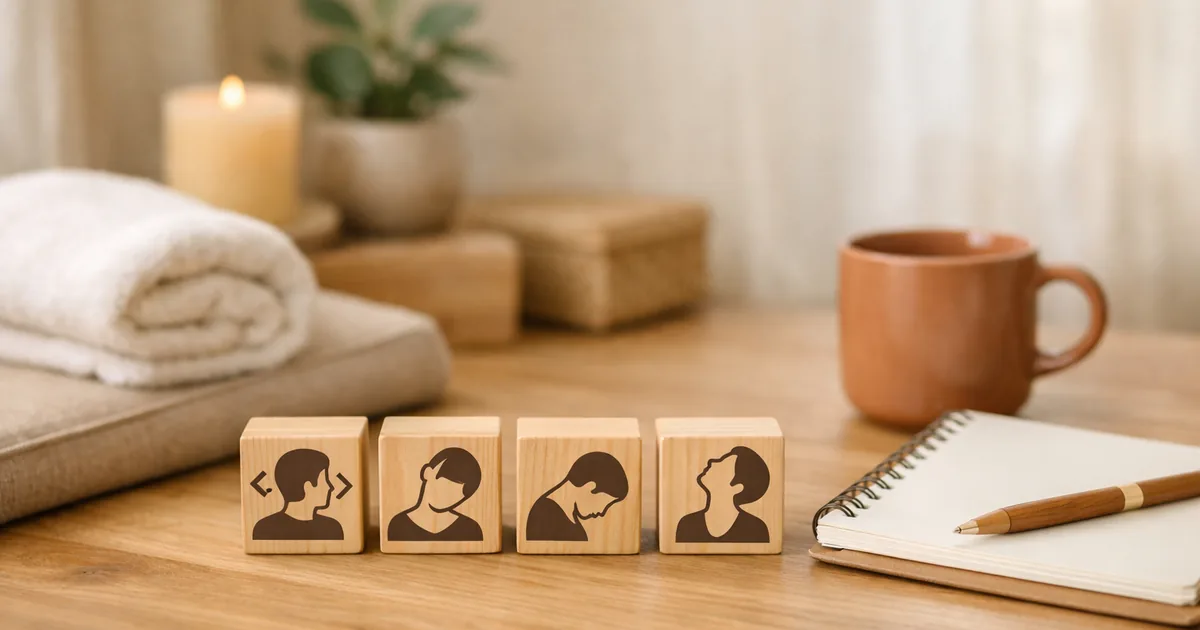
1. Turn, tilt, chin down and up, arms out — the 4 exercises, sitting, lying or standing.
2. 2 to 3 repetitions at a time, every hour, adding 1 or 2 every few days, to around 10.
3. Stop if symptoms worsen or there is new pain; get advice if not better within 6 weeks.
First — NHS inform
| Topic | What NHS inform says | Worth noting (ours) |
|---|---|---|
| Who for | Useful for anyone with a new neck problem. If you have been diagnosed with a condition or had recent surgery, follow your healthcare professional’s advice | After surgery, their advice comes first |
| Why | Getting movement and strength back supports tissue healing and gets you moving. You may not return to usual levels at once and progress may be slow, but a gradual return to normal activities gives the best short and long-term results | — |
| At first | Listen to your pain, especially early on. Symptoms may rise slightly at first but should ease with regular practice. If there is discomfort, prescribed medication from your GP or pharmacist may help you keep going | In Korea, ask a doctor or pharmacist (our gloss) |
| Safety | Somewhere safe, only if you feel well enough. If you start to feel unwell, stop immediately | — |
The 4 neck exercises — NHS inform
| Exercise | What NHS inform says | Worth noting (ours) |
|---|---|---|
| 1. Head turn | Sitting or lying on your back. Facing forward, slowly turn your head to one side as far as is comfortable — you should feel a stretch on the opposite side. Hold for 2 seconds, return, repeat on the other side. Both sides is one repetition | Don’t force it — the page says “as far as is comfortable” |
| 2. Side tilt | Sitting or lying on your back. Facing forward, slowly tilt your head towards one shoulder as far as is comfortable — a stretch on the opposite side. Hold for 2 seconds, return, other side. Both sides is one repetition | Head moves, shoulder stays down (our gloss) |
| 3. Chin down and up | Sitting or standing. Facing forward, bring your chin down towards your chest, then slowly back up. Down and up is one repetition | — |
| 4. Arms out | Sitting or standing. Arms at a right angle in front, palms up. Keeping upper arms still, move palms and forearms out to either side. Hold a few seconds, then back. Out and in is one repetition | Elbows stay at your sides (our gloss) |
We named the exercises. The page has a video for each, but on the day we checked the video titles did not display, so we named them from the written movements.
How much pain is OK — NHS inform
| Topic | What NHS inform says | Worth noting (ours) |
|---|---|---|
| Pain score | Rate pain out of 10 (0 = no pain, 10 = the worst you have ever had). 0 to 3 minimal, 4 to 5 acceptable, 6 to 10 excessive | — |
| During | Keep pain within 0 to 5. Above that: fewer repetitions, a slower movement, or more rest between movements | Changing just one may be enough (our reading) |
| After | Exercise should not make your existing neck pain worse overall. New exercises can cause short-term muscle pain, but it should ease quickly and be no worse the morning after | The next morning is the test |
| Topic | What NHS inform says | Worth noting (ours) |
|---|---|---|
| Start | 2 to 3 repetitions at a time | — |
| Often | Small amounts through the day — for example every hour | — |
| Build | As it gets easier, add 1 or 2 repetitions every few days | “A few” has no number on the page |
| Aim | Over time, to around 10 | This page has movement exercises only; no set rule |
In short: start with 2 to 3 repetitions at a time, a little every hour, then add 1 or 2 every few days as it gets easier, up to around 10. You can do all the exercises together or start with one or two and add more as you get comfortable.
To count how many days it takes to reach your target, use the planner in building up exercise when it hurts.
Three sums — our example
| Case (our example) | To around 10 | Worth noting (ours) |
|---|---|---|
| Start at 2, add 1 every 3 days | 8 increases → 24 days | “A few days” taken as 3 (our example) |
| Start at 3, add 2 every 3 days | 4 increases → 12 days | 3 → 5 → 7 → 9 → 10 |
| The 6-week mark | 6 weeks = 42 days | Get advice if not better by then |
When to stop and when to get advice — NHS inform
| Topic | What NHS inform says | Worth noting (ours) |
|---|---|---|
| Stop | If the exercises make symptoms worse or cause new pain | — |
| Advice | If your neck pain gets worse while following the advice, talk to a healthcare professional | In Korea, orthopaedics or rehabilitation medicine (our gloss) |
| 6 weeks | If it has not improved within 6 weeks, talk to a healthcare professional | 6 weeks = 42 days (our sum) |
Causes of neck pain and what to do at home are in neck pain.
Checklist
- ☐ A new neck problem? Diagnosed or after surgery — your clinician’s advice first
- ☐ Somewhere safe, only if you feel well enough
- ☐ 2 to 3 at a time, every hour, add 1 or 2 every few days to around 10
- ☐ Pain 0 to 5 out of 10, no worse the next morning
- ☐ Stop if worse or new pain; advice if not better within 6 weeks
Questions that remain
Should I hold each one like a stretch?
The page gives “hold for 2 seconds” for the turn and tilt and “a few seconds” for arms out. It has no 20 to 30 second stretch rule.
What if my arm tingles or feels weak?
The page doesn’t list such signs. It only says to stop if exercise causes new pain, so with tingling or weakness in the arm, get seen before exercising (our gloss).
Sources
- NHS inform (NHS 24, Scotland) — Exercises for neck problems — source (no update date shown on the page; checked 27 October 2026). Who it is for, why, at first, safety; the 4 movement exercises (movement, hold, what counts as one repetition); the 0 to 10 pain scale and 0 to 5; pain after; 2 to 3, every hour, 1 or 2 every few days, around 10; when to stop; 6 weeks.
- Not read. The 4 videos (titles and lengths did not display); the self-management page (linked only).
- What we added. The exercise names (the page’s video titles did not display, so we named each movement), the “worth noting” column, “our sum”, and the Korean care gloss.
Where to check further
- Orthopaedics or rehabilitation medicine — no better after 6 weeks, or worse.
- A pharmacy — pain relief to help you keep exercising.
Written on 27 October 2026. The content is from NHS inform; the glosses are ours.