If your calf or ankle is stiff and sore after a twist or a lot of walking, NHS inform says exercises that bring back movement and strength help recovery. The health information site run by NHS 24 in Scotland sets out 5 exercises with videos for calf and ankle muscle or joint problems: the ankle bend and ankle tilt, a seated heel raise, standing double heel raises holding a wall or chair, and a standing calf stretch. Keep pain within 0 to 5 out of 10, aim for at most 2 sets of 15, hold stretches 20 to 30 seconds if possible, and get advice if not better within 6 weeks. Here is the page as written.
1. Ankle bend, ankle tilt, seated heel raise, standing heel raises, calf stretch — 5 exercises.
2. Start with 2 to 3; 2 sets of 8, 2 to 3 times a day; at most 2 sets of 15. Stretch 20 to 30 seconds.
3. Pain within 0 to 5; stop if worse or new pain; advice if not better within 6 weeks.
First — NHS inform
| Type | What NHS inform says | Worth noting (ours) |
|---|---|---|
| Who for | Useful for people with a new calf or ankle problem. If you’ve been diagnosed with a calf or ankle condition or had recent calf or ankle surgery, follow your healthcare professional’s advice | After surgery, your clinician comes before this article |
| Why | Getting movement and strength back matters — it supports tissue healing and gets you moving again. You may not return to usual levels at once and progress may start slowly, but a gradual return to normal activities gives the best short and long term results | — |
| At first | Listen to your pain, especially early on. Symptoms may increase slightly at first but should ease with time; regular practice can improve movement. If there is discomfort, medication prescribed by a GP or pharmacist may help you keep exercising | In Korea, ask a doctor or pharmacist (our gloss) |
| Safety | In a safe place, only if you feel well enough. If you start to feel unwell, stop at once | — |
The 5 calf and ankle exercises — NHS inform
| Exercise (video title) | What NHS inform says | Worth noting (ours) |
|---|---|---|
| 1. Ankle bend (video 0:21) | Sitting or lying. Heel of one foot on the floor, toes to the ceiling; the other foot firmly planted. Slowly point your toes forwards, hold a few seconds, return. Bending the ankle down and back is one repetition | — |
| 2. Ankle tilt (0:19) | Sitting or standing. Same start (heel down, toes up, other foot planted). Tilt so your toes point left, hold a few seconds, then tilt right. Side to side is one repetition | — |
| 3. Seated heel raise (0:20) | Sitting. Feet flat, gradually lift your heel as far as is comfortable, slowly lower. Up and down is one repetition | — |
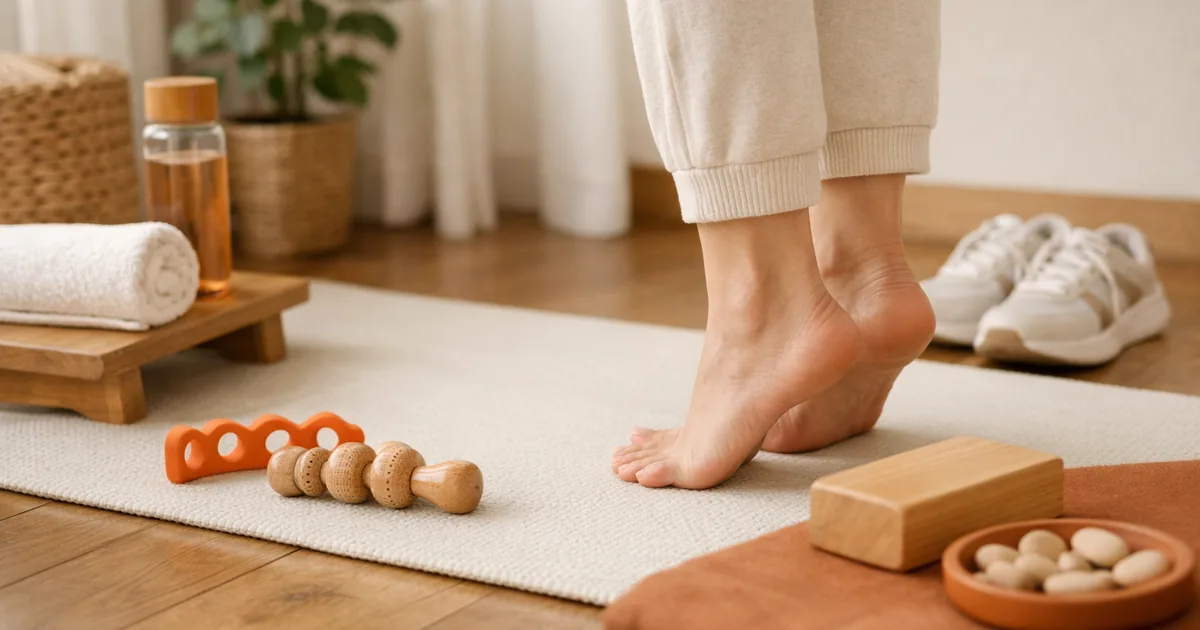
| 4. Standing double heel raises (0:16) | Standing, in front of a wall or chair for support. Slowly lift your heels as far as possible onto your toes, hold a few seconds, slowly lower. Up and down is one repetition | Once 3 is comfortable (the “ankle pain” page below) |
| 5. Standing calf stretch (0:28) | Standing, leaning on a chair in front. Bring one leg out behind until you feel a stretch, front leg slightly bent. Hold a few seconds, return. Gradually build the hold to 20 or 30 seconds. Out and in is one repetition | Labelled a stretching exercise |
The names are the page’s video titles and the times are video lengths. All five videos come to 104 seconds, under 2 minutes (our sum). The same site’s “Exercises to help with ankle pain” page adds a single leg squat, side on to the same five — stand next to a kitchen worksurface or chair, stand on the affected leg, lift the other, gently bend the affected knee a small distance and return — and says to try standing heel raises only once you can do a seated heel raise comfortably.
How much pain is OK, how many — NHS inform
| Type | What NHS inform says | Worth noting (ours) |
|---|---|---|
| Pain score | Rate pain out of 10 (0 = none, 10 = the worst you’ve had). 0 to 3 minimal, 4 to 5 acceptable, 6 to 10 excessive | — |
| During | Keep pain within 0 to 5. If it goes above — fewer repetitions, slower movement, more rest between movements | Changing one of the three may be enough (our reading) |
| After | Exercise shouldn’t make your calf or ankle pain worse overall. New exercises can cause short-term muscle pain while the body adapts, but it should ease quickly and be no worse the morning after | The next morning is the test |
| Type | What NHS inform says | Worth noting (ours) |
|---|---|---|
| Start | New exercises: 2 to 3 repetitions at a time | — |
| Often | Small amounts through the day — for example every hour | — |
| Build | As it gets easier and if you feel able, add 1 or 2 repetitions every few days | “A few days” has no number in the source |
| Sets | When you can do more, break into sets — more at a time, less often. This builds strength. For example: 8 repetitions → rest a minute → another set of 8, 2 to 3 times a day | 2 sets of 8 = 16 at a time; 2 to 3 times a day = 32 to 48 (our sum) |
| Aim | Increase over time to a maximum of 2 sets of 15 — repeating strengthens muscles and tendons | 30 at a time is the ceiling (our sum) |
In numbers, the page’s example is 2 sets of 8 = 16 at a time, or 32 to 48 a day at 2 to 3 sessions. The target of 2 sets of 15 is 30 at a time (our sums). You can do all the exercises together, or start with one or two and add more as you get comfortable.
Stretches are different — NHS inform
| Type | What NHS inform says | Worth noting (ours) |
|---|---|---|
| Stretches | For exercises labelled stretching, once a short hold is comfortable, hold longer as a stretch. Over time this can improve range of movement | — |
| Feel | A gentle stretch — it shouldn’t be sore or uncomfortable | — |
| Time | Hold 20 to 30 seconds if possible | — |
| Sets | For example 2 to 3 sets of stretches, 2 to 3 times a day | 20 to 30 seconds × 2 to 3 sets = 40 to 90 seconds a session (our sum) |
For the calf stretch, the page’s example works out at 20 to 30 seconds, 2 to 3 sets — 40 to 90 seconds a session, 2 to 3 times a day (our sum).
To count how many days it takes to reach your target from a starting number and step, use the planner in how to build up exercise when it hurts.
Three sums — our example
| Example (ours) | Result | Worth noting (ours) |
|---|---|---|
| Start at 2, add 1 every 3 days | 13 steps to 15 → 39 days | Our example, taking “a few days” as 3 |
| Calf stretch from 5 seconds, add 5 every 3 days | 5 steps to 30 seconds → 15 days | The page gives no step for holds |
| The 6-week mark | 6 weeks = 42 days | Get advice if not better within 6 weeks |
When to stop and when to get advice — NHS inform
| Type | What NHS inform says | Worth noting (ours) |
|---|---|---|
| Stop | Stop if exercises make symptoms worse or cause new pain | — |
| Advice | If your calf or ankle pain worsens while following this advice, talk to a healthcare professional | In Korea, orthopaedics or rehabilitation medicine (our gloss) |
| 6 weeks | If it hasn’t improved within 6 weeks, talk to a healthcare professional | 6 weeks = 42 days (our sum) |
If you’ve only just hurt it, such as a fresh ankle sprain, read the first days after a soft tissue injury first.
Checklist
- ☐ A new calf or ankle problem? After a diagnosis or surgery, your clinician first
- ☐ Hold a wall or chair for 4 (standing heel raises) and 5 (stretch)
- ☐ Start at 2 to 3; sets of 8 → a minute’s rest → 8, 2 to 3 times a day; at most 2 sets of 15
- ☐ Stretch to a gentle pull, 20 to 30 seconds
- ☐ Pain 0 to 5; stop if worse; advice if not better within 6 weeks
Questions that remain
I’ve just twisted my ankle — can I start straight away?
The page only says the information may be useful for a new problem; it gives no day to start after an injury. After a diagnosis or surgery, follow your clinician.
How long is “a few seconds”?
The page says “hold for a few seconds” for the bend, tilt and heel raises and gives no number. The only number is the 20 to 30 seconds for stretches.
Sources
- NHS inform (NHS 24, Scotland) — Exercises for calf and ankle problems — source (no update date shown on the page; checked 28 October 2026). Who it is for, why, at first, safety; 5 exercises (ankle bend, ankle tilt, seated heel raise, standing double heel raises, standing calf stretch) with video lengths; the 0 to 10 scale and 0 to 5; pain after; 2 to 3, every hour, 1 or 2 every few days; the set example (8, a minute, 8, 2 to 3 times a day); at most 2 sets of 15; stretches 20 to 30 seconds, 2 to 3 sets, 2 to 3 times a day; when to stop; 6 weeks.
- NHS inform — Exercises to help with ankle pain — source (no update date shown; checked 28 October 2026). The same five plus a single leg squat (side on); standing heel raises only once seated heel raises are comfortable.
- Not read. The 5 videos (titles and lengths only); the self-management page (linked only); the site’s foot condition and Achilles exercise pages.
- What we added. The “worth noting” column, “our sum” and “our example”, and the Korean care gloss.
Where to check further
- Orthopaedics or rehabilitation medicine — no better after 6 weeks, or worse.
- A physiotherapist — form and how many.
Written on 28 October 2026. The content is from NHS inform; the glosses are ours.